
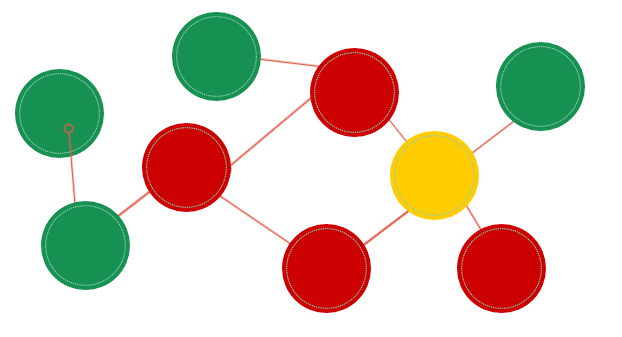
The Internet has had, and continues to have, a major impact on business worldwide. We can identify two levels:
- The first, obvious effect was the emergence of companies based on the Internet (IBCs, Internet-Based Companies, e.g. Amazon, TripAdvisor, Facebook, Google, etc.), businesses whose very reason for existing lies in the Internet.
- The second, less obvious but equally important effect is the interconnection between companies and the abstraction of activities.
Let’s examine this last point, as it underlies a new way of thinking about the company of the future. We will start with the classic concept of the Value Chain (Value Chain), before looking at its evolution towards the Value Network (Value Network).
Porter’s Value Chain model
The value chain model was first formalised in 1985 by Michael Porter in the book “Competitive Advantage: Creating and Sustaining Superior Performance”.
The model (shown in the image below) has been very successful in strategic marketing and among business consultancies, and is still widely used.
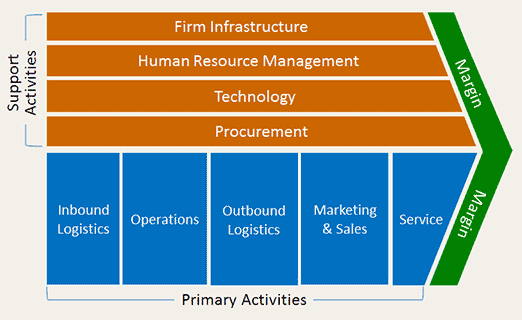
A company is seen as a process that generates value, starting with a series of inputs and arriving at the final product or service offered to the customer. A company is a system made up of n components/subsystems working to generate value. During the process, these subsystems consume time, money, materials and labour.
The final output must deliver value to the customer and value to the company.
In Porter’s view, this model helps build competitive advantage: breaking activities down makes it possible to understand the company’s strengths and the areas needing improvement. If a company can perform strategically important activities better than its competitors, economically and efficiently, it will be able to create a competitive advantage.
Activities are divided into:
- support activities
- primary activities
 Book on Amazon

Primary activities
Inbound logistics: managing the procurement of production inputs, delivery, storage, inventory control, etc.
Operations: the entire production process, from transforming raw materials to the final product. For a software company, for example, this is the activity of developing code.
Outbound logistics: managing the finished-goods warehouse and fulfilling orders, including delivery to the customer.
Marketing & sales: all the classic marketing activities, which we can illustrate through the marketing mix levers, including promotion and sales.
Services: after-sales assistance, customer care, technical support, etc.
Naturally, the meaning and strategic value of these activities vary depending on the type of business. In fast-moving consumer goods (a pasta manufacturer, for example), logistics and production activities will carry greater weight.
Support activities
These functions work across the entire company, which is why the model places them at the top, horizontally across the process.
Firm infrastructure: the activities of administration, finance, the legal department and general management.
Human Resource Management: the classic personnel-management activities, from recruitment to training and the development of technical and managerial skills.
Technology: from information systems to all the technical and technological tools used in the various primary activities. Automated warehouse management is one example.
Procurement: typically the responsibility of a company’s purchasing department, which sources the production inputs needed at every stage.
As you can see, the model is strongly oriented towards manufacturing companies, but with the appropriate adjustments we can apply it to any company.
We have seen that the aim of the value chain is to identify and generate competitive advantages by identifying and improving strategic areas. To do this, each activity must be broken down into subactivities, and all internal links (with other subactivities) and external links (with suppliers, distributors, etc.) identified. The analysis must then identify the internal cost structure and compare it with the market and competitors. Are we better at selling? Do we have lower processing costs? Is our logistics more efficient? Is the market leader strong at promotion?
For Porter, the Value Chain belongs within a wider system, which he calls the Value System, encompassing all suppliers, indirect channels and partners in general. Extending knowledge and analysis to the Value System is important for identifying areas of advantage. This concept connects with the Value Network model we will explore in the next section.
The Value Network or Value Constellation model
Porter’s model was heavily focused on costs and efficiency, but the market context and landscape have changed in recent years because of the following developments:
- Competition: competition has increased and expanded globally.
- Demand: customers are increasingly informed and curious, and therefore potentially disloyal. Push strategies are also becoming less effective.
- Dynamism: business timeframes have shortened. In the past, a company that gained leadership or a good market share could expect to maintain it for decades. Today, a business (especially in the digital world) can emerge, achieve success and then die (or shrink considerably) within a few years (see Myspace, Altavista, Lycos, Nokia, Blackberry, etc.).
- Technology platform: the arrival of the Internet and the digital, interconnected economy opens up many new opportunities through abstraction, dematerialisation and turning a business’s fixed costs into variable costs.
Let’s look straight away at the model best suited today to creating value for customers and companies. The Value Network model is also called the Value Constellation model.
Value is created within a network of actors who together create (and co-create) that value.
How does it work, and how can it be used in practice?
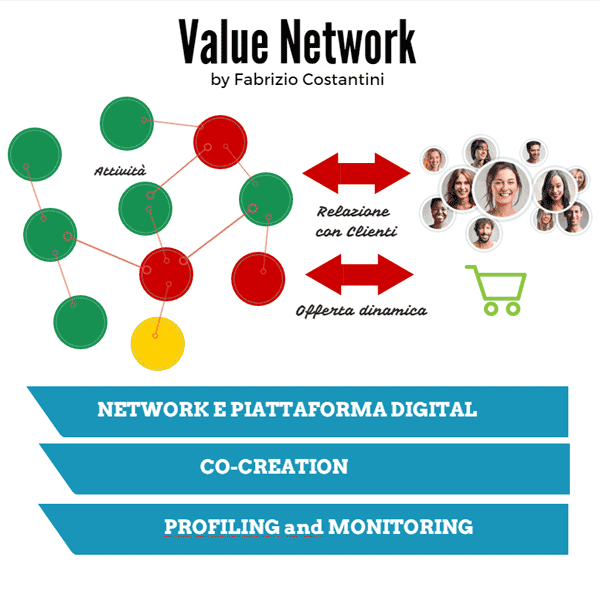
In the model above (my own version of the VN), we can identify the following key components:
- Activities and skills within the company and the market
- Logical network
- Physical network and digital platform
- Co-creation
- Customer relationship
- Profiling & monitoring
- Dynamic offering
In the diagram, the logical network, activities, customer relationship and dynamic offering rest on the layers of the physical and digital network, co-creation and profiling.
Key activities and skills
This is the most important element: the business must be broken down into basic units, considering both internal activities and external, third-party activities.
Then, with the strategic business objective in mind, we need to identify the core competencies: those skills that can help create a competitive advantage. In the automotive market, for example, design is certainly a core competence, as is knowing how to build fuel-efficient engines (a competence that allowed Marchionne’s Fiat to enter the American market).
When assessing skills, it is important to look beyond our own company to the entire external market (including markets different from our own).
The questions to ask are: Who is the customer and how do they see value? What activities are needed to create that value? What resources are needed to carry out those activities? Who can use those resources, and how? How do the actors in the network interact and influence one another?
On the left of the diagram above, basic activities are shown as green spheres, core activities in red, and core activities outside the company in yellow.
Mapping skills is the basis for defining a value-creation strategy. Indeed, a sound analysis can provide insights for completely redefining the company’s business model.
The final objective is to identify the strategic skills clearly and bring them into the company (if not in the short term, then at least in the medium term), while relying on the external network/constellation for non-strategic activities.
Logical network
In the diagram, we saw that skills can be internal or external to the company.
The logical network comprises all the partners and actors who can offer their skills to create value.
For example: external sales organisations, couriers, contact centres, etc.
Are there partners who can perform our non-strategic internal activities well, or better than we can? Who has the strategic skills?
Strategic skills can be obtained from external partners for short periods to test the viability of the business, but in the medium to long term they must become internal activities.
For digital companies, for example, outsourcing code development and design is unthinkable!
There are various highly specialised companies in the market, optimised for particular non-strategic activities. In these cases, it makes sense to include them in the value-creation network.
Physical network and digital platform
The VN model becomes explosive thanks to new technologies, primarily the Internet (the physical network) and digital platforms.
The former turns the actors in the model into a unified whole, free from geographical barriers and the need to belong to the same company. The physical network connects everyone and allows activities to be fully integrated in real time, regardless of their location.
For example, an order placed online by a customer is seen at the same moment by both sales and the external production office connected to the network. A third party will automatically receive the order for delivery as soon as the goods are ready. The partner handling the contact centre will connect to the customer CRM that the company makes available online.
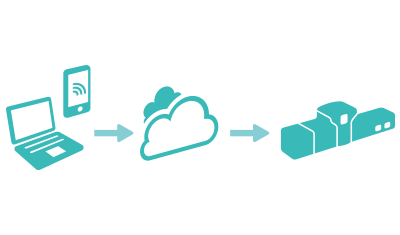
In the mid-2000s there was a further revolution, brought about by the famous Web 2.0 manifesto, ushering in the era of social networks, collective intelligence, collaboration, user-generated content (UGC) systems and new desktop-like interfaces. In fact, Web 2.0 brought two innovations that are extremely important for building business models (and are spreading rapidly):
- Web/mobile as a platform
- Web services (WS) and software as a service (SaaS)
The first means being able to use the web/mobile as a platform through which everything passes. In practice, every service is accessed through our browser or an app that communicates with a web server.
With web services and SaaS, we have a complete catalogue of services that can be integrated and are available for every need. For example, there are SaaS services for CRM (customer relationship management), social media management, personnel management, buying online advertising, graphics and office automation, etc. At an even more granular level, web services provide specific functions: all of Google’s mapping services, for example, social logins, web services with weather forecasts, credit checks, etc.
To outsource the entire technological infrastructure, there are cloud solutions through which a company pays to use remote servers.
The best-known and most widely used service is undoubtedly Amazon Web Service (AWS).

In practice, you can install whatever you want on the servers and pay as you go. No fixed costs, no maintenance and maximum scalability.
For this reason, many digital companies start with AWS (DropBox, for example) to assess the value of their idea before considering investments in their own infrastructure.
Today, we can find any service we need online, without fixed investments and with maximum flexibility and modularity. This makes the possibilities for combining and recombining (or reconceptualising) a business almost endless! Using third-party services typically allows us to choose the best in class and therefore improve the activity in its own right.
Co-creation
We have seen the need to focus on strategic activities and skills while bringing together the best external expertise. From this perspective, the “supplier” becomes a partner in value creation, and we speak of co-creation. The VN model goes further: the customer also becomes a co-creator.
Co-creation really fulfils its potential in the VN model when customers engage in dialogue with the company to increase the value of its products and services. Today, it is much easier to gather and channel customers’ ideas. Communities among consumers and between consumers and companies are the perfect place for co-creation.
Co-creation makes the mission of marketing even more practical: it must be customer-centred rather than company-centred.
What are the key factors in co-creation?
- Dialogue: creating a system of customer–company interaction; the dialogue must also focus on areas of shared interest.
- Transparency and access to information: being transparent in interactions and guaranteeing access to information useful for co-creation.
To benefit from co-creation, companies must understand these factors, otherwise every action risks backfiring!

Nike created its Nike Plus community, a collaborative platform that strengthens the bond between customers and the brand and supports healthy co-creation.
With Nike Plus, Nike defines what I like to call the “extended product”: I am not simply buying a pair of running shoes, but access to a world of services, content and relationships. All of this, of course, thanks to digital!
A lighter version of co-creation is lurking: listening (unseen) to customer communities in the market (including competitors’ customers) to understand emerging needs, problems to solve, and positive and negative experiences.
To do this, it is important to map all the spaces where customers exchange views (e.g. Facebook, Twitter, LinkedIn, forums, blogs and specialist portals) and develop the ability to filter data to extract information.
Customer relationships, profiling and a dynamic offering
For the reasons mentioned at the beginning, managing the customer relationship is a critical success factor. In a completely interconnected world, collective intelligence is such that it does not forgive poor relationship management.
In the Value Network model, the customer is always at the centre, and all the interaction tools available today should be used.
The aim is to know customers as well as possible, monitor their needs and experiences, and target specific profiles.
In the digital age, segmentation and profiling are essential because customers are more demanding and better informed, and want a product/service that perfectly meets their needs.
Profiling capability is certainly a core competence in new business models; profiling follows the entire customer lifecycle.
Once all relationship and interaction channels have been activated (including co-creation), and customer knowledge has been improved through profiling, all of this must be used to build the perfect offering for our target audience.
The offering must be dynamic, and the company must read the market quickly, offering the right products and services. The speed and relevance with which it does so underpin the new value network model.
The business models of Airbnb, Uber, Booking, Netflix and Spotify
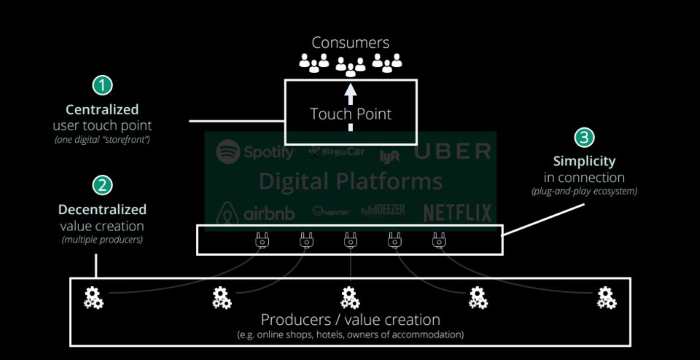
Most Internet/digital companies use the VN model and, as the image shows, the underlying pattern is always the same:
- I connect the entire constellation of car, hotel and apartment owners through the digital platform, and they co-create my value.
- I control the touchpoints to give customers the best experience and channel co-creation (for example, ratings and reviews for hotels, apartments, taxis, etc.).
- I analyse data and profile customers so I can build dedicated, dynamic offers and services.
A corollary of the Value Network model is that the core activity often does not involve owning or possessing the asset at the centre of the service.
Indeed, as we know, Airbnb does not own houses, Uber does not own cars and Booking does not own the hotels.
IKEA’s business model
The IKEA brand is known worldwide, and its distinctive positioning is clear: design solutions at highly competitive prices.
IKEA is the most striking example of applying the Value Network in a traditional, non-digital market.

IKEA does not make furniture or even assemble it. IKEA’s key activities are:
- Design
- Production processes and logistics system
- Service
From its headquarters in Almhult, a team of just 20 designers defines and oversees the creation of all products.
These designers’ expertise is fundamental to IKEA; the constellation of Swedish design universities continually supplies the company with young talent.
The design process cannot be separated from how the product will be made. Breaking the furniture down into components and its packaging are key elements, optimised down to the last centimetre. This process is conceived and designed within the company, then transferred to the partner network, which makes and packages the final product to IKEA’s specifications.
Other core competencies are logistics through to the point of sale and customer service.
IKEA’s constellation is so extensive that the co-creation model also involves the customer, who transports and assembles the furniture.
GIFF GAFF: the value network model applied to telecoms
Another very interesting example of co-creation and the value network is GIFF GAFF, a British mobile phone operator (an MVNO: a mobile virtual network operator without a network of its own).
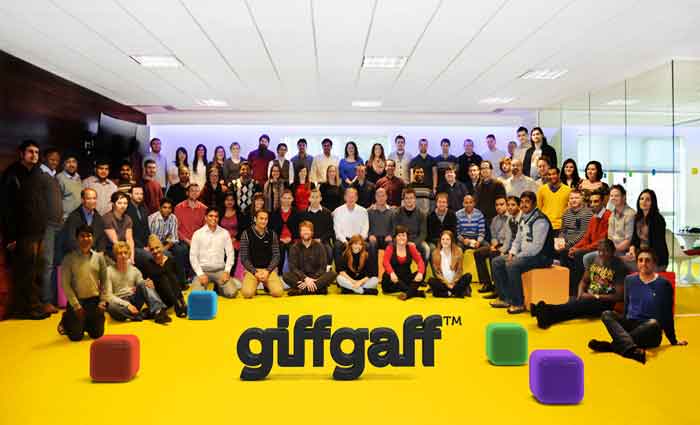
With a small team (14 people in 2010), the company carved out a position of excellence in the British mobile phone market using the VN model.
In 2014 it won the Which? awards for best telecommunications service.
Giff Gaff offers the best prices on the market while guaranteeing the highest level of service and quality.
Breaking down the value network, we see that:
- The company does not own the infrastructure: as a virtual operator, it uses the network of the partner providing the service rather than its own.
- Giff Gaff sells only online; there are no physical shops.
- Customer service is provided only online, through the community.
Giff Gaff’s core competence lies in managing the online channel and the community. The concept of co-creation has been taken as far as possible: not only does the company obtain ideas from the community, but that same community is its primary support channel. In practice, customer service is provided by the customers themselves!! (A self-support strategy.)

Giff Gaff has built a system to reward experts who help other customers, based on kudos and free top-ups.
The ultimate result of co-creation is maximum customer satisfaction and a drastic reduction in customer service costs.
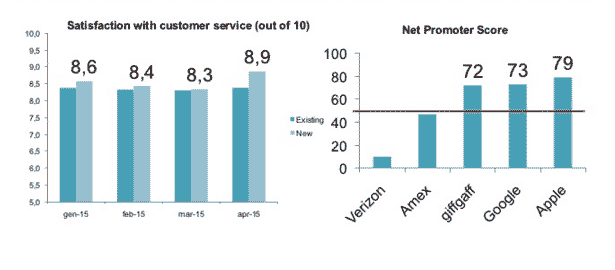 The exceptional results of Giff Gaff’s Net Promoter Score
AMAZON’s business model
Now let’s look at a giant of the digital world: Amazon.
The value network model lies at the heart of Amazon’s business. As well as organising its activities around core competencies, Amazon plays a leading role in reconceptualising other companies’ businesses.
Indeed, as we saw with its cloud service (AWS), Amazon offers the complete dematerialisation of technological infrastructure.
Amazon’s core competencies are:
- Logistics
- Managing the online channel
 Amazon warehouse
Amazon’s logistics process is certainly the most innovative in the world, allowing it to manage an enormous catalogue and guarantee an exceptional delivery service.
Amazon has been a pioneer in customer relationships and profiling, and its recommendation system is also well known.
In ecommerce, Amazon is increasing the share of sales made by external merchants. In practice, it follows Airbnb’s model, making its platform available to sellers while retaining control of the customer relationship.
Conclusions
We can summarise the essence of the value network model:
Perform the distinctive activities customers notice better than anyone else. Delegate the rest to specialists in their field, to create the best possible end customer experience. Profile, monitor and listen, then act quickly.
Do NOT delegate core activities: keep them in-house and build a centre of excellence.
The key factor is expertise!
Expertise in identifying strategic activities, expertise in the core activity, and expertise throughout the company to create a valuable relationship with the customer. Both expert and less experienced customers (for different reasons) want expertise and relevance!
Expertise and passion in core activities are a guarantee of success.
The VN model is all about agility. In today’s markets, we need to be agile and quick to seize opportunities, and equally quick to leave them at the lowest possible cost (no lock-in or switching costs).
The following video, taken from Big Hero 6, is a useful illustration of new business models made up of many small components that dynamically combine and separate, adapting the business to market opportunities.