Fully understanding the concept and practice of marketing is essential for any business (or other activity) that requires a relationship with a customer.
digital marketing today is precisely the combination of basic marketing principles and the digital world; it is no coincidence that we now rightly speak of MarTech (marketing + technology).
Having said that, this discipline is less complicated than it may appear from outside. Once its basic principles are understood, every possible business strategy can be derived from them.
The classic mistake is to equate marketing with advertising. It is nothing serious, but it is very limiting: as we will see, advertising is one of the tools available to achieve business objectives.
Overview of the topics in this guide:
- The history of marketing
- What marketing is
- Functional value and emotional value
- The stages of the marketing management process
- Analysis and research
- Strategy: segmentation, targeting and positioning
- Action: the marketing mix
- Control
- Success factors
- Final summary
When did marketing begin? Its history
To get warmed up, let us look at when marketing began and why, retracing the different stages of companies' orientation towards the market.
Four periods are typically identified:
- Production orientation
- Product orientation
- Sales orientation
- Marketing orientation
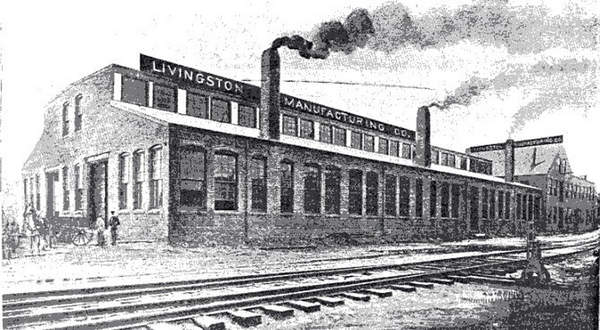
1 – Production orientation (until 1950)
During this stage, companies focused only on production. The aim was to maximise factory utilisation and economies of scale and minimise costs.
The market's ability to absorb the product was not a problem, because people needed everything and paid little attention to detail.
2 – Product orientation (until 1960)
As the previous stage evolved, companies focused on product quality, believing that with existing demand, making a good product was enough to beat the competition.
3 – Sales orientation (until 1970)
At this stage, the strategy was push: the sales force pushed the products being made without considering customers' needs, to empty companies' warehouses or, in saturated markets, increase consumption.
4 – Marketing orientation (from 1970 to today)
Marketing emerged in the early 1970s, as businesses began to realise it was better to pause and understand customers' needs before producing something and/or pushing it onto the market.
Let us look at the most important concepts, starting with a comprehensive definition.
What is marketing? Definition and meaning
A good definition of marketing activity is enough on its own to explain this discipline's essence. Of the many available, the best is certainly Philip Kotler's, the father of modern marketing:
It is the business function that identifies unmet NEEDS, BEHAVIOURS, EXPECTATIONS and DESIRES (expressed and unexpressed), defines their scope, determines which target markets the company can best serve, defines the value to offer through products/services and programmes aimed at those markets, and encourages every part of the company to think in terms of customer service and relationship management.
This definition has everything! I have also made small additions to underline elements I consider important, such as unexpressed needs and desires and the focus on behaviour as well as need.
Marketing is a ‘human-centric’ discipline based on studying consumers as people. For this purpose, it is important to draw on psychology, sociology and anthropology, and also to develop empathy and observation skills.
Marketing is a company function, so there are people who do this work continuously.
The first task is to study, analyse and identify people's needs, desires and expectations, both explicit and unexpressed (the ANALYSIS and RESEARCH stage).
At this stage, however, we also need to understand how widespread a need is and all its characteristics. Misjudging market size is one of the most frequent problems: we fall in love with our idea, invest and work hard, only to discover later that the real market is not large enough to make a profit.
Once markets are defined in terms of needs, the task is to understand which are attractive to the company, incorporating other business parameters (the STRATEGY stage).
The final stage is ACTION, where marketing's tools come into play: the famous 4Ps of the marketing mix:
- Product (researching and developing the product; naturally this also applies to a service)
- Price (pricing policies)
- Place (distribution channels, retail outlets and, generally, the entire structure enabling the product to reach the end customer)
- Promotion (promotional activity, primarily advertising but also public relations, personal selling, sales promotion and direct marketing)
 A store of the well-known Starbucks chain
The final part of our definition is the most current and refers to managing the customer relationship.
We also speak of relationship marketing to emphasise the importance of retention and building customer trust.
In highly competitive markets with high customer-acquisition costs, managing relationships and retaining the customer base become increasingly important. Various studies suggest that acquiring a new customer costs five times more than retaining one.
The secret of marketing? Value and margin. Functional value and emotional value!
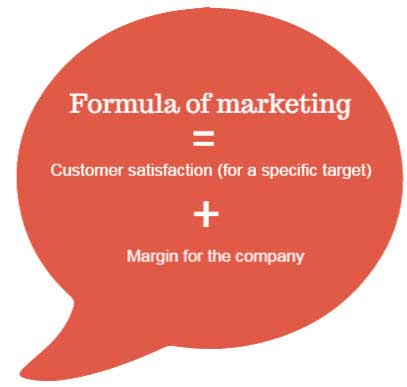
Create value for the customer (Customer Value) and generate profit for the company.
The essence of marketing is simple: solve your customers' problems, fulfil their needs and desires, and generate profit.
This principle applies to any business, large or small.
To take it to an extreme, you could have the most useful and coolest product in the world, but if your income statement does not hold up, there is little hope. The list of companies that have found themselves in this situation is very long.
In the short term, having no profits is normal, but in the medium to long term, positive cash flow and positive EBIT are necessary.
But what is Customer Value?
It is the value customers attribute to a product or service, related to their perception of the ratio between benefits and costs.
Customer Value differs from the Value Proposition: the latter is the company's statement of value, explaining why customers should buy its product.

Be careful: cost differs from price, and benefit differs from quality. Using only the price/quality ratio is dangerous.
Quality in a service or product is not what you put into it. It is what the customer gets out of it.
Quality in a service or product is not what you put into it. It is what the customer gets out of it, the benefit and advantage they obtain. – Peter Drucker
Product characteristics (the famous features) are something else again.
For example, ABS, airbags, protection bars and distance radar are features of a car that produce the benefit of safety (ultimately, customers buy the concept of safety, not the airbag).
The following image shows the difference between features and benefits for the iPod. The feature is 1GB of storage for MP3 files, while the benefit is having all your music (1,000 songs) in your pocket, always with you.
The difference in impact between communicating features (a more technical element) and benefits is clear. It is no coincidence that Apple chose the option on the right.
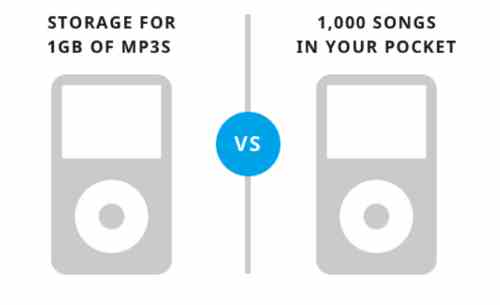
The difference between a feature (left) and a benefit (right)
Customer satisfaction is achieved only when the expected cost/benefit ratio matches the perceived cost/benefit ratio.
It is useful to explore perceived benefits and perceived costs in detail.
Let us start with the first: perceived benefit consists mainly of two elements, functional/utilitarian benefit and emotional benefit.

Functional benefit
This factor includes all the product or service features that fulfil our need: for example, a car with low fuel consumption, a spacious boot, good safety, and so on.
For a telecommunications operator, the benefit is a network that causes no problems when watching a film or making a video call. It results from features such as the connection's download and upload speeds, network latency, the number of GB available on the SIM, and so on.
Functional benefit is typically characterised by measurability.
Network externalities
One particular effect on functional benefit is network externalities: for some products, the benefit grows as their adoption and penetration increase.
For example, imagine finding fantastic video-communication software with every feature we ever wanted and the best performance on the market. Its benefit would collapse, however, if we could only communicate with others who had installed the same software and there were few of them.
Conversely, the same phenomenon drove WhatsApp's success through its widespread adoption and therefore the ability to communicate with many people. There are countless similar and better software products that are less successful because they have not reached the critical mass needed to generate network externalities.
Emotional benefit
When buying certain products or services, emotion accounts for much of their value: the meaning we attach to them and what they represent for ourselves and others.
When we buy a product or service, we buy a piece of identity.
Take a Prada handbag: functionally, a leather bag made by an artisan might be even better and cost much less. But here, emotions and the values that the brand builds come into play: the meaning customers attribute to the product, the identity we stitch onto ourselves.
Investment in brand helps increase emotional benefit, raising the value perceived by customers and consequently potentially allowing us to set a higher price too (see the Value-Based Pricing strategy).
What characterises many premium brands is precisely the creation of a unique world of values that customers embrace, building a community and a sense of belonging.
Emotional value can be built for any product or service.
Returning to telecommunications, we could communicate the meanings and values enabled by the network, such as expressing ourselves, accessing infinite knowledge or connecting with anyone in the world.
This shifts the focus to much more powerful and aspirational elements.
Monetary and non-monetary costs
In perceiving value, customers certainly consider monetary cost first (the price and all additional expenses), but non-monetary costs must not be underestimated either.
Non-monetary costs include physical effort and time (for example, getting to a shop), the energy needed to understand a product's features better and the psychological burden of some purchasing processes.
Particularly from the perspective of digital marketing and inbound marketing, understanding these costs is important to simplify customers' lives by reducing their impact. Just think of the purchasing experience on Amazon compared with a traditional shop.
Indeed, Adam Smith (the father of economics and economic science) said:
The real price of everything, what everything really costs the person who needs to acquire it, is the toil and trouble of obtaining it.
Value for society: corporate purpose and corporate activism
All recent market research underlines that people are highly sensitive to companies' and brands' impact on society, to the point that it becomes a deciding factor in their choices.
Many would like brands to show concern not only for profits, but for the communities they serve and the world we live in.
We have seen that marketing's essence is value for customers and value for the company. Today this is no longer enough strategically; a third component must be added: value for society, the contribution we make to our planet.
Value for society can be divided into two closely related aspects: purpose and corporate activism.
Purpose is the company's why, its reason for being. It is at the centre of its vision and must express a higher value beyond the product or service sold. It must imply a contribution to society.
Simon Sinek expresses the concept of why very well in the following video:
For example, Nike's purpose:
We want to unite the world through sport to create a healthy planet, active communities and a level playing field for everyone.
As you can see, the positive impact on society is very high.
Modern companies must align with their customers' values, converge on the same meanings and resonate with the same worldview. It is equally important to do this with their employees.
Customers will never love a company unless its employees love it first.
The ideal scenario occurs when employees become brand ambassadors increasing its reputation in an extremely natural, organic way and making direct contact with customers.
The question is simple: if employees do not believe in the company and what it does, why should customers?
The company's CEO must lead the brand ambassadors.
Corporate activism, or social commitment, is the company's ability to take a social stand, for example in defence of the environment, minority rights, women, and so on.
A good book for exploring the subject is the one written by the legendary Philip Kotler and Christian Sarkar, aptly titled Brand Activism:
But communicating and stating in your vision that you want to contribute to society is not enough: you must demonstrate it through action (as they say across the Atlantic, walk the talk). Pretending to be socially aware while doing the opposite can actually backfire.
A wonderful example of a company aligned with its customers' and employees' values, with strong purpose, activism and social impact, is Patagonia, founded by the great Yvon Chouinard in 1973.
The company's powerful activism statement (to which it devotes an entire website section):
We're in business to save our home planet.
We're in business to save our home planet.
Patagonia is very active in environmental protection and land conservation; every year it donates 1% of its total sales to environmental groups (One Percent for the Planet).
To defend land, the company has pursued several lawsuits against the United States and boycotted various events, most recently removing advertising from Facebook and Instagram to support the ‘Stop Hate for Profit’ campaign.
But perhaps its most striking and interesting marketing initiative was an ad a few years ago (shown below) suggesting, during the period between Black Friday and Christmas, that people should not buy its jackets: ‘Don't buy this jacket’.
The message is consistent with the company's vision (here is the PDF with the full, readable ad). In the ad, Patagonia says its products are made to last and asks potential customers whether they really need a new jacket. It suggests repairing it instead, or passing it on for someone else to use. In the extreme case that the product can no longer be used, the company will take responsibility for recycling it.
Wow! That is strong positioning! The ad concludes with:
Together, let us reinvent a world where we take only what nature can replace.
Patagonia also stands out for its care for employees and their families, with support and family-leave policies.
The marketing of the future must think about sustainability in two directions: for the business and for the society in which it operates.
Profit and selling at any cost will pay off less and less unless they are part of an authentic, credible story capable of creating the most precious asset: trust.
Beware of Woke Washing!
What is Woke Washing?
It is a manipulative technique that leads companies to make superficial gestures to show that they care about society, the environment, inclusion and, generally, all the issues consumers now pay particular attention to.
‘Woke’ refers to this sudden awakening of corporate commitment (positive in itself), but combined with ‘washing’ it means that the commitment is superficial, without genuine investment or effort.
This strategy is very dangerous for a company because today's consumers are much more aware and can quickly expose superficial gestures.
PS: Woke Washing also includes Green Washing, essentially a specific branch concerned with activities intended to make a brand appear interested in and active on environmental issues.
What are the stages of the marketing management process?
To create value and maximise the customer relationship for both sides, the concepts discussed so far must converge into a specific process within the company, called the marketing management process and consisting of the following four main stages:
- Analysis and research
- Strategy
- Action
- Control
The process is driven by an overarching corporate strategic objective: for example, we might decide to enter a new market with a new product, create a new product in an existing market, increase market share, counter a potential new competitor, increase revenue by x%, and so on.
In general, once an objective is set, strategy is the plan of action guidelines for achieving it, following careful preliminary analysis.
The objective always comes before the strategy; not being clear about it is a classic mistake.
Objectives exist at every level (not only the strategic level), followed by specific strategies.
Consequently, the strategy stage may break down into detailed marketing objectives, followed by the action plan.
Analysis and research also follow the objective when they are specific, while ongoing exploratory research across the field is transversal and often provides ideas for defining new strategic objectives.
The four stages are a good method for any business objective, even a highly detailed one.
For example, suppose our specific objective is to increase visibility on Google for a particular intent, phrase or keyword. We begin with analysis: what are the search volumes, who are our competitors and what content do they offer, what are our own pages, and so on. Then we move to strategy: create high-value content that positions us as the sector's leading experts. In the action stage, we define what to create, who should do it and when.
Finally, the control stage tells us whether we are on the right course or need to turn (for example, modifying content to improve search-result rankings).
Analysis and research
Analysis is a distinguishing feature of modern business: compared with the past, we now have enormous amounts of data and many more tools.
The marketer's art is the ability to turn data into information!
Analysis falls into two broad areas:
- External analysis
- Internal analysis
Within external analysis, we identify these basic elements:
- PEST analysis of the environment
- Market analysis
- Competitor analysis
- Critical success factors
PEST
Through PEST analysis (Political, Economic, Social and Technological) we identify all external environmental factors affecting our business: political, economic, social and technological.
The legislative and political situation can create new businesses or kill them!
For example, a law funding alternative energy (such as photovoltaics) can create a market or accelerate its growth.
Other areas typically worth monitoring include competition legislation, labour-policy laws, taxation, and so on.
Economically, we should monitor the macroeconomic situation: inflation, economic growth, trade balance, interest rates, energy costs and exchange rates. For an exporting company, for example, the exchange rate is a decisive factor.
Social factors include demographics (e.g. population size, numbers of men under 60 or families with at least two children), income distribution, social mobility, education, and so on.
The most important part of social analysis is psychographic analysis aimed at identifying society's personalities, beliefs, attitudes, behaviours and evolving lifestyles.
For a food company, for example, it is essential to understand whether society is moving towards health-conscious values or culinary pleasure.
Lifestyle: the set of values, attitudes, beliefs, opinions and behaviours expressing a group's uniqueness. Lifestyle is a form of social grouping.
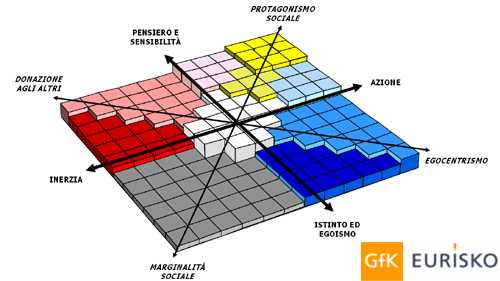 Eurisko's large lifestyle map
Analysing technological factors requires the ability to identify how new solutions may affect the market and one's own business. Naturally, the more technology is used, the greater this factor's impact.
Think of the impact of the Internet: entire markets have been revolutionised and new businesses created from scratch.
Market analysis
More detailed external analysis examines the market in which the company operates, identifying its most strategically useful elements. Each company builds its own indicators and focuses on those it considers most important.
The following elements certainly need to be studied:
- potential-customer analysis
- size and segments
- market trends
- segment characteristics
- market players
- distribution channels
Quantitative and qualitative customer analysis is where needs, desires and expectations are investigated.
Analysing the purchasing process and behaviour is essential for go-to-market strategies and is the heart of digital and inbound marketing.
Products are temporary; customers' needs and requirements are not!
One concept that has always intrigued and fascinated me since studying marketing at university is the customer's Black Box 🧠. Perhaps because I already struggle to understand my own box 🤪, but I think the key to all marketing lies here.
Black-box analysis helps us understand what customers may want and create the best experience and communication to resonate with their characteristics and worldview.
The table below shows the black box and how it is stimulated by the company's and competitors' actions and by the environment.
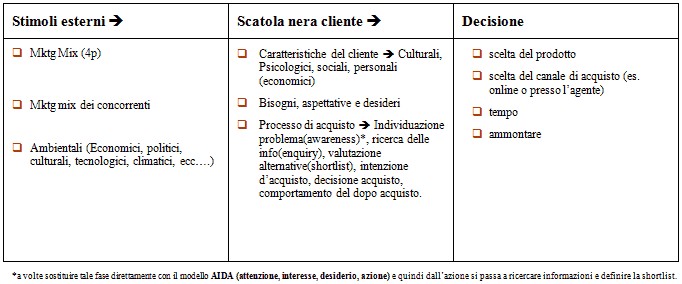
These stimuli meet the customer's specific characteristics and purchasing process (which also varies by product and service type) to determine final market choices.
Factors affecting our thinking when choosing one product over another (regardless of objective data) include beliefs and convictions, values, knowledge, motivation, perception and lifestyle.
All these factors come into play in the purchasing journey's decision-making process when a need or desire arises.
It is no coincidence that particular attention is now paid to the customer journey and neuromarketing, to better understand what happens in people's minds in response to external stimuli.
Competitor analysis
Naturally, external analysis cannot ignore competitors.
Every possible aspect of the competition should be recorded: positioning, size, market share, penetration, satisfaction and loyalty, marketing mix, investment, communication channels and share of voice, customer perceptions, and so on.
Critical success factors
Studying the environment, market and competitors should lead to a concise identification of the factors that, when present, can ensure a company's success.
In practice, we need to understand which elements to focus on.
These factors can be anything, from production to sales and communication. For example, in the market for ice creams sold in cafés, the CSFs are a good distribution channel and a broad, regularly renewed product range.
Internal analysis
At this stage, all indicators relating to the company itself are analysed and monitored. First, we examine:
- what are the elements of my value chain (or value network), what are its boundaries, activities, connections and core competencies?
- what is the current market positioning?
- what is the current situation regarding the marketing mix: product, price, distribution channels and promotion?
- what are the business figures: revenue, sales volumes, breakdowns by channel, geographical area and type, market share, and so on?
Strategy: segmentation, targeting and positioning
The analysis stage must provide a comprehensive, concise picture of the context to enable a winning strategy that gives the company a competitive advantage.
SWOT matrix
A very useful tool at this stage is the Strengths and Weaknesses, Opportunities and Threats matrix.
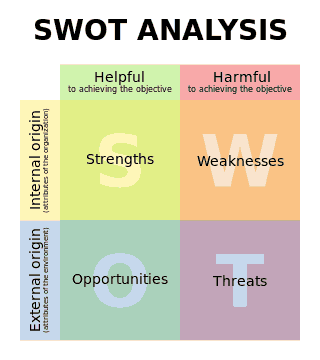
To build the matrix correctly, remember that strengths and weaknesses relate to the company: they are internal factors we control. Threats and opportunities are external to the company and not under our direct control.
Let us take an ice-cream company as an example:
- Strength: number of retail outlets
- Weakness: long lead times between ordering and delivery to shops
- Opportunity: a trend towards eating ice cream as a meal replacement, recommended by a hugely successful new American diet promoted by famous influencers
- Threat: a law banning a key ingredient in our flagship product
SWOT's strength is that it offers a very clear, concise picture from which to develop strategies to limit harmful areas (right-hand column) and exploit useful areas (left-hand column).
Segmentation
This is the most delicate stage of the entire marketing process, and companies must approach it with the utmost attention and care because it lays the foundations for the following stages.
The analysis stage provides plenty of data, but how can we use it best?
Segmentation is the process of identifying areas or segments within the market using multiple variables. Segmentation is an art: choosing the right variables reveals opportunities (and suggests new strategies) and/or allows a better business focus than competitors have.
Segmentation can be macro or micro. The first identifies the business areas to target, while the second goes into detail.
The most recent tool for macro-segmentation is the Abell model, which identifies strategic business areas.
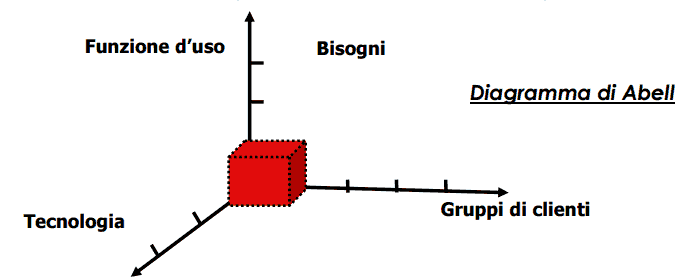
There are three axes: customer groups (who we target), needs/functions (what we want to offer) and technologies (how we deliver it).
This matrix helps us understand not only which segments to reach, but how and with which solutions. In a world where technology offers countless possibilities, this perspective could suggest innovative strategies.
The most important starting point is the variables used to segment potential customers. Let us look at the main groups:
- Demographic: age, sex, income, education, family size, generation (e.g. those born between 1995 and 2002 are defined as Millennials, well educated and technology-oriented), occupation, life stage, religion, and so on.
- Geographical: macro-regions (North America, EMEA, BRIK, etc.), country, region, city, urban areas with more than x inhabitants, coastal or mountain towns, and so on.
- Psychographic: psychographic segmentation divides individuals into groups based on psychological elements, personality traits, lifestyles and values (in Italy, the most widely used tool is Sinottica Eurisko's large map, seen in the external-analysis stage). For example, we can segment by innovators or traditionalists.
- Behavioural: behavioural segmentation is very interesting (and closely linked to the buying-cycle model), as it divides individuals according to their knowledge, attitude, use and response to a product or service.
Behavioural segmentation
Let us explore behavioural segmentation further, as it is very useful in digital and inbound marketing.
Here are the detailed variables:
- Purchasing decision-maker: who buys? Who decides what to buy? Who influences them? Within a family, for example, the man typically decides and influences technology choices (a new television, a new PC, etc.), while the woman decides on and buys all household-cleaning products.
- Usage occasion and function: when is the product consumed and for what need? For example, I can buy ice cream in the middle of the afternoon as a snack between meals, or after dinner as a dessert.
- Expected benefits
- User status: non-users, ex-users, potential users, first-time users and regular users.
- Usage rate: light, medium and heavy product users.
- Stage in the purchasing process
- Loyalty level: hardcore, split, shift, switcher.
- Attitude: enthusiastic, positive, indifferent, negative and hostile.
Naturally, depending on the market type and the company's stage of development, it will be more appropriate to focus on some factors than others.
Targeting
Segmentation gives us a range of possible markets; targeting then identifies which target markets the company is interested in serving.
Target markets can be selected in the following ways:
- concentration on a single segment
- product specialisation: covering multiple segments with the same product or service
- market specialisation: choosing one market and offering several products
- selective specialisation: covering several different segments with different products
- full coverage: multiple products to cover every market need
Positioning
Positioning is a key marketing concept, a pillar on which a company's success is built.
We have identified the target market; now we need to understand how the company positions itself within it.
Definition:
Positioning consists of building an offering that carves out a clear, distinct and valued position in the minds of customers in the target market.
Positioning begins with assessing competitors' positions and choosing differentiating elements to stand apart from them.
For example, from the outset De Cecco pasta has focused on quality as the differentiating element positioning it as the best pasta on the market.
Some important considerations:
- Positioning concerns where the product or service sits in the customer's mind, so we must work simultaneously on value and the perception of that value.
- Because we are talking about customer perception, it usually helps to have a single differentiating element that is easier to communicate and support. For example: the lowest price, the best service, the most advanced technology, and so on.
- Positioning must be clear, strong and credible: there must be no confusion in the message, it must be firmly supported and have reasons making it credible; customers must have no doubts.
A company achieves its positioning objective if customers recognise and position it according to the chosen differentiating element.
Market research into brands' distinctive characteristics is essential to reconstruct mental positioning maps of products and services and understand whether they match what is communicated to the market.
Communication is clearly a fundamental positioning tool, but so are all elements of the marketing mix (whose weight also varies according to the type of differentiation chosen).
Below is Fastweb's commercial, showing clear positioning based on speed and innovation: We are the fibre that flies!
Price is itself a positioning element: psychologically, a high price communicates higher quality. Usually, when consumers have little specific knowledge and want quality, they let price guide them (this is how I choose bottles of wine :-)).
Because price is intrinsically tied to positioning, a very important rule of thumb follows: a price can always be lowered, but never raised!
If you want to use price incentives for an expensive premium brand, it is better to use promotions so as not to lower the perceived price.
Action: the marketing mix and the 4Ps (Product, Price, Place and Promotion)
Once objectives and markets have been defined, we move to planning the execution stage and developing the marketing mix discussed at the beginning.
The marketing mix has four components, the famous 4Ps. Other Ps are occasionally added (such as packaging, people, platform, etc.), but those are just marketing exercises :-):
- Product
- Price
- Distribution (Place)
- Promotion
The first two are fairly clear, since they concern defining and developing the product and price in all their components.
Let us focus on the last two, as their scope is often confused.
The P for Place refers to the entire physical and commercial distribution chain, also called the marketing channel: the activity that brings the product to the potential buyer (physical and commercial distribution). This includes all logistics and intermediaries inside and outside the company. For a pasta manufacturer, for example, the marketing channel consists of transport operators, warehouses, wholesalers, agents and retail outlets of all sizes. This is where the choice is made between an internal or external sales force (e.g. company-owned stores or franchises).
Promotion is not just advertising; it also includes:
- Sales promotion: from promotions in the strict sense to loyalty-point schemes, prize competitions, and so on.
- Public relations: press reviews, conferences, seminars, relations with the press and external environment, sponsorships.
- Personal selling: all sales-force management, from sales meetings and presentations to trade fairs and exhibitions.
- Direct marketing
An important step in promotion is communicating the company's positioning and value proposition (as well as the product's and/or brand's unique element). To do this, we need to build the promise and its supporting reason why.
If we wanted to map digital marketing and e-commerce onto this framework, they would sit alongside direct marketing, from which they evolved, but also partly within the marketing channel.
The sales force appears both as a marketing channel (commercial distribution) and as a promotional tool.
The marketing mix serves as a reminder of the points to address to put corporate strategies into action. Naturally, how some tools are applied depends on the specific business type.
Control
This is the stage where all marketing activities are monitored against the objective.
It begins with defining key performance indicators (KPIs), which must be monitored to analyse trends, understand what is happening and decide whether to adjust our actions.
Typical high-level company KPIs include sales volume (revenue and unit volumes), number of customers, revenue share, advertising efficiency, acquisition costs, margins, and so on.
Each area then has its own detailed breakdowns, so sales will be split by product line, type, geographical area, and so on.
The control stage is becoming increasingly important because markets are so dynamic: companies must spot problems quickly so they can take corrective action just as quickly.
In digital, by its nature, the control stage is extremely sophisticated precisely because of the flexibility required.
Success factors in marketing management
We have taken a quick tour of marketing's fundamental components, which can form a good basis for any action. On top of these are specific tools and techniques to explore according to your needs.
I would summarise success factors in marketing management in these five elements:
- Analytical ability: the analytical element, the ability to identify all the market's key aspects quantitatively and qualitatively, analyse the company's current situation and identify new parameters or combinations to segment and regroup the market differently from competitors. It means studying the purchasing process for products and services and perceiving everything accompanying customers' behaviour before, during and after buying. Above all, analysis investigates the essence: customers' needs, desires and expectations. Analysis requires complete mastery of marketing techniques and a good measure of empathy.
- Seeing ideas: if analysis is conducted correctly, we should have a complete picture of the market and, more importantly, our potential customer. Combining all the elements and observing scenarios from widely different angles generates ideas. I like the expression ‘seeing ideas’ because ideas become visible by observing the analysed context, making them actionable and achievable, as opposed to abstract creativity that is sometimes inconsistent and impractical.
- Positioning: the ability to find a distinctive, differentiating element of your product or service that customers recognise and that you can sustain and strengthen over time, positioning yourself clearly in the market while knowing that positioning has a medium- to long-term impact.
- Good organisation, planning and control: once the broad strategic framework is defined, it is important to plan activities and follow the product or service's development through every stage. This is the project-management stage, moving from concept to final product or service. It is the longest stage and requires consistency and determination in leading the project. Many good ideas and businesses are lost precisely during execution through lack of organisation or tenacity.
- Agility: last but not least, agility in running the business and delivering projects. Today, companies have access to the same information, strategies resemble and copy one another, and the difference lies in the ability to test and launch as many ideas as possible and in the sensitivity and flexibility to modify strategies based on market feedback. Only controlled management of chance can lead to innovation.
NOTE – Beyond technical expertise, what skills must a marketer have to increase the chances of success in marketing management?
Here you will find what I consider to be the soft skills and specific marketing aptitudes, among which an important role is played by creative and idea-generation skills.
Final summary
If we had to explain marketing simply, rigorously, clearly and briefly, we could say it is the activity that:
- studies the market to understand customers' current and future needs and requirements, expressed and unexpressed, values and beliefs
- understands, in relation to the previous point, what exists and what is missing in the market, and studies competitors
- builds a value proposition: an offering to the market or target audience that is attractive, satisfies them (see Apple) and differentiates us
- makes our offer known and our value perceived (value perception cannot remain only in the mind of whoever conceived the product)
- makes taking action extremely accessible and easy for our customer: in practice, it optimises the user/customer experience (UX/CX), with digital playing an important role in this differentiation process.