
One of this website’s objectives is to discuss and explore all aspects of Digital Marketing.
First, though, we need to understand what we mean by Digital Marketing. Is it a new buzzword? How does it differ from web marketing?
Of all the buzzwords around, digital marketing is probably the one most deserving of its existence! :-) It represents the evolution of web marketing and includes it as a tool.
Defining the scope of Digital Marketing is extremely important because it shapes strategies and their impact on business.
There is a horizontal/restrictive definition of DM (from the Financial Times):
A collection of interactive marketing tools for products and services that enables precise targets to be reached and converted into leads or customers, all in an extremely measurable way.
In essence, it is a marketing and/or communication channel that fits within the marketing mix tools.
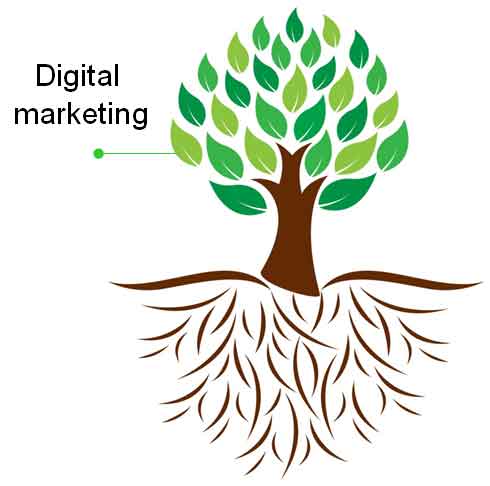 Digital marketing as branches of the marketing tree
For example, a food ecommerce website is a classic digital marketing channel, while online display-advertising campaigns for those products fall under promotion tools.
But in my view:
Digital marketing does NOT exist; there is marketing in a digital world!
In essence, Digital Marketing goes beyond the tools of the marketing mix and revolutionises every foundation of business: analysis, strategy and action.
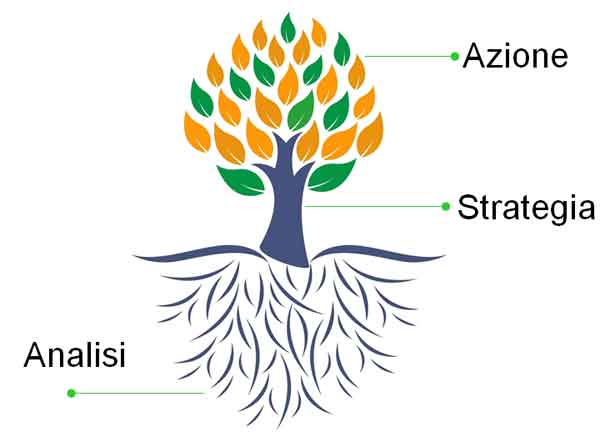 Digital as a new marketing tree
Changing our mindset is important if we are to see and seize all the opportunities of the digital revolution.
An example will make it clearer how changing the scope can change the impact.
Take a food producer selling through large retailers: digital could allow it to completely reconceptualise its business and customer experience by selling culinary journeys.
Customers could choose recipes online through a website/app (or intelligent personal assistants such as Echo), then receive all the necessary ingredients at home and, if desired, a chef to cook them.
As we can see, this goes beyond an ecommerce website or the use of online channels: it changes the entire business model (read about the value-network model to reconceptualise business).
Many products contain a service component, and many services include a product component (such as the meal on a flight).
Digital multiplies service opportunities: the product concept can evolve into what I call the ‘extended product’.
For example, take a pasta producer selling hundreds of thousands of packets. The shift to an extended product comes from placing a simple link (and QR code) on each packet, pointing to online recipes specifically for the pasta shape purchased.
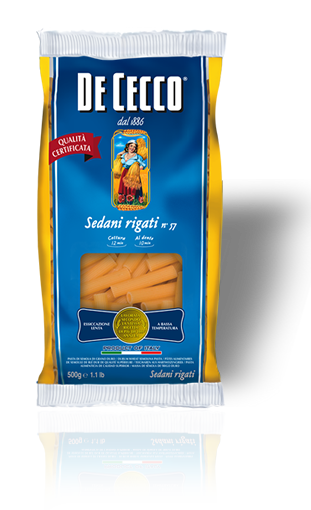 Packet of De Cecco pasta
With the arrival of the Internet and global interconnection, the classic strategic concept of the value chain risks preventing us from seeing new opportunities. It should be replaced with a more modern model such as the Value Network (constellation theory).
Online, offline and Web2 (web squared)
In the first decade of the 2000s, the Web was the main focus, and digital strategies concentrated on it. Over time, however, the number of connected devices and communication channels has grown rapidly, leading us to talk today about Web2 (web squared, as a continuation of Web 2.0), because opportunities are growing exponentially rather than linearly.
From this perspective, it is clear that web marketing must sit inside a broader framework to avoid limiting its strategic scope.
The major trend of the coming years is the meeting of the virtual and real worlds: online meets offline.
The bridge between these worlds? Our smartphone!
In general, the bridge consists of mobile devices and all devices that let us interact with the surrounding world (think also of smart car). Information in every form and from every source is always with us; in practice, we already live in an augmented/enhanced reality.

Traditional devices are also evolving towards greater interactivity and personalisation. TV has taken its first step into the future with digital television and personalisation: on-demand viewing, personal schedules, etc. The next step will be interactivity: the television will be the best solution for video communication activated by voice commands (remember Back to the Future!). It will also be fully social, allowing real-time interaction with the television programme and our friends. Imagine watching a match with many friends and commenting on it, each comfortably seated in their own armchair at home!
Let’s list the devices a digital marketer needs to understand and use:
- PC
- Smartphone
- Tablets and MIDs (mobile Internet devices)
- Games consoles
- Connected TVs
- Wearable devices (smartwatches and smart glasses)
- Augmented reality tools
- Connected/smart car
- Internet of Things (all objects and sensors connected to the network, collecting and providing information)
- GPS navigation devices
- Etc.
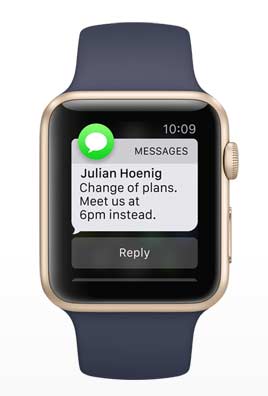 Apple smartwatch
Now let’s look at platforms and technologies:
- Web
- App
- Instant messaging (e.g. WhatsApp)
- Video platforms (YouTube, Facebook video, Vimeo, etc.)
- VoIP and video communication (Skype, Hangouts, etc.)
- Social networks (Facebook, Twitter, LinkedIn, Google+, Pinterest, etc.)
- Digital games
- Maps
- Cloud service
- Podcasting & streaming (Periscope, Facebook Live, Meerkat, Blab, etc.)
- E-commerce platform
- UGC platform
- RFID, QR code, beacons, Bokodes, zigbee, NFC
- Digital wallet
- SMS
- Etc.
 digitalmktg.it QR code
Digital Marketing models and tools
For a sound digital strategy, these are the three models to keep in mind:
- Value Network model
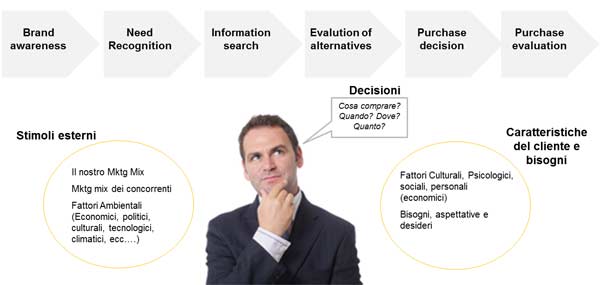
- Buying Cycle model
- Strategic Path model
For the first, I recommend the following in-depth article: How to redefine business with digital.
The buying-cycle model is an analytical tool for marketing in general, and is extremely important in digital.
It is important to understand our customer’s journey and behaviour, identify different paths and compare them across targets. This analysis helps us identify the right actions (push or pull) and the best tool. The model also matters for a multichannel strategy, creating the right synergy between online and offline actions.
In the third model, we take the company’s perspective and identify the business funnel:
- Reach/audience
- Acquisition
- Conversion
- Loyalty
- Influence/advocacy
In the first phase, we reach potential customers through all paid and unpaid means outside our digital properties. If a prospect is engaged (for example, clicking through to our landing page), we enter the acquisition phase.
The next phase is conversion: if we have done well, the prospect buys a product, signs a contract or, at worst, becomes a qualified lead.
The subsequent phases are equally important, allowing us to build a good brand reputation until customers become ambassadors.
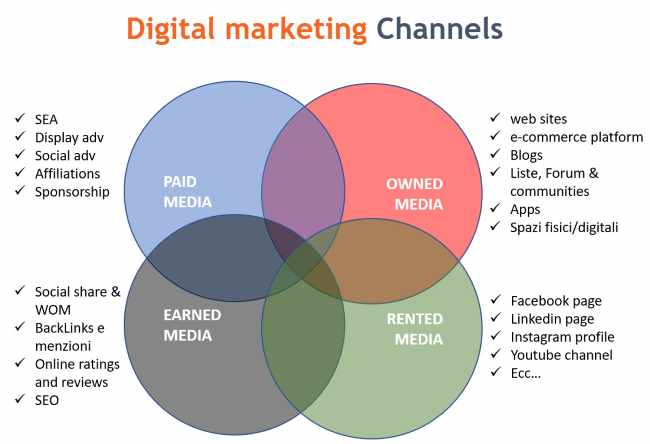
When defining digital strategies, consider all available tools and map them into these categories:
- Owned: the company’s digital properties, such as its website, mobile app, content, blog, communities (lists, forums, etc.), products and services with the ecommerce platform.
- Paid: all paid channels, from display to keywords and affiliate programmes, etc.
- Earned: engagement earned through shares, links, reviews, etc. This is traffic we do not pay for, but generate because our content/services are considered valuable and useful.
- Rented: the company’s presence on social platforms through their tools: Facebook page, LinkedIn page, Instagram profile, YouTube channel, etc.
Below are the main digital marketing tools:
- Search engine optimization (SEO)
- Search engine marketing (SEA)
- Content marketing
- Inbound marketing
- Community management
- Lead management
- Social Media Marketing
- Pay-per-click advertising (PPC)
- Display advertising
- Online Behavioural Advertising(OBA)
- Real-time bidding (RTB) and programmatic advertising
- Retargeting
- Affiliate marketing
- E-commerce
- Email marketing
- Campaign management
- Mobile marketing
- Visual design
- Copy
- UX design and usability
- Digital Analytics
- Conversion rate optimization (CRO)
- Contextual mktg
- Real time mktg
Each of these topics deserves a separate article, but listing them is important to understand which we know, manage and experiment with.
Analysis, measurability and time to market
In the initial definition of DM, I emphasised measurability as a distinguishing feature.
We can improve only what we can measure.
Today’s market has countless changing variables, and understanding and harnessing developments before others becomes a critical success factor.
This requires a monitoring and analysis system tailored to our business needs, enabling us to understand how each tool contributes to the objective and to explore new ones.
The system must provide real-time, or at least near-real-time, data so we can quickly understand whether we are on the right track.
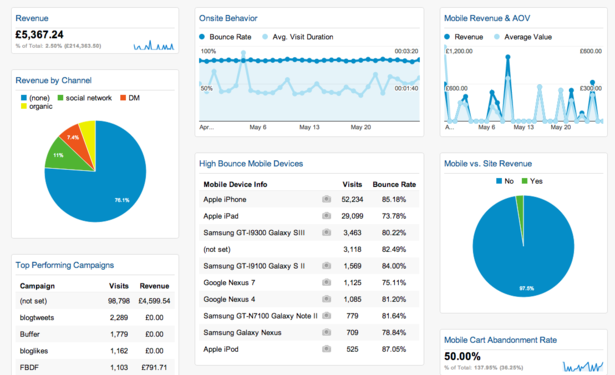 Example of a Google Analytics dashboard
Studying the data helps us better understand the strengths and weaknesses of tools, old and new.
The biggest problem is that some tools work well for some people and poorly for others, so it is essential to assess results rather than follow the crowd! Budget allocation must also be dynamic to maximise marginal and total investment.
An analytics system must give us a complete business dashboard and show which tools perform best, which should be switched off, which new experiments to run, and the advertising-investment threshold beyond which money is lost, etc.
Digital marketing is a try-and-learn process in which analytics plays a fully recognised role.
Skills and success factors
Digital Marketing is a fascinating discipline because theory and practice come together perfectly!
Theory leads us to discover and experiment with new paths; practice returns information to refine theoretical models. This is the magical, incidental cycle behind most discoveries in scientific disciplines.
Reasoning and using concepts is not enough if you do not then put them to the test.
The changes and developments in Digital Marketing are so numerous that continuous study and extensive practical application are needed. Sustaining this kind of environment requires passion and curiosity!
Mastering and harnessing the digital world requires a combination of marketing and technical knowledge.
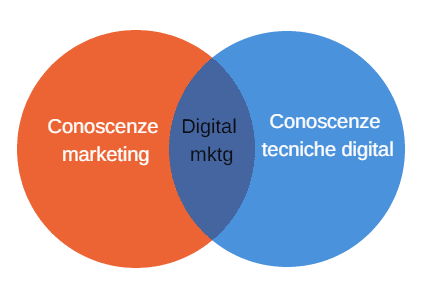
You need what I call a digital green thumb to cultivate the DM garden.
At company level, the ability to keep testing and experimenting and to build an interdisciplinary, Agile organisation is important. Fewer Gantt charts and plans, more prototypes!
The lesser-known theories in Tim O’Reilly’s Web 2.0 manifesto point precisely towards agility as a success factor. It is no coincidence that all successful Internet companies adopted this approach.
Failure is an essential component of innovation. If you know it’s going to work, it’s not an experiment. And so if you want to invent, if you want to innovate, failure is part and parcel with that.