
Throughout my professional career, I have had the opportunity to work with large companies, some already well established, and startups that, as they grew over time, progressively adopted increasingly hierarchical organisational models.
I observed a recurring phenomenon: the more a company grew, the more it felt the need to organise itself through decision-making layers, control structures, procedures and rigidly defined responsibilities. Technical departments in particular adopted distinctly pyramidal models, very close to military ones.

Vision, decisions and power were concentrated at the top. Moving down towards the base came the various management levels and, finally, the people tasked with turning those decisions into results.
This model worked for decades, especially in industrial settings where efficiency, standardisation, predictability and control were important competitive factors.
But, particularly in the tech world, the hierarchical model produces little innovation, so flexible models and the whole Agile movement gradually gained ground.
The following video offers a cinematic analogy of how hierarchy and reduced discretion become lethal in highly dynamic settings. In the video, we see soldiers having to line up in an orderly fashion and wait for the captain’s command, but…
But today there is another change.
The digital revolution, accelerating technology and, above all, the arrival of artificial intelligence are changing the rules by which companies create value.
Knowledge no longer necessarily resides at the top. The best insights can come from anywhere in the organisation.
Today, real competitive advantage no longer lies only in processes, size or financial resources, but in the quality of people and their ability to generate innovation.
The ability to attract, retain and inspire talent is the challenge facing modern companies.
That is why I believe the time has come to radically rethink the organisational model of businesses.
It is no longer enough to make organisations less hierarchical and leaner: we must change the principle around which a company organises itself.
What the atomic organisational model is
I imagine a completely different organisation. A model I like to call the atomic model.
In the traditional representation of the atom, there is a central nucleus around which electrons are distributed. It is a particularly effective metaphor for representing what I believe the business organisation of the future should become.
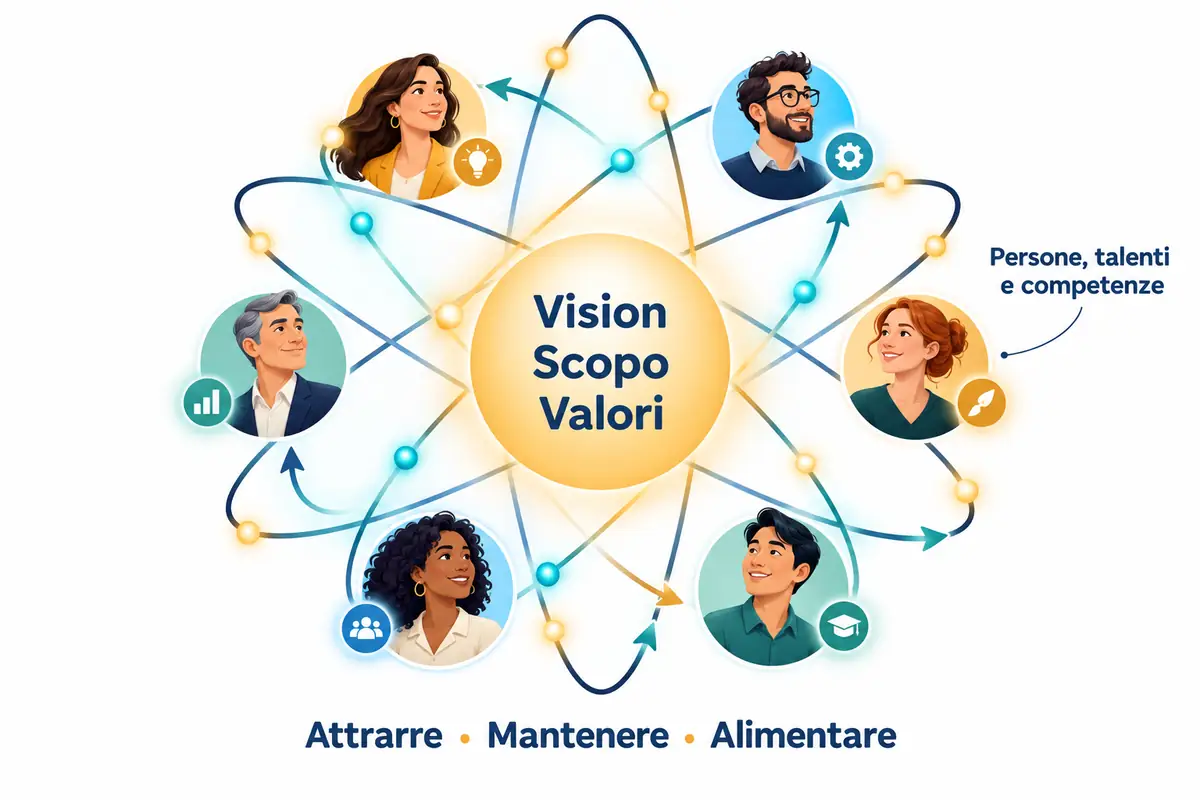
Talent moves around this nucleus. These are people with their skills, creativity, experience, curiosity and ability to imagine new solutions. They represent the organisation’s energy.
In the hierarchical model, people occupy a position within a structure. In the atomic model, people contribute their energy and abilities to the organisation’s overall strength.
It is a fundamental change. A company should no longer be conceived primarily as a structure that manages people, but as a system capable of attracting, connecting and amplifying talent.
Of course, this is an organisational metaphor, not a scientific description of the atom. Its value lies in highlighting a principle: a company’s strength depends on the relationship between a centre of shared meaning and the people who choose to contribute to its development.
Attracting talent: companies’ new strength
If talented people represent the electrons in our model, the first question a company must ask is simple: why should the best people choose to be part of our organisation?
In the past, the answer might have been tied mainly to the company’s stability, job security, pay or opportunities to move up the hierarchy.
Today, these elements remain important, but they are no longer enough. Talented people, especially in technology and knowledge-intensive sectors, are also looking for something different.
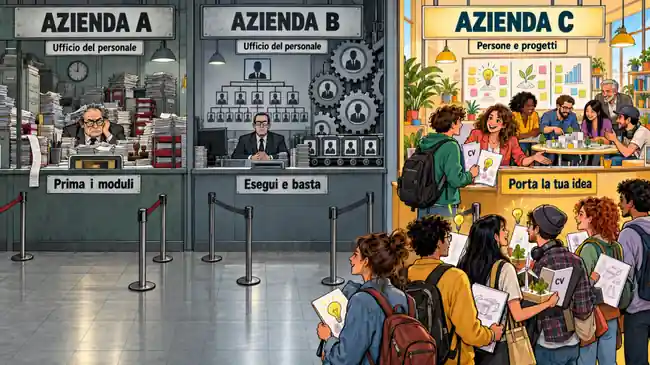
They want to work on ambitious projects, tackle complex problems, use advanced technologies, keep learning and feel that their contribution has a tangible impact. They want to grow not only financially, but above all professionally and personally. And they want to identify with a project that has meaning.
In the atomic model, then, the company’s nucleus must have authentic pulling power. This power cannot be built through slogans or statements of principle. It must emerge from consistency between what the company claims to be and what it actually does.
An ambitious vision, genuinely shared values, a culture based on trust and the chance to participate in meaningful projects become essential tools for attracting the best professionals. But attraction alone is not enough.
Keeping talent’s energy alive
The real difficulty lies not only in finding and hiring talented people. It lies in continually creating the conditions that make them want to stay, grow and give their best.
A talented person cannot be considered a static resource. Their expectations change. Their skills evolve. Their ambitions grow. A professional who finds a particular project stimulating today may no longer find the same motivation in it two years from now.
That is why companies must learn to keep renewing their ability to engage people. They must offer new challenges, encourage internal mobility, invest in learning, recognise merit and leave room for experimentation.
They must build environments where people can propose ideas, take responsibility and contribute to decisions without being constrained by rigid organisational barriers.
Pay remains important, but a talented person’s motivation cannot be reduced to money alone. There is an equally valuable form of recognition: the chance to work on something meaningful, develop new skills and see one’s ideas become reality.
Retaining talent does not mean preventing people from leaving. It means building new reasons every day for them to choose to stay.
The role of leadership in the atomic model
If the organisational model changes, the meaning of leadership must change too.
In the traditional pyramid, the manager’s role is mainly to direct, coordinate and control. In the atomic model, the leader takes on a different function: creating the conditions that allow talented people to realise their full potential.
They do not necessarily have to be the person with all the answers. They must be able to identify the right people, connect them, entrust them with responsibility and remove obstacles that prevent results.
Their authority comes less and less from their position on the organisation chart, and increasingly from their ability to create value through others.
This does not mean eliminating every form of structure or responsibility. An atomic organisation also needs clear objectives, decision-making processes, coordination and systems for measuring results. The difference is that the structure must serve talent, rather than talent serving the structure.
Leadership thus ceases to be primarily an exercise in control and becomes the ability to create conditions in which autonomy and responsibility can coexist.
In this model, CEOs and managers must learn to communicate consistently and effectively, and personally represent their work both inside and outside the company. Maximum transparency and authenticity are needed. Nor are resource ‘managers’ enough any more: the manager must be the first enthusiast for the world they manage, and enthusiasm is worth more than a thousand slides.
Artificial intelligence accelerates organisational change
The arrival of artificial intelligence is a powerful accelerator of this transformation.
Many activities that required complex organisational structures only a few years ago can now be automated, simplified or enhanced through digital tools. Small groups of highly skilled professionals can deliver projects that once would have required much larger organisations.
A company’s value therefore becomes less and less proportional to the number of people it employs, reducing the need for management layers. It becomes increasingly tied to the ability to combine skills, technologies and creativity.
In this scenario, artificial intelligence does not diminish the importance of human talent. On the contrary, it can greatly amplify its contribution. But only if the organisation allows people to use it to experiment, innovate and create new opportunities.
A company that introduces artificial intelligence while leaving all its bureaucratic mechanisms unchanged risks making processes more efficient when they actually need rethinking.
The real transformation is not just technological. It is organisational and cultural.
From individual energy to collective intelligence
The atomic model is not simply an organisation that brings exceptional people together. A group of talented people, however brilliant, does not automatically create a successful company. The real challenge is to turn individual energies into a collective force.
This is where the central nucleus plays an essential role. Shared values, vision and purpose enable people with different skills, personalities and ambitions to move towards common objectives. They become the reference point that makes collaboration possible without constantly depending on hierarchical authority.
Talented people must also be able to build direct relationships with one another, crossing traditional boundaries between functions, departments and organisational levels. Innovation often emerges precisely where different skills meet.
A technology expert working directly with a product professional, a researcher or someone close to the market can generate insights unlikely to emerge through a long chain of hierarchical communications.
The energy of individual talent creates value. Interaction between different talents can multiply it. That is why the atomic model must be open, dynamic and able to evolve. People must be able to change roles, join new projects and create connections in response to emerging opportunities.
Meta Superintelligence Labs: talent, resources and a flat structure
An interesting case for seeing these principles in practice is Meta Superintelligence Labs (MSL). In the interview with Cheeky Pint on 12 October 2026, Alexandr Wang and Mark Zuckerberg describe the relaunch of Meta’s AI programme and a specific organisational choice: concentrating talent and resources in a small group while maintaining a very flat structure.
The central concept is talent density: creating an environment in which highly capable people can work closely together and have the tools they need to develop their ideas.
- Few researchers, plenty of computing power. In the interview, Zuckerberg describes a research team of fewer than 200 people, with a core of close to 100 researchers supported by those working on infrastructure. The choice is to allocate substantial computing capacity to each researcher, avoiding spreading it across too many competing projects: what he calls peanut buttering, spreading resources too thinly.
- Leadership that stays technical. The flat culture Wang wants aims to avoid layers of non-technical managers. Zuckerberg clarifies that there are team leaders: the point is to keep those leading close to technology, code and the practical work of research. Growing in responsibility should not mean losing touch with what is being built.
- Ambition and self-criticism. Wang jokingly describes his colleagues as insecure overachievers: people capable of extraordinary results, but very demanding of themselves. He says their three-month forecasts are often pessimistic and subsequently exceeded by results. Zuckerberg distinguishes this severity towards one’s own project from confidence in MSL’s overall work.
In this experience, I recognise several elements of the atomic model: a shared vision, connected talent and leadership that creates the conditions to amplify people’s contributions. A small group gains value when accompanied by adequate resources, skills and autonomy. It is this combination that makes Meta’s case interesting.
The future of companies: attracting and amplifying energy
For too long, we have assessed an organisation’s strength by looking at its structure, headcount, the size of its divisions and its ability to exercise control.
I believe that in the near future we will have to learn to ask different questions. How strong is our ability to attract talent? How much can we help people grow? How much room do we give their ideas? How motivated are they to contribute to our project? How quickly can we turn their collective intelligence into innovation?
And, above all, how strong is the sense of belonging to what we are building together?
In my view, these will be some of the fundamental questions for assessing companies’ competitiveness. Because technologies can be purchased, processes replicated and business models imitated.
But building a community of extraordinary people, united by a shared purpose and motivated to generate something new, is much harder. And this very ability can become one of the most important and lasting competitive advantages.
The transition I imagine can be summed up in a simple distinction.
In the old model, power is at the centre of the system.
In the atomic model, meaning is at the centre of the system.
In the first, people’s energy is channelled through the structure. In the second, the structure is designed to release, connect and amplify that energy.
The challenge for companies of the future will therefore be more than finding the best talent. It will be becoming organisations where the best people want to work, grow and contribute to something greater.
The pyramid grows by adding layers. The atom grows by releasing energy. At the centre, what unites us. Around it, the people who help us evolve.