
Most Internet traffic today is generated by video consumption!
Apart from the technical nature of video (it is “heavier” in bits than text and images), the reasons for its growth are:
- the quantity and quality of content available online, in different formats and on different platforms
- people like videos! They prefer watching a video to reading text.
- the spread of broadband at home and on the move
We are in the age of images and self-expression, and video is the perfect tool for responding to these trends.
Moreover, the mobile revolution makes it possible to watch video everywhere and at any time.
In marketing terms, video offers enormous opportunities for companies (and others), and can evolve from a tactical tool into a strategic element.
Skilful use of video increases the effectiveness and efficiency of marketing activities.
In terms of effectiveness, several studies confirm that including a video on a landing page (focused on the customer's need, of course) significantly increases conversion rates (by up to 80%).
72% of people prefer watching a video to learn about a product or service rather than reading text.
After searching for a product, 55% of people look it up on YouTube to understand how it works before buying it (source: Google/Magid).
Below is some very interesting research on the content formats most appreciated by different generations, using the traditional demographic segments: Boomers, Gen X, Millennials, Gen Z and Gen Alpha.
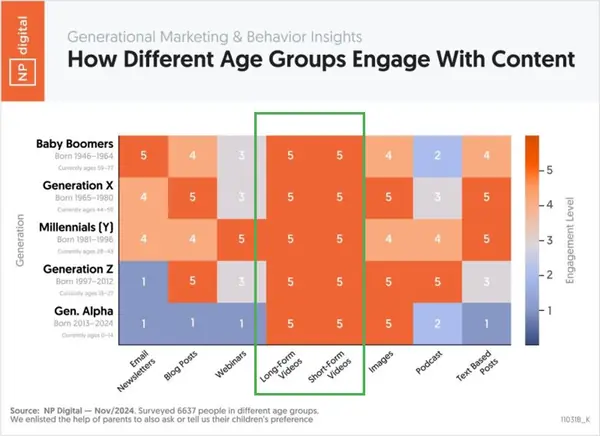
What clearly emerges is that:
Video is the cross-generational format everyone prefers, in both long-form and short-form versions.
Below is my video (have mercy 🙏🏼) explaining this tool's advantages at every stage of the customer journey.
Content marketing
In light of the reflections above, video plays a fundamental role in content creation strategy and can be used at every stage of the customer journey/buying cycle.
The strategic objective of content marketing is to build authority and trust to attract and influence potential and existing customers.
The most important tool for planning our activities is certainly the target, context and content matrix (which, in my book, I call the Marketing Path Matrix): depending on the stage (context) our audience is in (represented by customer personas), we create the right content while considering our objectives.
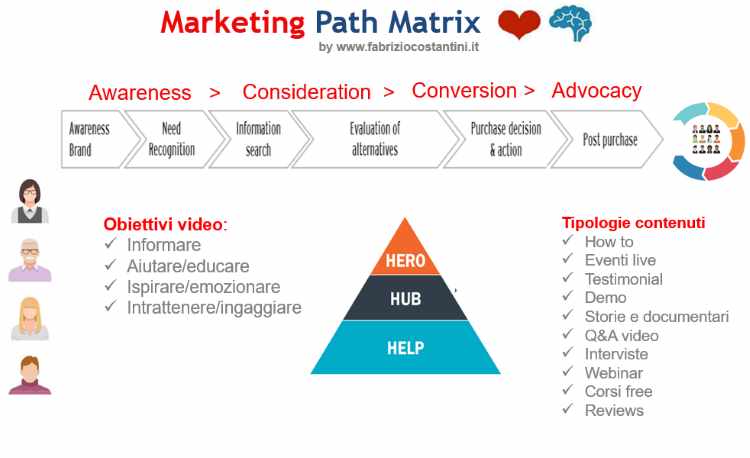 The customer journey matrix
With video we can:
- Inform
- Help/educate
- Inspire/evoke emotions
- Entertain/engage
Let your imagination run free when defining formats. Here are some examples:
- How-to
- Live events
- Live-streaming ecommerce
- Testimonials
- Demos
- Stories and documentaries
- Q&A videos
- Interviews
- Webinars
- Free courses
- Reviews
Entertain
One example of using entertainment to achieve a major awareness return on a small budget is Blendtec, with its bizarre videos in which absolutely everything gets blended!
Tom Dickson is the engineer and CEO who founded Blendtec after a bad experience with a blender he received as a wedding present.
It broke at the first challenge, and Tom decided to build a blender capable of destroying anything!
And he succeeded!
To test his products, Dickson constantly experimented at the company, blending all kinds of objects.
One day, Blendtec's marketing manager noticed him and had a brilliant idea.
He asked Tom for that month's advertising budget (50 dollars) and bought safety glasses, a lab coat and marbles at a nearby hardware store.
They began filming Dickson's experiments in the company lunchroom. The CEO started by blending marbles, then moved on to other objects, eventually including iPhones and iPads.
The success was enormous, and the videos immediately went viral.
In this case, Blendtec's videos not only entertain but also convey the product's quality and power.
Inform
Product and service descriptions serve the objective of informing. Below is a very interesting example from the famous American gym chain Gold's Gym. The video shows positioning more oriented towards lifestyle and wellness, with a focus on coaches and instructors.
The video brings many elements together: people happily training together (not exceptionally muscular bodies, as in Gold's Gym's former positioning), and the coach's passion, expertise and personal connection. Ruth Bruhn says:
“The benefits of coaching include having someone who motivates and encourages you, and belonging to a community. I do what I do because I love helping people. When I see the change in mindset, I realise that what I do is worthwhile.”
Evoke emotions and convey brand values through video
Create videos that tell the story of a brand's values, vision and history and communicate its identity. Here we work on meanings shared with our customers.
In the following video, Martin Guitar uses one of its expert craftspeople to show what making a guitar means to the company!
This category can include all inspirational videos that remain connected to the brand's identity and vision.
Gillette's video describing Treo, the first razor designed for assisted shaving, deserves a mention.
A radical shift in the product's symbolism, which had always been represented through pure masculinity (see “shave like a bomber”).
With this video, Procter & Gamble won a Cannes Gold award at the International Festival of Creativity (Cannes Lions) in 2017.
The commercial moved me deeply, and it is bound to move anyone at a stage in life when they see their parents becoming more vulnerable.
The video features the family of Mr Rex, a strong sailor (a Hemingway type, to give you an idea), who lost his independence after a stroke and, thanks to his children's love, can lead a dignified life (as everyone who has worked all their life deserves!).
In its simplicity, the commercial stirs countless emotions and reminds me of the value of humility and care: we will not always be strong and invincible.
From a marketing perspective, we cannot overlook the commercial's length of more than 3 minutes. In my view, this will be the trend for major brands in brand building. To move people, a video needs time to tell a story.
Another emotionally powerful video (also produced by P&G) is the following, launched for the Sochi Winter Olympics (the #becauseofmom campaign).
To become great champions, we try, make mistakes and get back up with greater determination, having learned from those mistakes. Here, the protagonist is the mother who supports her son or daughter and teaches the value of always getting back up.
Another authority in this genre is Nike. In the video below, we dive into the brand's values and the world of “no pain, no gain”, “never give up” and the effort behind small achievements, whatever the activity or level reached.
Help: tutorials, video blogs, guides and how-tos
The objective of helping through video (“Help” in YouTube's categories) is one of the broadest in the content landscape. It is important to identify the right topics and ensure they align with the company's field.
Video unleashes its full multimedia potential when used to explain how to do something.
For example, for a DIY retail chain, how-to content with practical demonstrations is a perfect content marketing tool.
In another example, Home Depot's video explains how to move house. It is very useful for viewers, while also showcasing the company's products for the task.
Events and webinars
Organise online events and webinars on topics that may interest our potential customers.
If the brand is well known, a keynote presenting the company's latest developments is a highly effective and engaging format. Apple, Facebook and Google are famous examples; in Italy, I recall Fastweb's keynote in its “Niente Come Prima” format (below is the video in which the company's CEO presents the news).
Interviews
We can interview experts in our sector: for example, if I sell technology products, I can interview experts and futurists in the field.
Video and sales
We have seen how video is used in the early stages of the customer journey, leading us to conversion and sales.
There are two major problems in online sales:
- the customer is typically alone in front of a screen, interacting only with our UI
- it is often impossible to experience the product or service first-hand
Video helps us considerably reduce these problems.
We can address the first problem by bringing the company closer to the customer through a video that gives the brand a face and a voice.
Less digitally confident people in particular need reassurance; humanising the interface helps, together with the content conveyed through video.
I recommend always using a real person from the company to explain the product or service and its features and provide useful information to clear up any doubts. Here, analyses of customers' most frequent questions and concerns can be useful.
The video within Fastweb's ecommerce channel:
The person's authenticity is the critical success factor and makes it possible to create an emotional connection.
Eye contact and a knowledgeable but informal tone of voice are very important (familiarity, empathy, “I am one of you”).
The ideal video combines information, emotion and reassurance.
The call to action (CTA) can be in the video itself or left to the landing page containing it.
Naturally, the video's approach also depends on brand awareness and how much creativity we want to include.
Speaking of creativity, a well-known case is DollarShaveClub.com's video (“Our Blades Are F***ing Great”, featuring CEO Michael Dubin). It includes the CEO telling the company's story (putting his face to it), its vision, the company itself (humanised by showing the people who work there) and the final product, all through entertaining, original storytelling.
The video was so effective that multinational Unilever eventually bought the whole lot 😁
Video's other major advantage is the ability to show a product or service in action.
Think of software: video can immediately show what it can do without requiring any installation.
I like to call it the “sneak peek effect”: I show you what awaits you.
For some products, showing them in action can be essential to immediately understanding their features.
Below is a video of the DJI Mavic drone: the images are worth a thousand words!
Another highly effective technique is video testimonials: existing customers describe their needs and how the product or service met them. After all, major consumer goods brands such as Procter & Gamble and Unilever have always made extensive use of this technique in TV commercials too.
The following video is an example of a testimonial for Hootsuite (the SaaS software for managing social media). Here we have both the social proof effect and the brand trust effect, because the testimonial comes from a well-known American publishing brand.
The sales video
We can take video to its full extent as a stand-alone sales channel, providing all the information, evoking emotion, reassuring people and prompting them to buy on our website.
The video then follows its own path across the web, like a digital salesperson who can reach anyone (as in the case of DollarShaveClub.com).
For a sales pitch, I consider the P.A.S.T.O.R. model the most effective. Here is what it involves:
- Problem: present the problem the product aims to solve; sell the fire, not the extinguisher :-)
- Amplify: amplify the problem and increase the perceived costs of leaving it unresolved, ideally using third-party data. For example, if I sell an alarm system, I can show rising burglary rates and the risks people could face.
- Story: tell the story of your own experience or of someone who solved the problem using the solution you propose, so people can identify with it
- Transformation and testimony: show what the product or service can do for people and how it will change their lives. A testimonial illustrates the transformation and creates empathy.
- Offer: present the final offer
- Response: encourage action with a call to action, using a behavioural psychology principle such as urgency (the offer expires in 2 days).
Salespeople and video
A brand's value is also a function of the combined personal brands of its people.
Trust in a company also depends on the trust its salespeople can build with customers.
Video can become an extremely powerful sales tool when used by the sales team, particularly in business-to-business markets.
Naturally, the strategy must be managed and monitored in a controlled way to avoid confusion.
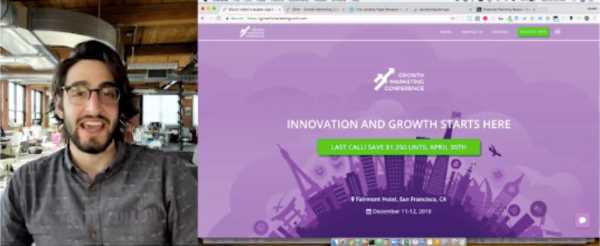
A video can show the product's features and how it solves customer problems. A picture-in-picture recording (as shown in the image below) lets us get the most from our pitch.
Video messages
With today's social and messaging platforms, people are becoming used to sending more audio and video messages, and in a few years video communication will probably finally become mainstream too
So why should companies not use this channel as well?
Imagine opening a customer care enquiry (by phone, email, etc.) and, instead of a text response, receiving a video explaining and demonstrating the solution! For example, a video showing how to connect my modem's cables.

We could also include a video message in a marketing funnel's message sequence (personalised as much as possible according to the customer's previous path).
Video's efficiency and how to make it
If you watched my opening video, you will understand what I mean by efficiency. This tool lets us create content at any time, in the most spontaneous and authentic way.
Today, producing a video does not require expensive equipment. All you need is:
- a latest-generation smartphone (video quality is very high, and they all have image stabilisation; in my video, the kayak was moving, but the image remained fairly steady)
- a selfie stick and a tripod (even a small one)
- a microphone of the lavalier type (this is the one I used, bought on Amazon)
You do not even need a computer for editing: you can keep using your smartphone with a video editing app such as InShot; the following video shows how it works:
Distribution platforms are no problem either; we are spoilt for choice: YouTube, Vimeo, Facebook, IGTV, and so on.
Video's power also operates at the individual level, allowing anyone to express themselves and produce content that educates, entertains, inspires or informs.