
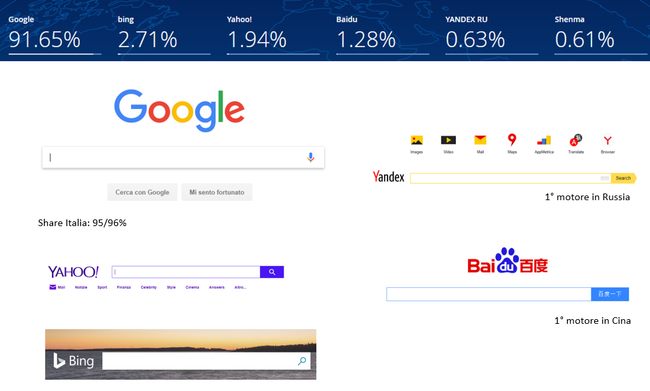
The Google search engine rapidly gained market share from the moment it entered the market, eventually dominating it completely. In Italy its penetration is 96%, and worldwide it is slightly lower only because of countries such as Russia and China where the leading search engines are, respectively: Yandex and Baidu.
After its first few years, Google quickly found a way to capitalise on that dominance through its advertising system, which auctions keywords.
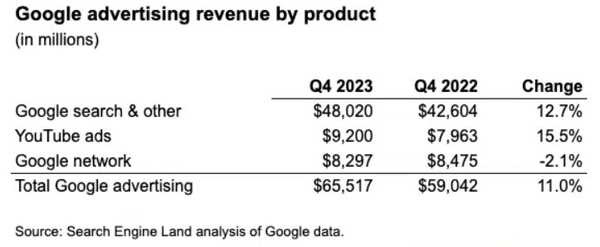
As the table below shows, in the last quarter of 2023 alone, search generated over 48 billion dollars in revenue. It is interesting to note that Google recorded double-digit growth compared with the previous year.
Threats 🌧️ to Google
Despite its excellent financial results, the world's best search engine sees several clouds on the horizon.
There are two major threats:
- The web being flooded with “synthetic content”
- The spread of generative language models such as ChatGPT used as search engines
The two phenomena are closely interconnected and will reduce search engine use and therefore revenue (various forecasts predict a reduction of 25 to 50% over the next 4 years).
Frequent Google users will recently have noticed lower-quality results.
The barriers to creating content have fallen considerably: anyone with ChatGPT and its APIs (or similar products and tools) can create large volumes of content in a short time. Many websites have sprung up out of nowhere, immediately packed with material.
This has reduced the quality of the search engine's output.
At the same time, for many searches ChatGPT can provide answers that are more immediate and relevant eliminating all the cognitive noise found on Google.
Is the company based in Mountain View just standing by and watching?
Certainly not.
Moreover, Sergey Brin (one of the two founders) has returned to the company to lead the fightback.
Google's countermeasures and actions
In early March 2024, Google launched a new core update to its search ranking algorithm, also updating its spam policies to target low-quality content created in large volumes: “Scaled Content Abuse”.
The aim is clear: to target synthetic AI-generated content that adds no value.
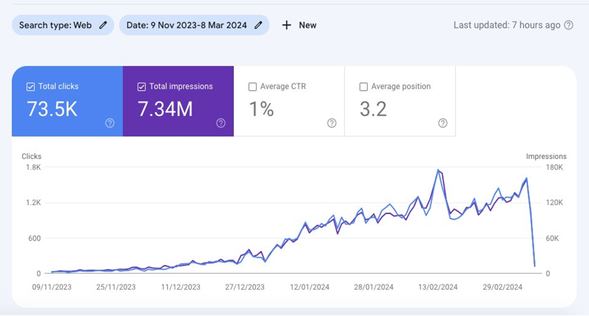
The update began on 5 March and the full rollout took about a month, but major changes could already be seen within the first 2 weeks.
Fortunately, the update began clearing out all the weeds of synthetic AI-generated content.
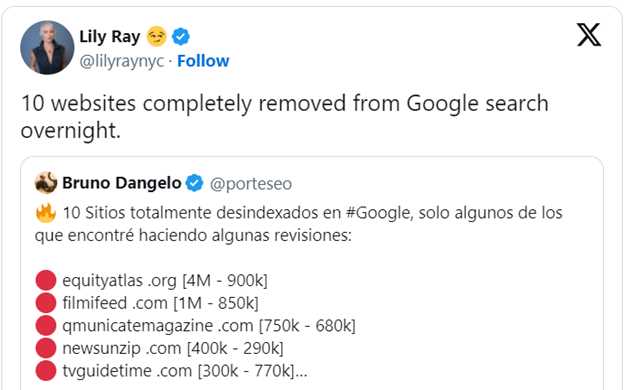
Websites, including large ones, disappeared overnight from search results.
Google stated that they reduced low-quality content by 40% :
“We believe these updates will reduce the amount of low-quality content on Search and send more traffic to helpful and high-quality sites. Based on our evaluations, we expect that the combination of this update and our previous efforts will collectively reduce low-quality, unoriginal content in search results by 40%.”
For people working in marketing and content strategy this is certainly good news, as it obviously is for search engine users, who will get better results.
Will ChatGPT replace the search engine?
As for the second threat, search being replaced by ChatGPT & co, Google threw itself into launching Bard, later renamed Gemini and integrating the chat experience into search.
In this frantic race they have stumbled several times, and they are still hesitant about the concept of the Search Generative Experience (search engine + chat), too (the video below shows the presentation at Google I/O).
We can see this concept in action using Bing or the fast-growing Perplexity.
OpenAI appears to be working on launching its own search engine.
The move would not surprise anyone closely following Sam Altman's statements: in his interview with Lex Fridman, OpenAI's CEO expressed great interest in integrating LLMs and search.
OpenAI's SSL certificate logs now show that they have created search.chatgpt.com.
Google's new AI-powered search engine
In May 2024, at Google I/O, the new search engine with integrated Gemini AI was presented, along with many changes to the search experience.
AI Overviews
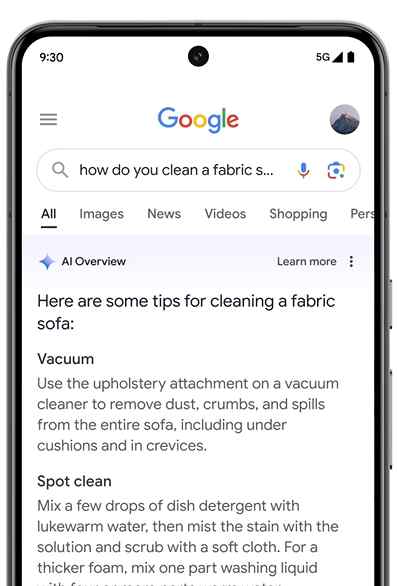
The main change is AI Overviews which allows the search engine to provide an immediate answer to our search.
We do not need to follow any links: Google answers us at the top of the page, providing all the details.
As the following image shows, the query “How do you clean a fabric sofa” returns all the relevant instructions.
Anyone familiar with Google's SERP (results page) knows that the search engine has long provided direct answers through what are called “instant answers” or “featured snippets”, depending on the case.
Try asking “how high is Mont Blanc” or “what is incidental marketing”: in both cases you will get an immediate answer. In the first case it draws from its Knowledge Graph; in the second it extracts a piece of text from the website that answers the query (a featured snippet).
With AI Overview, it is as though Gemini answers at the top of the page, with the search engine's links below.
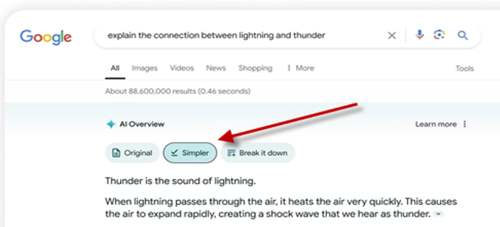
Among the new features available is the ability to choose how the answer is presented and the language it uses. As the following image shows, we can choose an answer that is “simplified” or broken down into several steps.
Complex questions and multi-step reasoning
With this feature, instead of running several searches we can ask the engine a complex question and, thanks to Gemini, it can answer while taking all the requested elements into account.
For example, if you are looking for a yoga or Pilates studio and want one with good ratings, in a convenient location for your journeys, which also offers a discount for new members, you simply need to run this search:
“find the best yoga or Pilates studios in Boston and show me details of their offers and the travel time from Beacon Hill”.
In effect, it is as though we have an assistant that processes the request and analyses its various components, running several searches and then combining them to give us a solution.
One variation on complex searches involves those that require planning. For example, searching for “create a 3-day meal plan with easy-to-prepare dishes” prompts the engine to create the plan by running several searches for us.
We can also use AI for brainstorming: if we need new ideas and inspiration, we can run a search and ask the engine to provide solutions.
Video to search and circle to search
One very useful Google feature is searching with an image: I point my smartphone at something and ask the engine a related question (or simply what it is).
The new feature is now video to search: the same concept, but instead of giving the engine an image, I give it a video.
As the following example shows, this is very useful when we need help and have to explain a problem.
Google is also extending the ability to use “circle to search” on phones to most Android distributions.
This is a very useful feature because it lets us interact with the search engine from any screen on the phone: simply circle the content we see on screen to launch the corresponding search.

PLEASE NOTE: the new features shown at Google I/O are currently available only in the United States.
Impacts on the digital ecosystem
The increase in searches made on ChatGPT and Google's new experience are bound to affect the digital ecosystem.
In practice, the current engine merges with AI and chat-style answers (what Google has long called the Generative Search Experience).
Users will soon get used to the changes, partly because, as we have said, the engine has long provided direct answers. The important thing to assess is whether the system can meet users' needs across the four traditional search categories: navigational, informational, commercial and transactional.
The major impact, however, is on the digital ecosystem of content creators, from large publishers to small blogs and startups.
If the engine (and the various AI chatbots) answers directly, the opportunities to capture organic traffic will shrink considerably.
Although Google writes these exact words on its website:
“With AI Overviews, people visit a greater variety of websites for help with more complex questions. And we see that links included in AI Overviews get more clicks than if the page had appeared as a traditional web listing for that query. As we expand this experience, we will continue to focus on sending valuable traffic to publishers and creators.”
This remains to be verified in practice: perhaps only websites in the top 3 positions get more clicks (although I still have my doubts).
For simple informational searches there will certainly be no contest: the engine will provide the answer, and I simply do not believe that people will click the links further down.
Google knows very well that it would be a serious problem if the balance and relationship of trust with content creators were broken.
From creators' point of view, this is a very unusual moment: while the advance of AI helps content production on one hand, on the other it is the main competitor in meeting users' needs.
We reach the paradox of AI chatbots and modern search engines learning from our content and then building a direct relationship with the user. The new intelligent voice agents from OpenAI and Google seem to be heading in this direction.
Many questions arise: are the answers we get from these agents 100% reliable? Could ignoring the source of complex answers be a problem? Does having a single answer and voice risk polarisation and just one point of view? Do we become easier to manipulate?
Major publishers have begun their battles and are starting to sign deals with the AI giants: at least they are trying to get paid for training the models (a temporary solution?).
And what about small content creators?
IMHO this is an important issue to address, less for economic reasons than to preserve a plurality of opinions (a fundamental principle of the Internet).
Without the discovery stage guaranteed by search engines, reaching users is much harder.
As a small creator of free content, I have reflected on future scenarios, particularly reduced visibility.
I have sketched out in this article what a content strategy might look like to avoid disappearing from the web.
Google has always been an ally of those producing quality content: it effectively discovered value. But will it still do so in the future?
To be more effective and relevant, AI acts as a meta-search engine to return the best of what is available online. From this perspective, Google's prospects look very good on paper.
In this scenario, how will the business model change?
Will inserting keyword-based ads into chats be a viable route?
Or are we entering the era of the AI meta-search engine for a fee? Or mixed versions.
As always, for marketing professionals it is essential to understand in advance how things may evolve so they can be ready.