
There are several interesting tools online for marketing, SEO and content-marketing analysis that let us retrieve absolute volumes of Google searches and much other useful information.
Ubersuggest
The first tool is Ubersuggest (https://neilpatel.com/it/ubersuggest/) As its homepage explains, we can use it to:
- estimate the volume of traffic generated by keywords
- analyse trends by observing changes in the number of searches over time
- understand how difficult it is to rank at the top of search engines
Let’s try the tool straight away by entering any keyword we want to analyse, for example: mountain bike.
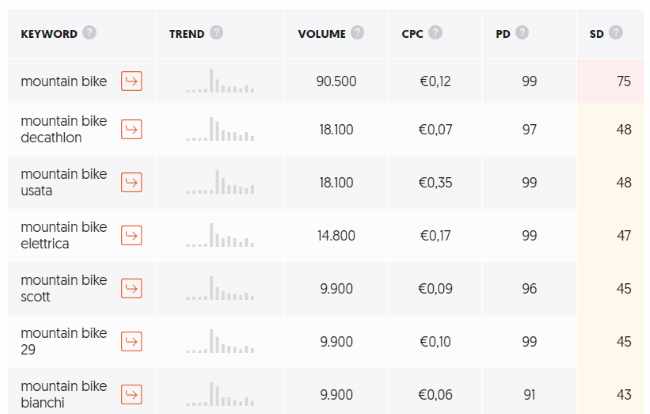
We immediately see the keyword’s monthly search volume, its cost if we wanted to buy it, the competition on Google Ads (CPC and PD), and the difficulty in organic search/SEO (SD).
The important information is the breakdown into other keywords/phrases containing ‘mountain bike’. As the image shows, demand for used or electric bikes is very strong.
Another very interesting report, found at the bottom of the page, concerns content ideas.
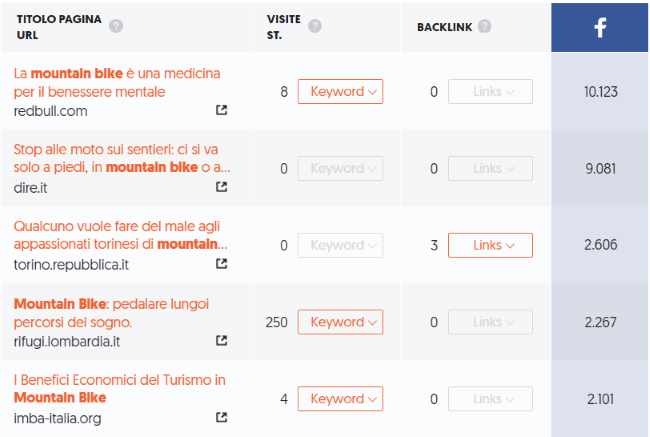
The image shows us which content and corresponding page titles are most shared on social media.
In the example, we see that Red Bull’s article ‘Mountain biking is medicine for mental well-being’ was reshared by more than 10,000 people.
Another way to analyse is to start from an existing website. For example, we can enter redbull.com and see which keywords its content ranks highly for.
Ubersuggest provides the same information as Google Ads’ Keyword Planner (using the latter requires a Google Ads account and ongoing advertising investment).
Ubersuggest used to be completely free, and its creator (the great Neil Patel) used it to attract traffic and leads. Over time, its success significantly increased the service’s operating costs, to the point where it had to switch to a freemium model.
In practice, if we register on the website we can use the tool free for three queries a day. After that, we need to wait until the following day or switch to the paid version.
Semrush
A similar tool is SemRush (www.semrush.com).

It works in a similar way to Ubersuggest: we enter the keyword whose volumes we want to find in the search field.
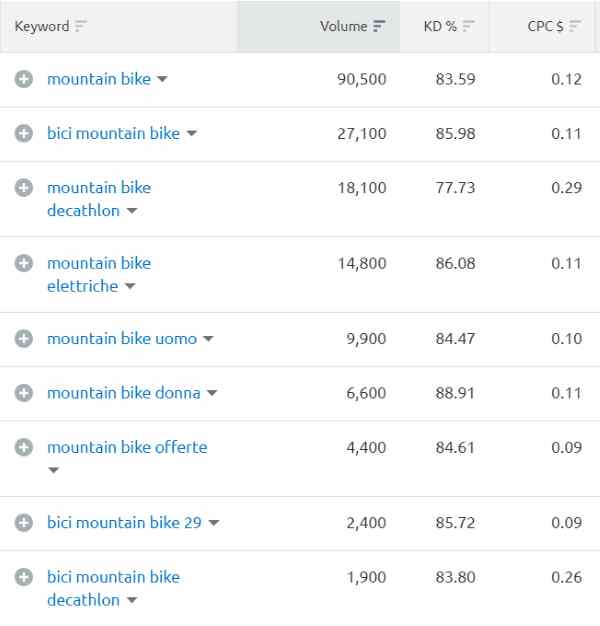
Below are the results for the term mountain bike, along with all the keyword variants and their volumes, SEO difficulty (KD) and estimated cost per click on Google Ads (CPC).
Semrush also has a freemium model, but unlike Ubersuggest, it allows up to ten free queries a day.
Both Ubersuggest and Semrush provide keyword volumes for exact-match searches. What does that mean?
In practice, the total volume includes all searches containing only the keyword(s), while also counting close variants or terms with the same meaning, regardless of spelling or grammatical differences between the query and the keyword.
For example, if we want to know the volume for [scarpe tennis] (tennis shoes), the count will include (in addition to ‘scarpe tennis’) variations such as ‘scarpe per il tennis’, ‘calzature da tennis’, ‘scarpe tennis’, ‘tennis e scarpe’, etc.
By combining the free versions of Semrush and Ubersuggest (perhaps with multiple accounts 😉) together with Google Trends we can already carry out a good initial analysis.
If you work for a company involved in marketing, content marketing or SEO, a paid subscription is worthwhile.
Ubersuggest is cheaper but has fewer features than Semrush, which positions itself as a complete analysis suite.
If we have a temporary need and want all the analysis features, we can also use the time-limited free trial.