For many years, the price of a product or service was determined by bargaining between the parties.
With the rise of industrialisation and mass retail in the last century came the concept of a fixed price for products and services.
Price is one of the 4 elements of the marketing mix (the 4Ps: product, place and promotion); of the four, it is the only one that generates revenue for the company.
Depending on the market, products and economic conditions, price can be an important deciding factor. For example, for commodity products (with no differentiating features, such as electricity), it can shift sales from one company to another.
The choice of price has a direct impact not only on margins and revenues but also on the company's positioning.
When evaluating prices, people have their own ‘reference’ system combined with a series of cognitive biases.
Customers assess a product or service's price by comparing it with similar ones they remember or find on the market.
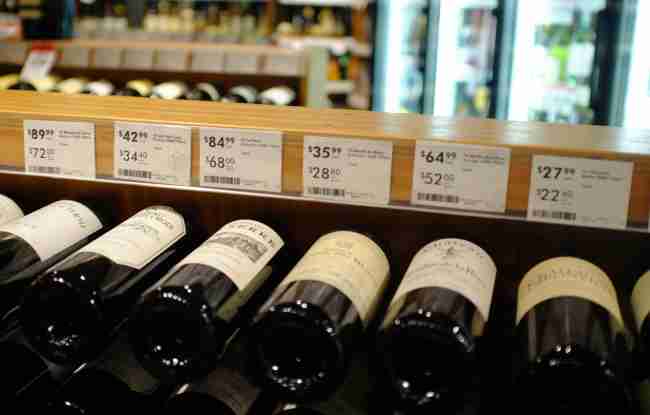
Three important biases come into play:
- people tend to attribute greater value and quality to products that cost more (for example, if we are not wine experts and have guests, we let price guide our purchase).
- prices are scanned from left to right, and the first digits serve as a reference for our brain. Rounding is a rational process that comes into play later. To take advantage of this bias, businesses use so-called psychological prices: €29, €49, €189, and so on.
- anchoring: when evaluating a price, especially if we lack information, we use any number (which acts as an anchor) that can help us (for example, if a product is sold at €99, discounted to €49 with the first price crossed out, €99 will be our anchor)
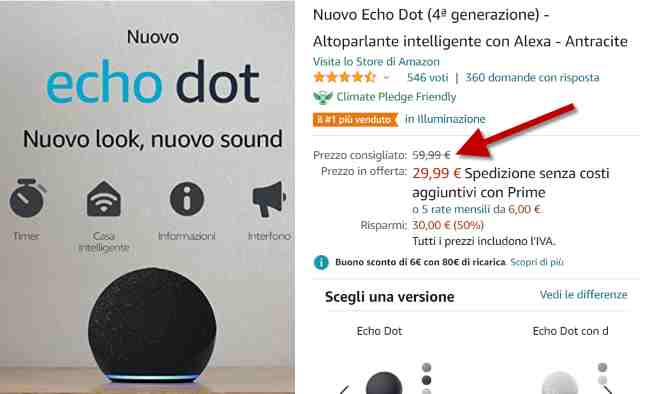 Amazon makes extensive use of psychological pricing and anchoring
Price is an important signal of market positioning.
For this reason, great care is needed when setting the initial price: we can always lower a high price, but the reverse is much harder.
The pricing dilemma affects many brands, and if we want premium positioning, we must resist the temptation to lower the price.
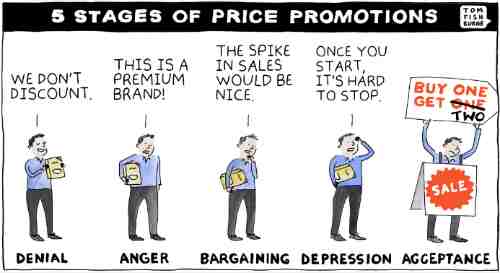
Tactically, however, you can create a promotional plan to exploit any price elasticity in the market. It is essential to emphasise the original, undiscounted price even more, strengthening the anchoring effect, and adopt a sensible, unpredictable promotional plan (we cannot constantly be on promotion).
If the premium positioning strategy is followed correctly, there can be substantial increases in sales during the promotional period.
Furthermore, when we want to be more aggressive on price, it is better to use discounts and promotions to preserve our positioning in the customer's mind and use the undiscounted price as an anchor.
Researchers Wansink, Kent and Hoch conducted a very interesting experiment whose findings are now applied by many consumer-goods retailers.
The test involved advertising Campbell's soup at a small 12% discount (79 cents per can instead of 89 cents) in several supermarkets in the same city.
Three variations were then introduced in rotation:
- Promotion with no purchase limit
- Promotion with a limit of 4 cans per purchase
- Promotion with a limit of 12 cans per purchase
The test results, as the chart shows, are very interesting.
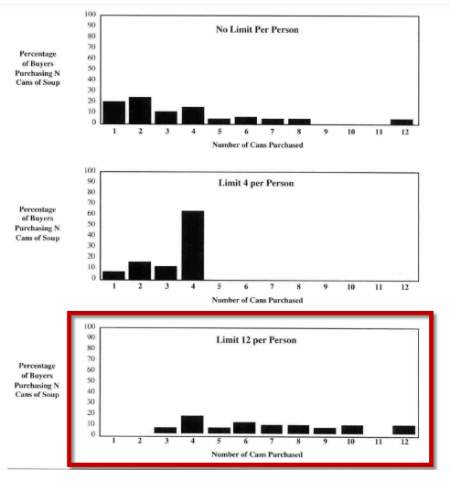
Introducing the purchase-limit anchor substantially increased sales.
On average, people who saw the promotion without a limit bought 3.3 cans.
In the other two cases, average purchases were 3.5 (limit of 4) and 7 (limit of 12), respectively.
In the last case, the increase in sales was almost 4 times greater.
The effect is clear: the limit increases perceived value through the scarcity effect, but the interesting part of the test is that the limit acts as an anchor and people move towards it.
For larger discounts, the limit also serves to prolong the promotion's loss-leader effect and avoid running out of stock immediately.
The start of the digital revolution, however, introduced a concept never seen before: a price of zero.
In the early 2000s, the free model underpinned many digital companies: the logic was to acquire large numbers of users and then monetise them through advertising.
Unfortunately, this model soon proved unprofitable, and we witnessed the collapse of the new-economy business.
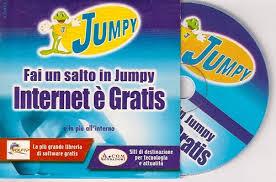 The Internet access service offered free in 2000 by Jumpy, Fininvest's digital company
The subsequent digital economy completely revised this proposition, using two new models:
- Freemium
- Free trial
Freemium combines the free model with the paid premium model.
In practice, I offer you a free basic service; if you want extra features or greater quantities, you pay for the premium version.
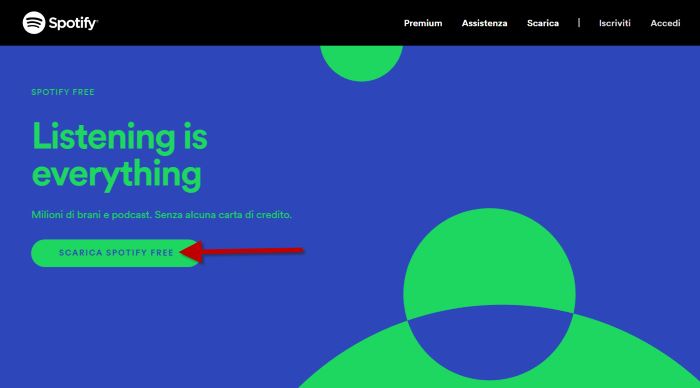 Spotify and the freemium model
For example, Spotify offers music for free; if you move to premium, ads are removed and you can listen in any order you like and offline.
Examples of freemium services that rely on quantity include cloud storage: Google Drive, for example, provides 15GB of free space, and by paying you can upgrade to xTB.
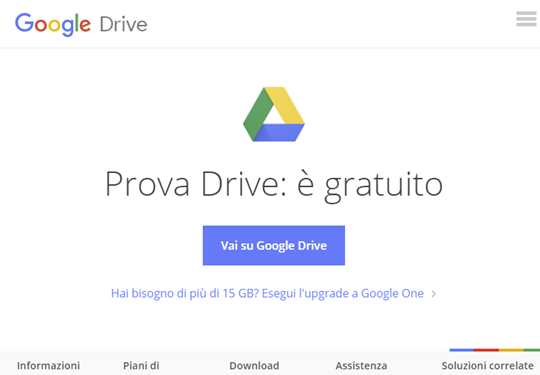 Google Drive freemium
Freemium is highly effective because it follows customers' needs and behaviour.
If customers get used to the free service and appreciate its features, their perceived value of the premium version increases, and with it their willingness to upgrade. Furthermore, learning and configuring the service can create switching costs when moving to other solutions.
For example, if I constantly use Google Drive and have configured all the synchronisation across my devices via apps and PC, when I reach the free limit I will be very inclined to move to the paid version (first because I have had the chance to appreciate the service, and also because I would otherwise have to start the setup and synchronisation all over again).
The other model is the free trial , also called Try&Buy: I offer you the chance to try my service for XX days, then you can decide whether to continue.
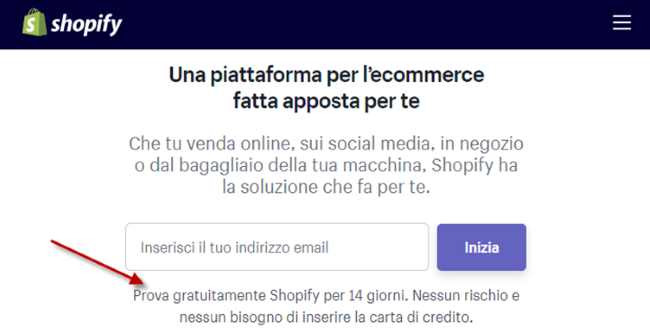 Shopify free trial
Today we can say that all Software as a Service (SAAS) providers use this approach.
Amazon also makes extensive use of trials for all its subscription services: Amazon Prime, Amazon Kindle Unlimited and Amazon Audible.
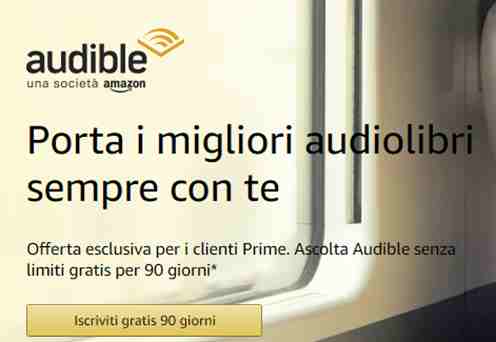 90-day free trial for Amazon Audible
The trial or try&buy model is obviously perfect for services that need to be tried. It also allows the brand to earn the customer's trust regardless of the outcome after the trial (as well as gaining a very warm lead).