A company’s market positioning is a key factor in its business strategy.
As we saw in the guide to marketing , after the analysis we need to identify the market segments we want to position ourselves in, and with what promise/proposition.
For example, IKEA has a clear positioning, supported by the promise of offering design at affordable prices. Apple offers the “coolest” products, with unique design, innovative and easy to use. LinkedIn offers, within social media, the best platform for companies and professionals to express themselves and connect.
Looking more closely, the heart of a company’s offering is its Value Proposition.
The Value Proposition is the value we offer the market: why buyers should buy our products or services (and what makes them unique compared with competitors), and the functional and emotional benefits they can gain from them.
When thinking about a new product or service, we need to consider the value we will give customers by solving their problems or meeting their needs and desires.
The counterpart to the value proposition is Customer Value , which represents the value the customer expects to gain from buying the product or service.
Perceived value depends on the relationship between costs and expected benefits.
Costs include money, the time and energy needed to make the purchase, and the psychological cost. Benefits, meanwhile, come from the product’s functional value and its emotional value.
Between the ages of 12 and 14, I was rather chubby. I did not like my appearance and wanted to do something about it.
One day we finished school early. While waiting to go home, I went to Standa (for those who remember it, a historic department-store chain founded in 1931 that finally disappeared in 2010).
Walking through the sparse sports department, I saw a piece of exercise equipment.
I picked it up, and I remember hearing the iron granules inside as I moved it (it is the one in the following photo, still alive in my garage 🤪).

My 5kg weight, still alive and well after all these years
It was plastic, entirely blue, and weighed 5kg (the product’s features).
I dipped into my savings and bought it!
At that moment, I did not simply buy a 5kg weight to exercise with (functional value 🧠). I bought a projection of my future self as a fit, muscular boy (emotional value ❤️).
Compared with that goal, the object’s price seemed tiny (even for a young student without a penny).
That was exactly why I was so excited and could not wait to take it home and start using it.
If you want to communicate and sell something, do not start with the product’s technical features. Describe and explain the functional and emotional benefits customers can gain from it.
Emotional value is closely connected with the purpose a product or service can serve in the customer’s life.
Know the customer, and you will understand how the product can help them achieve their purpose.
As you can imagine, it is essential for the value proposition to connect with customer value. Otherwise, we have a problem (or sometimes an opportunity, such as when customers identify valuable uses the company had not imagined).
How can we be sure that the value the company produces is also perceived by the customer?
This is where communication comes in: its job is to ensure that the value proposition is perceived correctly.
When building a communication plan or any advertising campaign, we need to start with the company’s objectives, positioning and brand identity, and have a clear practical understanding of the following 4 elements:
- the product’s technical characteristics (features)
- the advantages/benefits the product offers (value proposition)
- the Promise
- the Reason Why
Product features
Every product has its own characteristics, and we need to know all of them well. These are the technical features that distinguish a product or service.
For a mobile subscription, they include the gigabytes in the plan, connection speed, unlimited calls, etc.
Here, a 5G connection rather than 4G is a technical detail that can make a difference in the market.
For a fixed connection, low latency is an important feature of the connectivity service.
A car may have ABS, cruise assistance with autopilot, radar, side airbags, automatic parking, cameras, Wi-Fi connectivity, etc.
Communicating features is not recommended because they are technical elements, unless they are well established and understood by the market we want to address (particularly in B2B).
Advantages and benefits (Value Proposition)
We have seen that the Value Proposition lies at the heart of everything and expresses the company’s positioning in concrete terms.
Features tell us what our product can do. Benefits, on the other hand, explain what the customer can do with the product (the value they could gain).
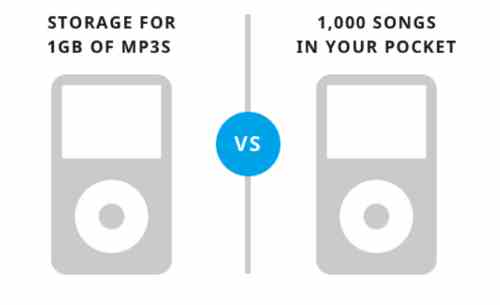
The difference between a feature (left) and a benefit (right)
Returning to the car example, side airbags, autopilot, ABS and radar underpin the creation of the benefit/value of safety.
For 5G, the advantage is greater connection speed, stability and responsiveness. An Internet subscription with low latency, meanwhile, is very valuable to online gamers who do not want packet delays.
Besides the functional benefit (my car is safer), we must not forget the emotional one.
A well-equipped, high-end car expresses a clear status, and customers place value on belonging to a social group and expressing a particular identity.
Still using the car example (with all its safety systems), it is easy to see how emotional value increases for a couple who have just had a baby and want to travel with complete peace of mind.
The Promise
The first two elements (features and value proposition) help us understand exactly what we have to offer. With the Promise and Reason Why, we translate all this into a message for our audiences.
Through the Promise, we communicate the value proposition and all its functional and emotional benefits to the market.
The aim is to make the value of our offering perceptible.
What characterises the Promise is that everything is expressed through the language of communication, adding creativity (in copy and visuals) and emotional force.
An example explains more than a thousand words.
Let’s return to our car, say a BMW, with the following features:
- ABS
- Cruise assistance with autopilot for autonomous driving and lane keeping
- Navigation and radar
- Automatic emergency braking
- 360-degree airbags (the egg effect)
- Automatic parking system
- Breathalyser ignition
- Cameras and sensors
- Driver fatigue detection
- Wi-Fi connectivity, etc.
The promise could be:
“BMW has created the safest car in the world, because your safety and your family’s safety matter most!”
Visually, we could have a TV commercial, banner or newspaper advertisement showing a family travelling 👪 with young children.
The aim is to capture the target audience’s attention and focus on benefits that meet a need the customer feels.
I promise that with our car, your family’s safety is in good hands.
Remember: there can be more than one promise!
Several benefits can be drawn from the value proposition, each supporting a dedicated promise. If we communicate with different audiences, we should have different promises.
For example, we could create another promise for our BMW:
“With the BMW XXX, driving and parking have never been so easy.”
Here, the audience is people who do not feel like experts behind the wheel and get nervous when parking in the city 🤪
Visually, we could use the “NO stress” concept, contrasting a typical day for someone going mad in the city’s chaos with that of someone who owns our car, which helps with everything.
For low-latency connectivity, meanwhile, the promise could be:
Lag will be a distant memory! With XXX, nothing will stand in the way of your skills.
The language of the promise must fit the target audience. When speaking to gamers, we can use their jargon.
The value promise is very effective in product communication, but is also used in corporate and brand communication.
Here, we communicate a brand’s vision, purpose and values.
So we have seen that there is a promise at the strategic level, defining our positioning, and a promise at the communication level, expressing the value of our product and/or brand.
Clearly, the two concepts are connected, and communication must make the value proposition and brand positioning perceptible.
Reason Why
Communicating the promised value is not enough: we also need to support it with the Reason Why.
The Reason Why is a clear, concise statement explaining why our product can deliver on its promises.
Returning to the car example, our reason why connects features with benefits/value: “Thanks to BMW’s unique XYZ system, the car always stays in its lane and brakes automatically in case of danger, etc.”
As you can see, we give food to the more rational part of our brain (Kahneman’s System 2), which communicates with the more emotional part to arrive at a perception of our value proposition.
Awards from authoritative sources work very well here: they simplify the customer’s evaluation process and lend themselves to visual representation.
For example, our BMW has won the award for safest car of the year from independent safety body XXXX, and we represent it with a certification badge (No. 1, Best Car of the Year, etc.).
The same applies to latency: an external source certifying it is a perfect reason why. For example, Ookla (the company providing the speed test and holding the largest database on network quality) could declare our service the fastest on the market according to its statistics.

In the reason why, it is very useful to identify the feature that makes the product/service unique and supports a value promise different from the competition’s.
In food, this might be a particular ingredient or production process the company uses (or does not use).
For example, pasta producer De Cecco has a distinctive production process that guarantees high-quality gluten: the wheat is milled and immediately kneaded very slowly, and the pasta is dried just as slowly using a system invented by the company.