Choosing a name for your company, large or small, is a very delicate and sometimes complicated stage. The naming question also arises when launching a new brand, website or service.
Getting the name wrong can have a significant impact on brand awareness, in terms of both recognition and recall. You also need to feel that it is yours and believe in it, because it represents your image, the meanings you want to communicate and, more broadly, what is called Brand Identity.
In marketing, we constantly use the word brand , which in Italian literally means marca.When I need to find a name for an idea, service or product, I find it very useful to study how brand names are constructed, starting with the different types. It also helps to understand the origins of now-iconic brands such as Google, Amazon, Nike, IBM, etc.
The main categories of brand name, according to how they are constructed, are:
- The owner’s/founder’s name
- Descriptive
- Evocative
- Invented
- Neologisms
- Acronyms
- Geographical
Let’s look at them all through practical examples.
Owners’ names: Ferrari, Versace, McDonald’s
This is the classic naming approach. The list of successful brands named after their founders is very long, and even when the founder is no longer the owner, the brand continues its journey.
This technique is widely used in the brick-and-mortar world but very little in digital (it could be an idea 💡 to transfer it to this world too, perhaps using a person’s name 🤔).
Descriptive: Hotels.com, Salesforce, Poltrone e Sofà
Descriptive names tell us what product or service is involved simply through the word itself.
While the name “Ferrari” could be associated with anything (and is indeed a brand in several sectors), Poltrone e Sofà leaves no room for ambiguity (and forgive the rhyme in Italian 😉).
In digital, particularly websites, this type of name became widespread partly to benefit from search engines: a name describing the customer’s need, with a matching domain, increased the likelihood of appearing among Google’s top results. This advantage did not last long, as the EMD (Exact Match Domain) update reduced the weight of the domain name.
Evocative/suggestive: Nike, Amazon, Patagonia
These brands arise from a metaphor, an analogy or an association with a concept, character, place, etc.
They can create associations that each of us can explore to add new meanings.
This category also includes words from ancient languages (Greek and Latin) or the languages of less familiar countries. For example, Ubuntu, the name of the open-source operating system, comes from an ancient African word meaning “I am what I am because of what we all are”.
How Amazon got its name: from a corpse to a river
On 5 July 1994, a company called Cadabra was born in Bellevue, Washington, destined to change ecommerce.
A year later, Jeff Bezos changed the name to Amazon after realising that his lawyer had heard the brand as “Cadaver” over the phone!
The new brand was chosen according to a grand vision 😊: its name had to start with A!
The choice was purely tactical, intended to put the company at the top of the web directories of the time, which were organised alphabetically.
If Google had existed, perhaps Amazon would have had a descriptive name 😉
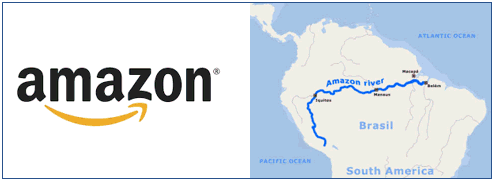
Looking through the dictionary, Bezos’s eye fell on the word Amazon and on the analogy between the famous river, the longest on Earth, and the biggest bookshop on Earth.
When Bezos announced the new name, he said:
“It is not just the longest river in the world: the second-longest is a long way behind. The Amazon crushes all its competitors.”
Never was a prediction more accurate 💰💰
How the Nike brand and the Swoosh originated
Reading Phil Knight’s wonderful book “L’arte della vittoria” (original title: Shoe Dog), by Nike’s founder, reveals the origin of the name and how quickly it was chosen.
From the book: “The day of the decision arrived. Canada had already put the shoes into production, and the samples were ready to leave, but we had to choose a name before they could be shipped. We also had magazine advertisements planned to coincide with the shipments, and the designers were waiting to know which name to insert. Last but not least, we had to submit the paperwork to the US Patent Office. Woodell came into my office. ‘Time is up,’ he said. I rubbed my eyes. ‘I know.’ ‘So, what is the name going to be?’ ‘I don’t know.’”
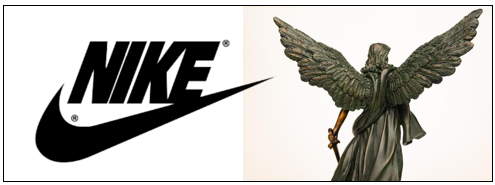
Then the idea arrived! Johnson, one of Knight’s first colleagues, said he had dreamed the right name: Nike.
There was no time. Knight wrote the name in his notebook and compared it with the others he had in mind: Dimension Six and Falcon.
Then he thought Nike sounded good and was short (as iconic brand names should be). He thought of the Greek goddess of victory and chose Nike.
As he wrote in the book, in the end even he did not know what had led him to that decision: perhaps luck, instinct or an inner voice.
The fact remains that the brand was a critical success factor for the company from the outset, and it gave rise to one of the most iconic logos of recent years.
The idea for the Swoosh came from a young art student, Carolyn Davidson. For 35 dollars and in less than a day, she drew on the origin of the name to create stylised wings: the wings of victory of the goddess Nike.
Invented names: Google, Tudum, Kodak
Invented names, as the term suggests, are entirely made up.
Their creators could not find them in a dictionary (as Bezos did), but hope they might enter it later 😉
Inspiration for an invented name can come from various sources, including chance and mistakes.
The origins of Google and mathematics
Google began in 1996 at Stanford, during Larry Page and Sergey Brin’s doctoral studies.
The search engine’s first name, however, was Backrub, which means massaging or rubbing someone’s back.
One day, the founders decided it was time to change the name, so they could move beyond academia and enter the market.
They held a brainstorming session with some Stanford students, and the name that emerged was Googolplex.
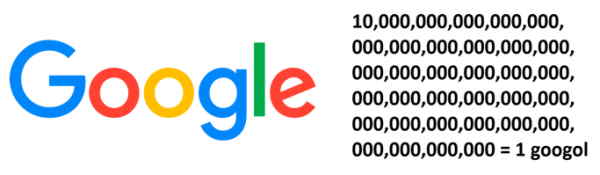
Googolplex was the name mathematician Edward Kasner gave in 1938 to the number 10 to the power of 100. The story goes that the name was created because his young nephew struggled to read a number consisting of a 1 and 100 zeros: 100000000000000000000000000000000000000...........
They took the first part of the name, but made a mistake when registering the domain (because the founders did not know how to spell the word), registering it as they thought it was written.
The rest is history, and the verb “to google” entered the vocabulary of neologisms.
The founders made up for the initial mistake by calling their headquarters complex in Mountain View, California, Googleplex (the following video takes you on a tour inside).
Tudum, the sound of Netflix
Tudum is Netflix’s content website covering its TV series and films: news, curiosities, behind-the-scenes stories, characters, actors, special content, etc.
The company is known for its creativity, and this choice of name confirms it. Tudum is an invented, onomatopoeic word recalling the sound we hear before Netflix videos (see the following video).
Beyond the name, the Content Strategy project is also interesting. Its aim is to “GO BEHIND THE STREAMS”, creating the largest hub for cinema and pop culture.
Kodak
An extremely imaginative name is Kodak, the famous photographic-products company that fell from grace.
Its founder, American entrepreneur George Eastman, chose the name because it was short and easy to remember and pronounce. It also made trademark registration much easier, since the name meant nothing!
The K at both the beginning and end also gave the brand vigour and strength. We find the same Ks in the well-known travel website Kayak.com.
Wordplay and neologisms: Adidas, Airbnb, Shopify
This technique could be considered a subset of invented names, since it ultimately produces names not found in the dictionary.
It combines words and plays with or transforms others.
Adidas and combining names
Adidas is an invented name combining the nickname and surname of its founder, Adolf Dassler.
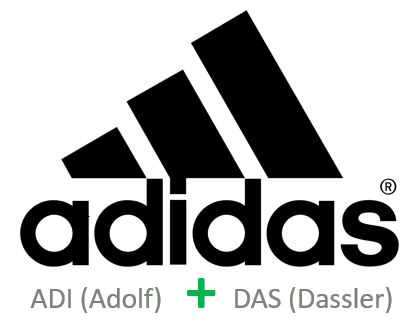
Adolf was known as Adi, and the first 3 letters of his surname were added to create the brand.
The result is a completely abstract name.
An interesting detail is that Adolf’s brother, Rudolf, also founded a sports-shoe company and called it RUDA , following the same pattern: the first two letters of his first name plus the first two of his surname.
He later changed Ruda to the well-known brand PUMA.
Airbnb and inflatable mattresses
Brian Chesky and Joe Gebbia were two young graduates struggling to make ends meet. To earn some money, they decided to rent out a room in their San Francisco apartment.
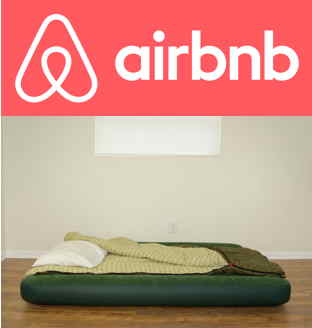
In 2007, they launched a website advertising short-term accommodation with breakfast and an inflatable bed: Airbed and Breakfast.
The name soon became Airbnb to make it shorter, and the abstraction freed it from the concept of an air mattress!
Acronyms: IBM, BMW, HP
Using an acronym is a classic naming approach: it is ideal because it keeps names short while incorporating several words.
It is probably the technique most widely used by small business owners too.
Some famous examples are:
- BMW: Bayerische Motoren Werke, Bavarian Motor Works
- IBM: International Business Machines
- HP: Hewlett Packard
Geographical names: American Express, Singapore Airlines, American Airlines
Geographical names are those that contain a geographical reference relating to the brand.
Airlines often use this technique to identify a country’s flag carrier.
Final considerations
If you need to create a new brand, I recommend trying to generate names using each of the techniques we have explored.
A brainstorming session is also useful.