You are on holiday in Spain, exploring central Madrid. It is 9 p.m. and you are starting to feel hungry.
You and your friends decide to get something to eat. There are many restaurants nearby.
On one street you find two: the first is completely empty (photo A), while the second is full (B). Your smartphones have run out of battery and there is no one to ask for advice.
Which one do you go into?

I am sure it is B. I have often found myself in this situation, and in hindsight, choosing the busier one has never been a mistake 😁
This is the Social Proof effect (riprova sociale in Italian), which I also like to call the restaurant effect 🍕, defined as:
a socio-psychological phenomenon whereby people generally tend to consider behaviours and choices made by a large number of people more valid.
The term was coined by psychologist Robert Cialdini in his famous 1984 book ‘Influence: Science and Practice’.
This effect is even more powerful if:
- we have limited knowledge
- the group consists of people similar to us, of our age, reference group and status.
- the group is recognised as knowledgeable in the field
In the restaurant example, we know little about the two places (we do not know whether restaurant A is empty because it has just opened, while B is hosting an Alpini reunion). We therefore reduce the risk of making a mistake by choosing where others go (especially if we see more Madrid locals than tourists eating there, since they theoretically have more information to guide their choice).
Furthermore, if I am young and digitally minded and see many young people with laptops open on the tables, the effect increases further.
Social proof helps us reduce the risk of making a mistake here; in general, it stems from the cognitive bias called the Bandwagon effect (literally, jumping on the bandwagon), or herd effect 🐏 whereby people adopt certain behaviours, opinions or beliefs if the majority does so.
The name ‘herd effect’ conveys the idea of conforming and following others like sheep, sometimes suppressing one's own thinking.
Trends, product demand and celebrities' popularity follow dynamics based on this effect, distributed like a logistic curve (S-shaped), starting slowly but then accelerating exponentially once they reach a certain level of awareness.
At the marketing level social proof is widely used offline and online.
There are various techniques for using it; let us look at the main ones.
Ratings and reviews: other people's scores and comments
Would you buy a product on Amazon with a rating between 1 and 2?
Would you go to a hotel rated 1 on Tripadvisor?
I would not.
Ratings are a pillar of online culture understood as collective intelligence, wisdom of the crowd or social computing. Together, users create value by sharing experiences.
If I need to book a hotel in a country I do not know (or buy a new product), I can use the opinions of people who have stayed there or are using it.

Beyond their great usefulness to buyers, ratings are a powerful persuasive tool: high ratings and positive reviews have a strong impact on the conversion rate of an e-commerce site.
Several studies have shown that people distrust ‘perfect’ scores, such as a 5/5 Amazon rating. In particular, a 4.4 rating with many votes is much more effective than a 5 with few.
A portfolio of customers and companies using your products and services
In B2B, a strong customer portfolio has historically been essential precisely to exploit social proof and reassure the person you are dealing with.
Imagine meeting two app-development companies: the first has Google, Amazon and Ferrari as clients, while the second mentions a couple of unknown companies unlike your own.
All else being equal, which would inspire greater trust?
Online, it is therefore essential to indicate the companies using our products and services. We could create targeted landing pages, each featuring a different portfolio aligned with the online campaign.
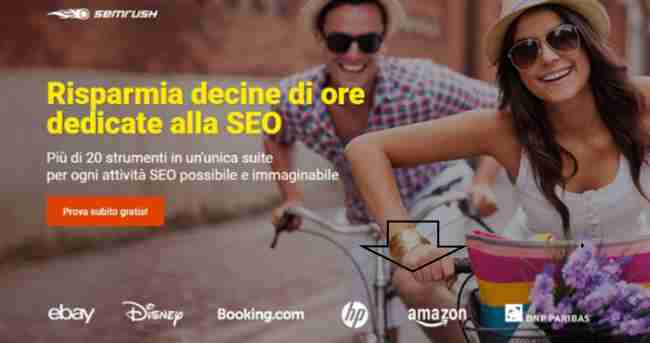
The following example shows a Semrush landing page (a tool for analysing online searches) showing the brands using the software at the bottom.
Often, especially for startups, it makes sense to accept a project for a new client in a strategic market at a low or zero margin, because the social-proof value will offset the cost over time.
Consider a startup working in the Internet of Things that views automotive as a strategic market: the value of a client such as BMW is so high that it could justify a low or zero margin.
Customer testimonials
Unlike ratings and reviews, a satisfied customer's testimonial is a more structured, qualitative format (we cannot include 100 reviews in this case).
It is used in both B2C and B2B.
Critical success factors are truthfulness and the reader's ability to empathise and identify with the customer describing their experience.
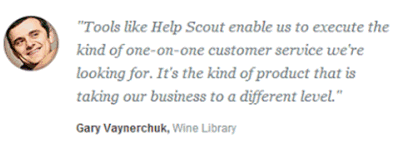
It is very effective in business and can pair perfectly with the portfolio effect; a testimonial from a manager at the client company carries much more weight.
Testimonials from expert customers and/or customers recognised as experts by the market are equally effective.
The example above features the great Gary Vaynerchuk giving a strong testimonial in support of Help Scout software.
In this case, another socio-psychological effect also comes into play: the authority effect.
Articles and reviews in major publications and trust icons (awards, third-party ratings)
Here, social proof draws on our visibility in authoritative sources and awards and recognition received from third parties.
For example, our startup has been reviewed in an important trade publication or voted the most innovative of the year.
In these cases, familiar brands' logos are used to create trust icons.
As the following example shows, we can say our company has been reviewed by The Wall Street Journal and has won a series of industry awards.

Here too, the authority effect operates according to the prestige of the source cited.
Facts and figures
If your service or product is widely used in the market, you can use social proof simply by mentioning the size of your customer base.
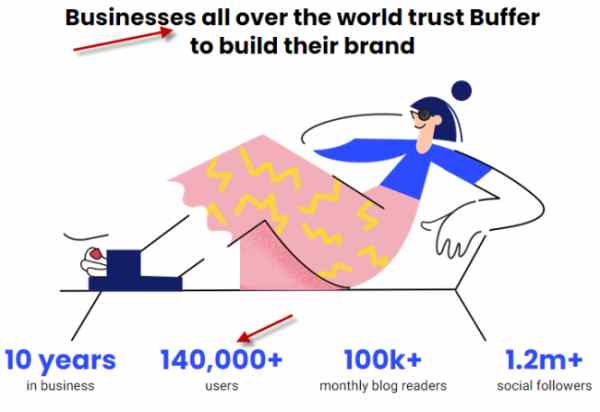
As the following example shows (Buffer is a well-known marketing-automation SAAS), the page states that over 140,000 customers use the service, as well as the numbers of followers and visitors to their content (the anchoring effect is also at work here).
Ethical marketing and social proof: what is the best strategy?
I do not like talking about ethical marketing because I believe marketing is ethical by design, but this is a case where it is worth clarifying how far you can go.
Given social proof's importance and its ability to influence purchasing decisions, unfortunately many companies try to manipulate or massage ratings, harming the credibility and value of the whole system.
In my online purchases, I have analysed various behaviours: here are some appropriate ones and others to condemn.
(I am including images of the two notes received in the parcels):Buying a magnetic whiteboard
Some time ago I bought a magnetic whiteboard on Amazon and found the following note inside the parcel:
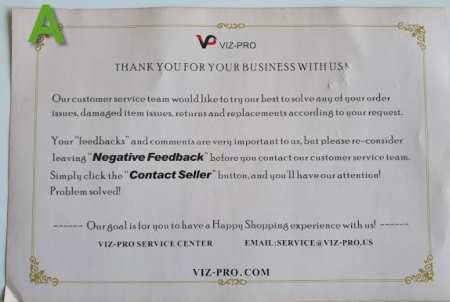
The company included a strongly customer-focused message in the parcel to address any problem I might have and thus prevent my disappointment from becoming negative feedback.
I consider this a very intelligent and constructive approach because it creates value for both customer and company. Of course, if problems arise, they must keep the promise; otherwise, the negative effects come back with interest.
Buying glasses similar to Ray-Ban Stories
In this case, also on Amazon, I bought a little gadget for recording through glasses (here is the unboxing and usage video), and again I found a note:
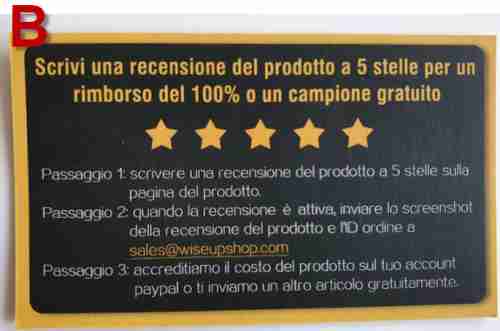
Here the company plays dirty to manipulate the rating. In practice, it pays you to give 5 stars.
I bought the product partly because of the good rating, but when I saw the note I realised where that high score came from.
We also know this practice is strictly prohibited by Amazon, and sellers caught doing it are removed from the marketplace.
The ratings battle is getting tougher, partly because of the phenomenon of positive-negative asymmetry: people are more inclined to give feedback when it is negative.
Psychologically, this is normal: when there are problems we make ourselves heard, while if everything went well we rarely spend time saying so.
From the company's perspective, the best strategy is clearly to provide customers with the best product and service, but alongside that we can take two actions:
✔️ anticipate negative feedback and provide a quick, easy point of contact if problems arise (as with the magnetic whiteboard)
✔️ give satisfied customers a voice organically by asking for feedback, making the ratings phenomenon less asymmetric.
It is no coincidence that Amazon itself invites customers to give feedback on the product or experience after purchases.
For the other techniques discussed, the key factor is authenticity!
Testimonials, figures, customers and trust icons must be real, not fabrications designed to deceive potential customers.
I almost forgot: if you want to absorb Social Proof techniques and all the principles of Cialdini's Influence in 5 minutes, you can listen to the original summary I created on my website: https://www.mindvibes.it/libri/influence.