In world of marketing we continually use the word brand which, in Italian, can be translated depending on the context, as we will see, as marca or marchio.
The American Marketing Association defines a brand as follows:
a name, term, sign, symbol or design, or a combination of these, intended to identify a company's goods or services and differentiate them from competitors'.
Historically, brands emerged from companies' desire to distinguish themselves and be recognised in the market.
When we talk about a Brand, there are physical/rational elements and elements representing the identity of the product or company — emotional/experiential elements.
The physical component of a brand includes its name, such as De Cecco and its sound, and visual elements such as font, lettering, logo, shapes and colours.
In Italian, this is the marchio, or trademark, the tangible part, while the marca is the intangible part: the perceptions through which people experience the brand.
We recognise some brands from just a few elements, such as a colour or icon.
These features help a company distinguish itself physically, but also legally protect its trademark and prevent it from losing its uniqueness.
Choosing a name is a very important stage. If you need to create a new brand, I have gathered useful information here.
What is Brand Equity?
A brand's value is called Brand Equity. In Italian, we might translate it as "patrimonio della marca": it is the added value attributed to a company's products and services.
Brand equity can be assessed in different ways, depending on whether the focus is the customer's experience or the company as an organisation: prices, market share, revenue, profits and so on.
The approach most widely used today is customer-based and defines brand equity as:
a company's added value arising from how customers perceive, think, feel, read and act in relation to the brand over time. It is, broadly, the sum of the customer's experience with the brand: the value and meanings customers and the market recognise in it.
The customer's experience creates Brand Knowledge and Brand Image and, depending on what customers associate with it, the brand may be strong or weak.
It may be obvious, but business results are closely linked to the strength of a brand.
Customers determine brand equity: if they are happy and satisfied and have an excellent experience with the brand, its equity will grow.
To create this equity, companies develop their Brand Identity.
What is Brand Identity?
By Brand Identity we mean:
all the physical elements — trademark and attributes — and perceptions created by the company to express its identity, personality, culture and vision, and generally how it wishes to be perceived and recognised in the market
In practice, Brand Identity is what we say about ourselves when introducing ourselves to a group: our name, what we like doing, what we dislike and so on. Meanwhile, Brand Equity is what people think of us, updated over time as they get to know us.
Following this metaphor, making a good first impression is useful, so launching a brand is extremely important; otherwise, building a good reputation becomes an uphill struggle. But it is equally important to give our identity positive substance over time.
For example, a brand aimed at young people will express its identity through different elements from one aimed at families.
If I have a mountain bike brand for outdoor enthusiasts, I will focus on elements expressing an identity close to my audience: the environment, exploration and so on. For example, I might call the brand Explorer.
When working to create our brand identity, we must keep these elements clearly in mind:
- Our vision and purpose — the brand meaning
- Our values: what do we believe in? For example, the environment, simplicity, equal opportunities or minority rights
- Our personality: adventurous, imaginative, innovative, determined, precise and so on
- Our unique positioning: what sets us apart?
- Our brand voice or tone of voice: how do we communicate? As with people, this is how we present ourselves and speak in relationships with customers — direct and formal, for example, or informal and simple
If we have created an effective brand system, the market will recognise all these elements, consciously or otherwise.
What is Brand Meaning?
At the heart of Brand Identity is Brand Meaning: the meaning we give to what we do as a company and how it is perceived.
Here we enter the realm of why a company is in the market, what is called its Purpose, the aim of its activity.
Purpose is fundamental to building strong brand equity. Doing so requires concrete action.
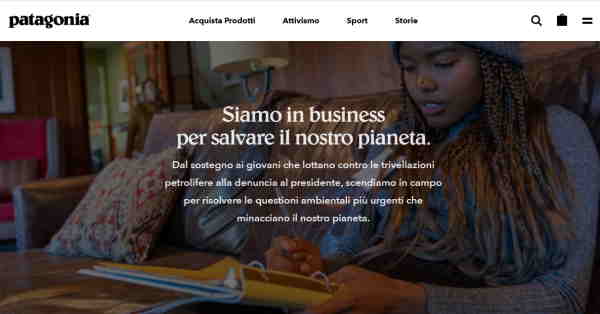
Patagonia's purpose and actions
Brands such as Patagonia, Lego and Red Bull have a clear purpose and communicate it through concrete projects they carry out: they walk the talk.
Patagonia declares that it is in business to save the planet, and follows through by donating 1% of revenue each year to environmental groups.
People who wear Patagonia share the brand's meanings.
BE CAREFUL: if we make statements without taking action and work only on appearances, the great danger is a boomerang effect that irreparably damages our brand.
This includes all the activities called and brand washing, particularly those involving sustainability and the environment — greenwashing.
Through all its content production, as the following video shows, Red Bull demonstrates that it believes in what its customers believe in: freedom, adventure, adrenaline, living life intensely and so on.
When a brand has a meaning that resonates with its customers' beliefs and values, it moves to a higher level.
Of course, a necessary condition is that the company's product or service provides value ; otherwise, the castle has weak foundations.
A brand that creates a community
If the products are excellent, the identity is clear and distinctive, and our meanings align with those of our customers, we will no longer have merely a market, but a Community.
It is the Holy Grail of Brand Equity.
The value of a community appears in:
- loyalty
- the trust
- advocacy: customers become brand ambassadors and recommend it to everyone
- the co-creation: customers participate with the brand in building value
- a sense of belonging: people who use a brand's products feel different; it is a club that gives identity and brings people together

One of the many Harley-Davidson community gatherings
To reach this stage, we must work on product and service value while also building the community by helping, informing and inspiring customers with valuable content.
A modern model for building a community is the 3Cs pull strategy (see the following video).
What is Brand Awareness and how is it measured?
Brand awareness measures knowledge and recognition of a brand: the term refers precisely to awareness and familiarity.
If I mention the brand NBM, does it mean anything to you? Do you know who they are? What market do you associate it with?
You immediately recognise a brand with high awareness and know what it does and what its products are. The choice of the right name and trademark is fundamental particularly in the early stages of building recognition.
For this reason, measuring awareness is important, especially when running marketing activities designed to increase familiarity.
For example, we can measure it before and after a wide-reaching advertising campaign, such as a TV commercial on linear television and VOD.
How is brand awareness measured?
It is very simple: ask people whether they know a particular brand! To do this systematically and with meaningful numbers, companies use market research firms that periodically interview a sample of the market.
Two indicators are used to measure awareness:
- Unaided awareness
- Aided awareness
In the first case, respondents are asked to name brands they know for a particular product.
For example: which sports shoe brands do you know? Someone might answer Nike, Adidas, Puma and so on.
The technical term is Brand recall: spontaneous recollection. Nike is remembered without any help, hence unaided awareness.
With Aided Awareness, a list of brands accompanies the question and respondents indicate whether they know them. There is therefore a prompt, and this is no longer Brand Recall but Brand Recognition: recognising the brand.
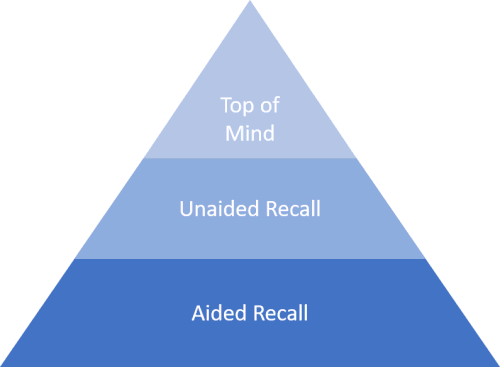
Both indicators are expressed as percentages from 1 to 100, with 100% representing those who remember or recognise the brand.
We also calculate total awareness by adding the unaided and aided values, since they are mutually exclusive.
So if 400 out of 1,000 respondents spontaneously name Adidas when asked for a running shoe brand, and another 500 recognise Adidas when shown a brand list, total awareness is 90%.
Clearly the two indicators relate to each other, and at the same total value, awareness is stronger when the Unaided value is higher.
The black belt of recognition, the top of the pyramid, is being the first brand mentioned — like Nike in the earlier example — and being seen as the reference point. This is called: Top of Mind.
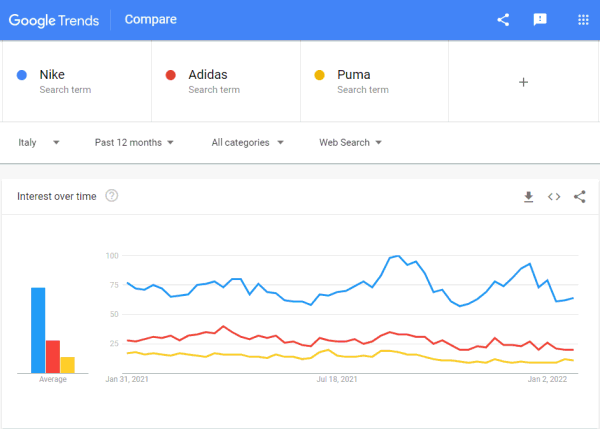
A very useful, inexpensive and quick tool for measuring awareness is Google Trends: the number of searches for a brand is a good proxy for familiarity and interest in it.
In a customer's purchase journey, brand awareness could be called a preliminary stage. I might know a brand without currently having any need it satisfies: for example, I know Ray-Ban but do not wear sunglasses and am not interested in having any.
Clearly, high brand awareness helps in later stages if the customer recognises the underlying need, even much further down the line.
So if, for some reason, I decide it is time to wear sunglasses, Ray-Ban may have an advantage in perception and recognition during my purchase journey.
When measuring Brand Equity, alongside recall and recognition, it is essential to measure customers' trust and loyalty and their likelihood of generating positive word of mouth. The ideal indicator is the: Net Promoter Score.