Setting the price of a product or service is a very delicate task; because of its importance, pricing is one of the four pillars of the marketing mix (alongside product, distribution and promotion).
There are various pricing techniques, and companies must find the right balance between product margins and competition. Of these, my favourite method is value-based pricing.
Remember that the advent of digital also established the free, freemium and trial models (follow the link for details).
What is value-based pricing?
Value-based pricing is a pricing strategy that puts the value perceived by the customer at the centre of the price-setting process.
Instead of calculating a price based on production costs or competitors' prices, this approach focuses on what the customer is willing to pay for the benefit the product or service offers.

It is essentially based on Customer Value, a fundamental concept in modern marketing.
How to use value-based pricing (a practical case: De Cecco gift boxes)
The first step is to understand how the customer perceives value.
To achieve this, it is essential to conduct market research to identify what customers value most. In theory, at this stage we already know the customer's needs and problems that our product or service solves, but we do not yet have precise information on price sensitivity or what pricing our value proposition can ‘support’.
Basically, the price must guarantee a certain margin on the product or service in the medium term. Sometimes, as part of a broader strategy, a negative margin can also be sustained if it supports other marketing objectives (for example, acquiring customers through aggressive pricing and then upselling and/or cross-selling).

One very effective technique is to test the product directly with customers to understand in practice how they perceive it and what price they consider appropriate.
In the 1990s, I applied this technique while creating a new line of De Cecco products: boxes for the gift market, designed for seasonal gifts, celebrations and corporate gifts.
Market analysis revealed interesting opportunities to position a new food product aimed at both B2C and B2B.
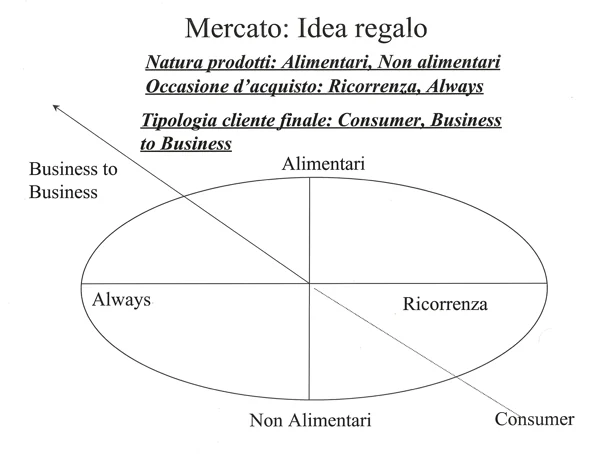
The cases included various products from the company's portfolio, such as pasta, oil and sauces. One unique feature was that the packaging itself became a product: a storage chest for bread or pasta and an oil cruet holder.
These objects were also made from birch wood, laser-cut using a digital technique that was innovative at the time. Assembly involved no glue or substances with an environmental impact, just simple pegs to secure the parts.
The first thing we did was make complete prototypes: boxes containing a selection of products. I then made use of the company shop, where De Cecco sold its products to the public, placing the cases prominently near the tills.
Below are photos of the prototypes and arrangements. I changed the contents each time, partly to understand what difference the products inside made.
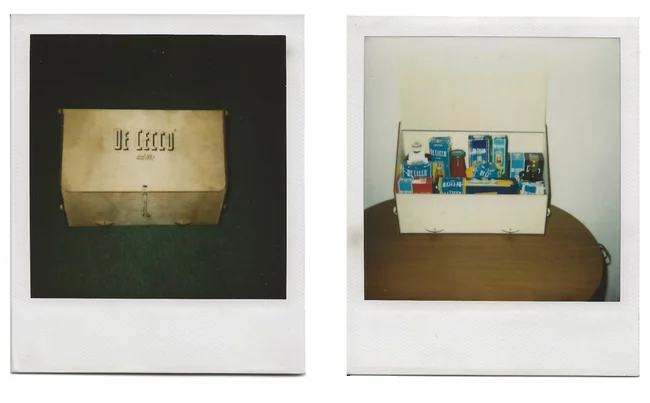 Polaroid photos of the prototypes
What distinguished these boxes from the other products in the shop was that they had no predefined price.
When a customer asked the price, I replied:
‘How much do you think it might cost?’
It is important to stress that ideal feedback is ‘pull’, coming from a customer already interested in buying, rather than ‘push’, where we propose the product ourselves.
In this simple way, I gathered a large amount of feedback on perceived value.
The test results were illuminating: the perceived value of the boxes (especially those with birch-wood packaging) was significantly higher than the value of the products inside (even at list prices) plus the cost of the case.
Customer testing also showed that the wooden chest was too large and became extremely heavy and difficult to carry as a gift, so we shortened it, as shown in the following photo.
In practice, I applied the typical techniques of Design Thinking (which David Kelley was formalising in those years).
Below is the final product from a range of boxes that also included simple cardboard versions.
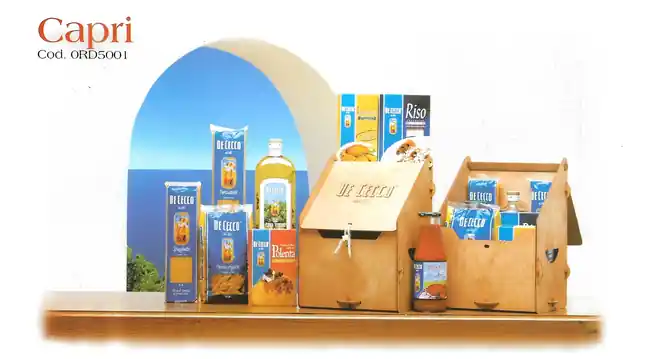 The Capri birch-wood box
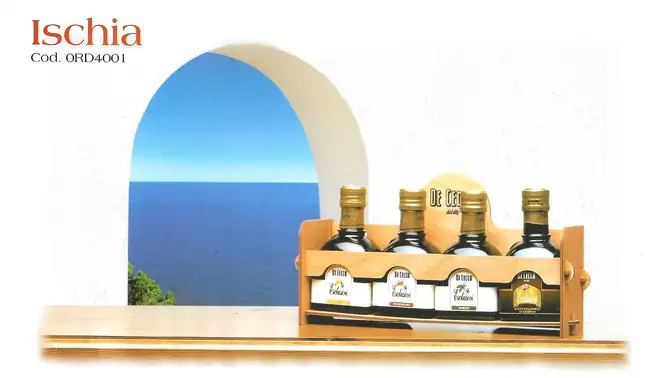 Ischia oil cruet holder
I am very fond of this project, perhaps because I was very young, but also because I had the chance to follow every stage: from the idea and analysis through to execution. It was also my first encounter with e-commerce, as the cases were available online too (although only for B2B).
The products launched before Christmas and sold out immediately. A simple but effective B2B technique was to obtain the list of all De Cecco suppliers and send a dedicated mailing with the new products' leaflet. Many companies bought the boxes as gifts for their customers. Narratively, the idea worked very well because the suppliers were giving a product whose creation they had, conceptually, ‘indirectly’ contributed to.
To increase perceived value, we focused on sensory appeal, Mediterranean identity and pleasure (directions indicated by qualitative market research). The product names were those of beautiful Mediterranean islands (Capri, Ischia, etc.), and the advertising visual was set on a Mediterranean island.
The following year I left the company to focus on the digital revolution, but I believe De Cecco boxes still exist, although only in cardboard, probably positioned as value boxes.
Value-based pricing reaches its fullest expression in products with high emotional benefits, such as fashion and luxury, where great value is attributed to the piece of identity acquired through owning the item.
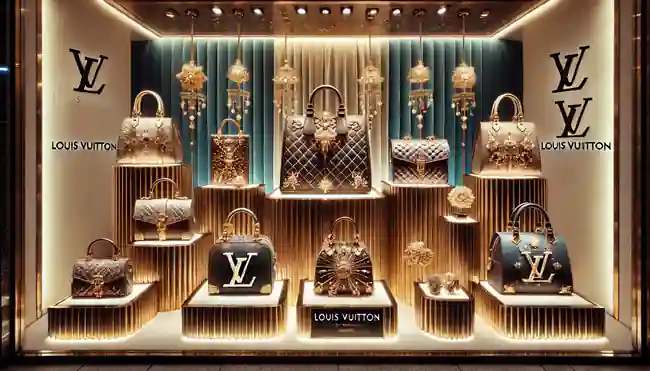
A product costs as much as people are willing to pay for it.
Good communication increases perceptions of both functional and emotional value. To support prices above intrinsic value, it is also essential to shift the focus to the problem the product or service solves or the concrete benefit it offers.
Sell the fire, not the extinguisher.
In B2B, companies often set prices for their services and products according to the customer and the economic advantage that customer can obtain. For example, if I sell a project to a large company with many customers, at the same cost a higher price will be applied because the final benefit will be greater.
Of course, it is important not to go too far in exploiting perceived value, to avoid entering unethical territory. This risk can arise, for example, in healthcare and entertainment.

A high price can also be unethical when it exploits a context in which the need for a product or service is particularly urgent or critical, making people willing to pay more to obtain what they need. Think of face masks during Covid, or try buying a bottle of water at an airport.
Conclusions
A growing number of brands now base their prices on the value perceived by customers, especially companies with premium positioning. Companies must therefore maintain the value promised by their proposition so that customers can fully recognise and appreciate it. Other elements of the marketing mix, such as advertising and the sales force, are used to communicate and reinforce perceived value in consumers' minds.
Value-based pricing is not merely a price-setting technique, but a change in mindset that puts the customer at the centre of every decision while enabling companies to increase profitability.