A very useful writing framework for selling a product, service, project or an idea in general is the PASTOR method.
The word is the English acronym for: Problem, Amplification, Story, Transformation, Offer and Request; there are actually more keywords in the acronym, but we will look at them all shortly.
I find this method very effective not only for selling in the strict sense, but also for presenting a project or getting an idea or concept across to our reader or listener.
It is no coincidence that political speechwriters use it widely.
We can also use just some of this framework's components when writing our content.
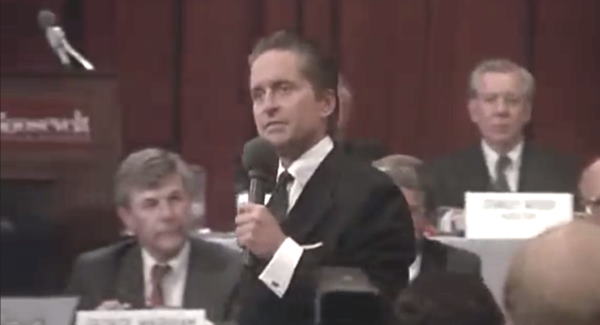
Michael Douglas's speech at the shareholders' meeting
A good example is the famous speech by financier Gekko (click to watch) at Teldar Paper's shareholders' meeting in the film Wall Street.
Problem, person, pain
The first step is to understand who our audience is and what benefit our product, service, project or idea provides.
What is our positioning in the audience's mind? What makes us unique?
If the marketing activity has been done well, we already know which problems our offer solves. With the PASTOR method, we must start from those very problems to lead our audience to think or take a particular action.
For example, bike sharing targets an active urban audience (typically urban millennials) and solves these problems: getting to the office and around the city, getting some exercise and making a positive environmental impact.
Once the problem has been identified, it must be described well: make it vivid, provide plenty of context and use the language and imagery our customer would use.
The aim is to tune in to the customer and follow the conversation already taking place in their mind.
At this stage, we need to create emotional tension.
As the saying goes:
‘sell the problem, not the product’.
I need to sell you the fire, the risk of fire, not the extinguisher.
For example, I tell you about the risk of burglary, how easily it happens and the likelihood of becoming a victim.
The problem serves to create or bring out the latent need.
In the case of fires and burglaries, the problem also carries a strong emotional charge rooted in fear.
For example, Ring, Amazon's security-system company, shows online videos of burglaries prevented by its product.

Burglar fleeing after a Ring alarm is activated (video here)
In his speech, Gekko speaks clearly to shareholders and emphasises the problem of the company's inefficiency and the distance between investors and management.
The financier's ultimate objective is to secure the meeting's approval to break up Teldar Paper and make a profit.
Amplification
At this stage, we amplify the problem to intensify the need.
To amplify it, we need examples, data and objective facts.
If I want people to exercise more or respect the environment, I must provide facts that amplify the problem and make them ask: what is the cost of not solving it?
Be careful not to overdo it or use only data and statistics, to avoid the ‘bucket effect’ switching off emotion and activating the analytical brain.
What does not exercising cost my health? What does not caring for the environment cost me?
Before telling you about heaven, I need to show you hell too.
This draws on the very powerful loss-aversion bias.
In Gekko's speech, much time is devoted to amplifying the problem, which becomes much more urgent and important: the dysfunction of the whole country, America.
Story and solution
At this stage, we tell the story of someone who went from hell to heaven (the hero's story) thanks to our solution.
For example, if we want to sell our Peloton exercise bikes, we can tell the story of someone who improved their life with our products.
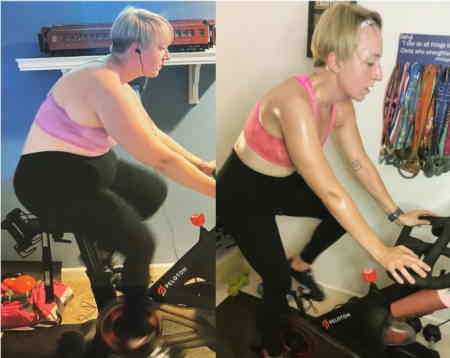
Photo of Daryl Banegas, who lost 100 kg
‘A year ago, when Daryl bought a Peloton, she did not feel comfortable sitting on the bike's saddle. After a year she has lost around 100 kilos and now says she feels very comfortable and happy when pedalling. Daryl credits her weight-loss success to the Peloton bike and the instructors who provided effective, guided workouts.’
We need to use the great power of storytelling, the great power of the scenery it creates in the minds of readers and listeners. Empathy will do the rest.
People project themselves into the story and emotional involvement grows; we need to capture their imagination.
It is our story that will persuade the audience, not a statement of our product's features.
Here too, science tells us that the brain is far more active when we hear a story than when we listen to a series of facts or features; the emotion generated by the story also improves recall.
We can also use a story in the initial stage, when we set out the problem and show it through the eyes of someone similar to our audience. This increases awareness, immersion in the context and therefore understanding.
The greatest effectiveness comes when the speaker (or writer) tells of their own experience and how they overcame the problem thanks to that product, idea or new lifestyle.
Gekko describes the company's inefficiency and bureaucracy through vivid images: business lunches and entertainment paid for by Teldar Paper, papers travelling back and forth between all the vice-presidents, golden handshakes.
During the speech, Gekko constantly points to management sitting in front of the meeting, helping shareholders imagine the activities he describes.
Transformation and testimonial
People buy on emotion and justify with logic.
At this stage, we add another emotional charge by discussing transformation and the advantages we will obtain by using our product or adopting our idea.
Here too, it is essential to use stories and testimonials from people already enjoying the benefits.
In the earlier example of Daryl, her life changed profoundly with 100 kg less: now she can dress as she likes, feel more confident, have more energy, and so on.
People care about the advantage: what benefits can I get from a Peloton bike?
If they identify with Daryl's story, they can grasp those benefits and imagine themselves after the transformation.
In reality, your customer is not buying an exercise bike, but buying health, beauty, energy, self-esteem, and so on.
Using testimonials also activates another powerful effect: social proof: if I see it has worked for others, I become convinced it can work for me too.
In his speech, Gekko talks about his successes and the resulting benefits enjoyed by shareholders who were in business with him.
But his project will bring more than profits: through their greed, they will also save that other dysfunctional company called America.
Offer
At this stage, we reach the final proposal. All the offer's benefits are spelled out.
Naturally, everything is connected to the advantages described so far, but we may provide more detail on how they can be achieved.
For example, with Peloton we can explain that all online classes are taught by leading experts in the field and that personalised programmes are created for everyone.
Response request
This is the final step, inviting the audience to act and briefly explaining how.
Online, it is the call to action (CTA) that appears after the whole story.

Apple's call to action
Conclusions and considerations
The PASTOR narrative is very effective when we have an idea, product or service that solves an important problem, but as we have seen, its ingredients can be used on various occasions.
At its core is a journey that sells benefits by moving through problems (in the first two stages) and desires (the transformation stage) in a highly emotional context (thanks to the stories).
Unfortunately, these techniques are also often used for sales patter and negative manipulation: in practice, they make people perceive value that does not exist.
Marketing must be ethical, and on this subject I like to quote a philosopher I love:
Every other science is harmful to those who do not have the science of goodness. (Michel de Montaigne)