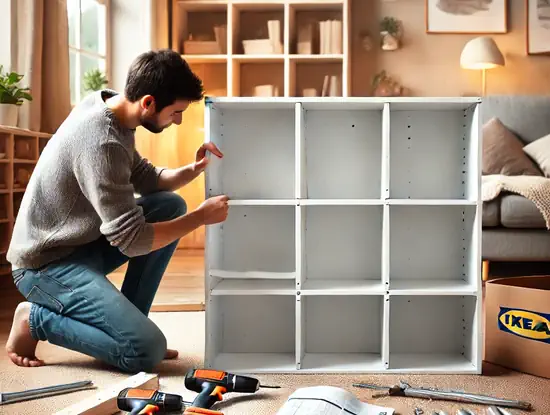
You have just tightened🪛 the final screw in your Billy bookcase or fitted the last piece of your LEGO Millennium Falcon.
From now on, you cannot escape the influence of the IKEA Effect! It will make you value objects you assembled differently.
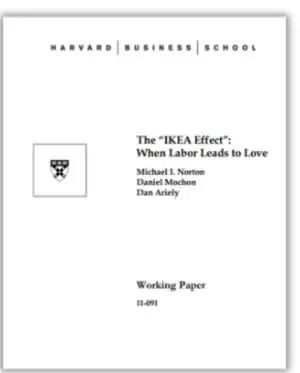
Researchers led by Michael I. Norton, Daniel Mochon and Dan Ariely explored the phenomenon in a Harvard Business School paper titled The IKEA Effect: When Labor Leads to Love.
The concept is simple:
we place more value on products we have built or assembled ourselves, even if they are imperfect🙋🏽♂️.
The IKEA effect shows how hard work turns into love❤️ for the finished product. We become emotionally attached to what we create.
The researchers found this applies both to practical objects, such as furniture, and enjoyable projects, such as building LEGO sets.

The key ingredient? Successful completion!
If we abandon the project halfway or have to dismantle it, the IKEA effect disappears.
The phenomenon is also amplified by the Consistency Effect which says that once people begin an activity, they are driven to finish it to remain consistent with their initial action.
This increases the value attributed to the object through satisfaction at successfully completing the task.
Failure creates the opposite effect: not only does the IKEA effect disappear, but we also feel less capable and lose self-esteem.
This is not limited to DIY enthusiasts. Even people who usually dislike building things value them more when they successfully create something with their own hands.
Products more complex than IKEA furniture also involve a show-off component.
Examples of the IKEA effect in marketing
At the marketing level a little creativity is enough to involve customers actively in creating the product or service.
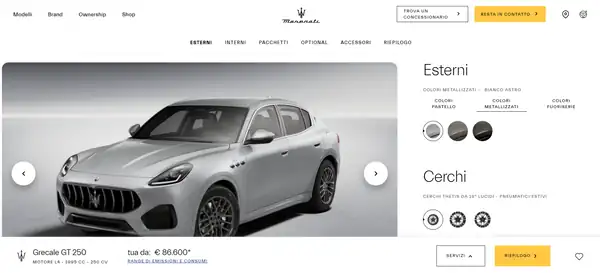
The first idea that comes to mind is letting customers configure and personalise a product through a tool that is simple but still requires a little work.
Bicycle and car configurators are perfect examples.
Another successful application is selling meal kits online: the recipe and ingredients arrive at home, prepared and measured for the dish.

The first kitchen kits appeared in the United States in the 1930s as cake mixes.

The IKEA effect strongly influences perceived product value. With functional value unchanged, it can greatly increase emotional value through the consumer's personal experience of creating or modifying it.
In software development, business simulations and beta testing can collect user feedback. Involving users can activate the IKEA effect because they feel part of building a better product.
Create contests or challenges to gather creative ideas from customers and prospects.
Activate co-creation channels for deeper user involvement. For example, if I sell caps online, I can use designs customers share with our community.
Introduce gamification into the customer experience, rewarding personalisation with prizes and badges.
Finally, build a content strategy and strong community that help customers get the most from, and personalise, their products and services.
One outstanding online example is certainly Canva.com.
Ultimately, remember that a human being is just a big child wanting to have fun and get their hands dirty 🤗