We are only at the beginning of the digital revolution, and AI — artificial intelligence — is already producing interesting results.
Growing computing power and the ability to handle vast amounts of data are turbocharging machine learning. As a result, machines will gradually replace activities performed by humans.
This process will affect not only repetitive, lower-skilled occupations but also jobs requiring specialised expertise.
The competition with computers on knowledge is lost before it starts.
Humanity's professional and cultural salvation lies in creativity.
Creativity is that airy, miraculous thinking generated in our minds, capable of connecting any elements to produce new ideas and solutions to problems.
There are several synonyms for creativity that are really elements within it, such as: fantasy, imagination, inventiveness.
Creative thinking is fundamental not only at work but also in shaping our lives: we can only achieve what we can imagine.
Creativity in setting our goals and deciding what we want for our future can give us a more fulfilling life.
Let's look at Treccani's definition of creativity:
Creativity, noun [derived from creative]. The creative faculty: the ability to create through intellect and imagination. In psychology, the term describes a process of intellectual dynamics characterised by particular sensitivity to problems, the ability to produce ideas, originality in devising them, powers of synthesis and analysis, and the ability to define and structure one's experiences and knowledge in new ways.
Contents:
- School, work, marketing and creativity
- Fun and play
- Seek informality
- Lateral and divergent thinking
- Travel makes us creative
- Passion
- Sport and walking make us more creative
- Scatterfocus mode
- Free thinking
- Train your imagination
- The power of music
- Nature
- Use pen and paper
- Do new things
- Curiosity improves creativity
- Cultivate writing
- Think Week: a week of thinking
- Use the power of emotions
- More is better
- The brainstorming technique
- Meditation improves creativity
- Spend time and play with children
- Randomness, chaos and disorder
- A creative workstation
- Continuous learning
- Metaphors and analogies
- Work and effort: only those who act create
- Conclusions
School, work, marketing and creativity
Essentially, creativity is an aptitude we are born with. Over time, we stifle or nourish it through school, work and leisure activities, such as hobbies and passions.
If the battle of the future will be fought with creativity, we sadly cannot say schools are ready. It is as though we were training children to use spears and stones when the battle will involve missiles and aircraft!
Children are rich in creativity, but the school system is a product of industrial education, based on managing large numbers and prioritising factual knowledge over imagination.
The following TED talk by Ken Robinson offers an interesting view of the relationship between school and creativity.
Work, too, often becomes creativity's grave. In companies, managing complex structures inevitably requires many procedures, processes and rigid frameworks.
In this environment, the mind conforms to the company's recurring thinking and patterns, limiting itself.
In business, we live in a market of perfect information: all companies have the same data, the same market research and the same analysts interpreting them!
In practice, everyone marks their opponents closely, creating a chain of "me too" strategies.
Sometimes a project is launched only if someone has already done it! A paradox!
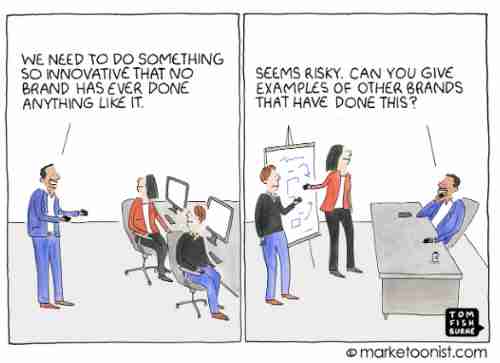
From a marketing perspective, what does this mean? Only those with more ideas who can experiment more can gain a competitive advantage. Creativity is indeed one of the most important soft skills a marketer should have).
Creativity is undoubtedly the most important human resource. Without creativity, there would be no progress and we would always repeat the same patterns. – Edward De Bono –
Creative people do not think solely on the basis of past experience: they seek new perspectives on a problem and produce different, sometimes unconventional solutions.
The beauty of creativity is that we find it everywhere, and everywhere it can make an important contribution.
Some time ago, while Donald Trump was considering how to build a 3,000-kilometre wall separating the United States from Mexico, two Californian architects, Ronald Rael and Virginia San Fratello, created and installed 3 pink seesaws across that very heated border.

A seesaw allowed a Mexican girl on one side to play with an American girl on the other.
Sadly, the seesaws were removed after an hour, but their symbolic value remained forever. The work won the Beazley Designs of the Year award, the prize awarded by the Design Museum in London to the world's best creative idea of the year.
Given the importance of creative thinking, the natural question is: can I improve and train my creativity?
In my view, yes.
Over time, I have studied myself to understand how to reach my best creative performance, gathering research on the subject as well as empirical observations from daily activities.
In the spirit of #sharingiscaring, I also created Creativity Gym, where we can practise the best creative thinking techniques together.
Fun and play, with a little healthy madness, improve creativity
When you are negative, you are not creative!
If you have fun, you are more creative; where there is play, there is creativity.
Laugh 😊 and the ideas will come. Do not stay stiff and tense. As Einstein said:
Creativity is intelligence having fun.
I really like the Fanta advert: how amazing an idiot can be! (the full original video is below).
It shines a light on the courage of "nonsense" in a world always seeking performance, rationality and results, whatever the circumstances.
Nonsense takes us back to childhood and is good for creativity.
Creativity needs space, imagination and freedom to follow bizarre, crazy paths.
Even doing things that make no sense can eventually make sense.
I think play will save us!
Artificial intelligence does not know what play is.
Playing makes us creative and lets us change our moods — discover the art of how.
Children are more creative than adults because they play much more.
Seek informality: formality kills creativity
Informal environments encourage creative expression.
The ideal environment is one where you do not have to watch what you say and judgement is suspended.
Unfortunately, judging others is the national sport in a great many Italian companies.
Digital businesses and communication agencies have informality in their DNA, and their workspaces reflect this.
The image of a creative studio is far removed from that of a government office.

Lateral and divergent thinking
Lateral thinking is the ability to see things from different angles.
In my view, this is a fundamental ability if you want to improve creative thinking. You may therefore find useful the guide to lateral thinking with the best techniques I have gathered over time (#sharingiscaring).
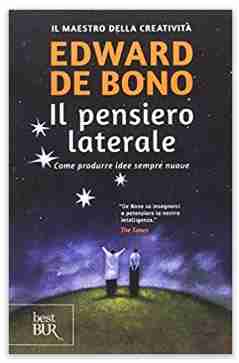
Intelligence is something we are born with, while thinking is a skill we must learn. (Edward De Bono)
Here are some fun lateral thinking exercises:
- Connect the nine dots
- The lift
- The trees
- The man in the bar
- The car with its lights off
- The Romeo and Juliet puzzle
- The Hotel
- The condemned man and the three rooms
- A dead man in the desert
- Arresting the murderer playing poker
- The driver's dilemma
- The eggs and the basket
- The storm and the henhouse puzzle
Travel makes us creative: it opens the mind and gives us new perspectives
When you return from a trip, everything seems different and ideas flood your brain.
Travel opens our minds, broadens our perspective and makes us more creative.
Mental paradigms fall away as we face new and unexpected situations that force us to adapt and move beyond our limits.

Photo of Tsavo National Park from my trip to Kenya
Remember: reading is an excellent substitute for travel. Our bodies stay still, but our minds travel all the same.
I think that when we pass on, Saint Peter will play back our minds in heaven. If he sees the same images of home and work, he will quickly compress them into a few megabytes.
My goal is for him to need a large hard drive instead, to enjoy all the images of my travels and reading, and to call the angels over to admire them too.
Passion❤️ for what you do increases creativity
Probably because you enjoy what you do.
A corollary of this principle is that, at work, we need passionate people rather than people who complain and are always ready to judge others.
Sport and walking make us more creative
It is established that thinking while walking or exercising generates more ideas.
How often have you struggled for an idea, only to solve the problem by getting up and walking a few steps?
Many great thinkers, such as Montaigne, Nietzsche or Heidegger conceived their most powerful ideas while walking, as did Aristotle with his students, who were therefore called Peripatetics, from the Greek peripatein, meaning to walk.
In our own times, Steve Jobs, Mark Zuckerberg and Jack Dorsey have all been known for walking meetings in which participants walk together.
In the following video, Nilofer Merchant explains the benefits of walk-and-talk meetings, both for health and for the closer connections people form away from a traditional meeting room.
You will be surprised how fresh air leads to fresh thinking, and as you do this, you will bring a whole new set of ideas into your life. (Nilofer Merchant)
A study from Stanford University by Professor Daniel Schwartz and Marily Oppezzo showed that creative thinking improves while a person walks and continues to do so for a while afterwards.
The following image clearly shows the effect of just 20 minutes of walking on our brains!
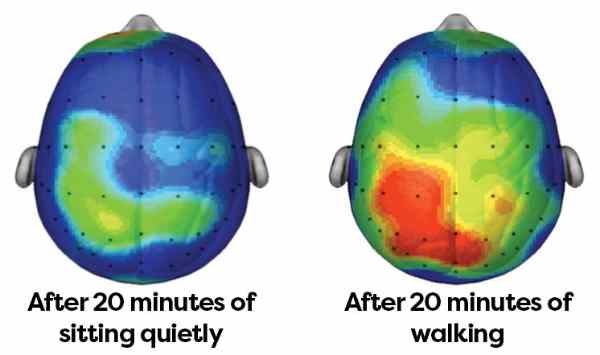
Brain scan from University of Illinois research
The great mathematician Alan Turing was also a great runner and said he imagined new ideas during his runs.
Several studies have also highlighted the effects of physical activity on students' cognitive functions, recording improvements in attention, results, perceptual abilities, and verbal and mathematical tests.
The Japanese writer Haruki Murakami wrote one of the finest books on running: What I Talk About When I Talk About Running.
Running changed his life: from a sedentary writer and smoker, he became a runner 🚬➡️🏃♂️ with more than 25 marathons to his name.
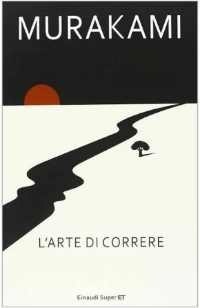
The book reveals how sport 👟 played an important role in the writer's creative process.
For Haruki, running is a continuous source of inspiration and a way to know himself better.
Murakami also discusses the runner's solitude, a recurring theme in his novels. For him, running is a solitary activity that allows him to reflect, generate ideas and find inner peace.
He also describes how running taught him to overcome his limits and confront pain and fatigue.
So?
…whether you are a writer or a product manager, what matters is that you start running 🏃♂️🏃♂️🏃♂️
Compress and decompress to activate Scatterfocus mode — or the shower effect 🚿🤪
How often does an idea for a problem we have been working on for ages come to us while showering, driving or washing dishes?
Our minds independently process everything we have taken in, and scatter mode allows us to create those creative connections between new and old information.
Research has shown that the mechanisms of creativity activate when we reduce the pressure on our minds.
In Hyperfocus, Chris Bailey calls this state Scatterfocus mode. We might describe it as a state of dispersed focus or non-focus, in which we let our minds wander freely while doing another activity requiring little cognitive effort, such as showering.

We can use this mode deliberately by first going through a period of Hyperfocus, then one of decompression.
For example, we can load our brains with information and data in the morning, then spend lunchtime on an activity that distracts and relaxes us. Or, to activate the previous point too, we can take a good walk or go for a run.
The thing is, creativity cannot be pushed: it must be attracted 😉
Free thinking
We need to set aside time for free thinking: take a subject and think it through.
With the Internet, we are used to immediately searching Google or asking ChatGPT, but the content we read may bias our thinking.
Whenever possible, think freely first and only then gather material on the subject.
After a certain age, reading distracts the mind too much from its creative pursuits. Anyone who reads too much and uses their own brain too little falls into lazy habits of thinking. (Albert Einstein)
Train your imagination: learn to visualise ideas
Ideas are seen, not thought!
Train your imagination. The legendary Albert also said: "Imagination is more important than knowledge!".
The etymology of the word Idea: from the Greek idein, meaning 'to see'.
When you ask creative people how they did something, they feel a little guilty because they didn’t really do it, they just saw something. It seemed obvious to them after a while.
When you ask creative people how they did something, they feel a little guilty because they did not really do it: they just saw something. After a while, it seems obvious to them. - Steve Jobs
The following beautiful quote by Arthur Schopenhauer perfectly emphasises the art of seeing what others do not:
Talent hits a target no one else can hit; genius hits a target no one else can see.
Look at the following image! It is the result of a new AI trend: text to image. You enter text and the engine generates an image. In this case the text was: "a brain riding a rocket towards the moon".
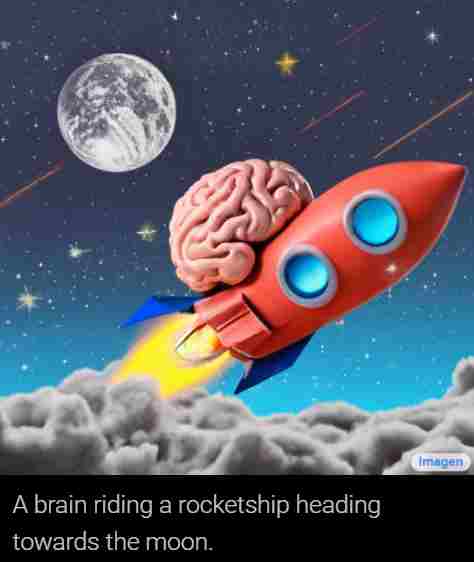
The image was created by Imagen, the AI tool launched by Google's laboratories for text-to-image modelling using the power of large transformer language models. For more information and some fun: https://imagen.research.google/).
Similarly, OpenAI's DALL-E 3 and Midjourney allow images to be created from prompts.
Whatever else may be said, I think it can be a spectacular tool to support creativity.
The mind needs imagination and this can offer a little help before we do it on our own.
The power of music 🎵🎧🎵
Does music improve creativity?
Yes, but be careful when you use it.
Several studies, including one from the University of Central Lancashire, the University of Gävle in Sweden and Lancaster University found that during the creative process, music is a distraction that reduces the ability to generate ideas.
Other research, however, tells us that music works very well in the decompression phase discussed earlier under Scatterfocus mode.
If, after studying and concentrating on a problem, I relax by listening to music I enjoy, I help my brain loosen up and activate the mental associations fundamental to creative thinking.
That said, it is very subjective. Personally, the distraction is more than offset by the positive mood effect music creates, so I often listen even when I need to think.
In particular, the music and voice of the wonderful Sade ❤️ take me into intensely creative atmospheres.
Below is the song "Is It a Crime" performed by Sade at Live Aid in London's Wembley Stadium on 13 July 1985. Close your eyes and listen to her voice.
PS: The song dates from 1985, but the artist's style was so innovative that, IMHO, it feels completely current.
Nature is creativity's ally: “There is the sea outside”
Don't worry, lad
There is the sea outside
There is the sea outside
Whatever my worry, my problem or the idea that will not come, the solution is always the same: the sea 🌊🌊

The sea in front of my home
A walk along the sea, and everything falls into place and ideas arrive.
I do not know why.
When I look at the horizon and the vastness of the sea, every problem seems to shrink like a boat disappearing offshore.
Meanwhile, ideas arrive in fleets. The mind can wander further and, without fixed reference points, broadens its outlook.
Of course, this applies to any natural setting — mountains, countryside, rivers or lakes — and amplifies walking's benefits, partly through increased oxygenation of the brain.
Similarly, it is important to have a working environment where we do not feel confined, with ample space and areas where we can wander.

If only all meeting rooms were like this :-)
Use pen and paper: 5 creative minutes
My handwriting has always been terrible; digital technology saved my life! I blame being left-handed, although I have met left-handed people who write beautifully😊.
Personally, I think pen and paper still matter greatly in helping our brains work well.
For generating ideas, nothing beats a pen and a blank sheet of paper!
Etymologically, writing means engraving: with a pen, we create rather than merely write; we become artists.
Studies show that writing, as a bodily activity, stimulates abstract thought, variety and the ability to connect different concepts, while developing memory.
Paper is like a printer for our ideas — images and words — and when they reach the paper through our bodies, they gain a new dimension and new combinations.

If you take a course, write notes in a notebook. This improves memory and understanding because we can represent concepts through diagrams and images that help us make them our own.
It is no coincidence that lecturers at prestigious Harvard University now suggest students take notes by hand!
Always carry paper and a pen to sketch and record every idea! Get into the habit of unleashing 5 minutes of creativity on a blank sheet.
A very effective technique is to create a mind map of your thinking.
I also like the romance of using paper to produce ideas capable of surpassing automation and artificial intelligence.
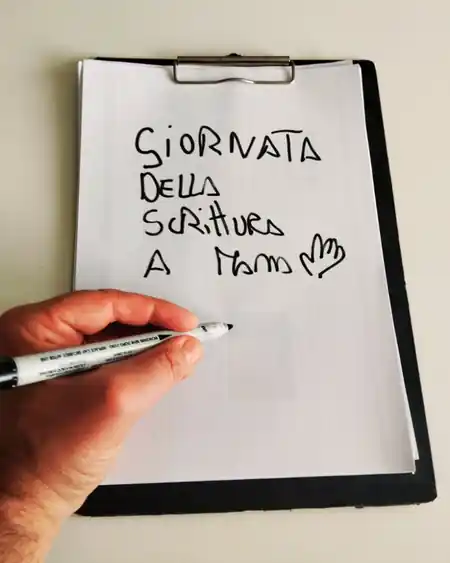
My coach's clipboard, where I scribble and take notes
Psychologists at Princeton University conducted an interesting test with 65 university students. Divided into groups, they watched a TED Talk and were asked to take notes in one of two ways: on a laptop without Internet access or with pen and paper.
After watching the talk, they performed other tasks to distract them from it, then immediately answered questions about the video to assess their understanding.
The study found no significant difference between the groups in recalling factual data, but those who took handwritten notes showed better conceptual understanding than those who used laptops.
Another study, by the Norwegian University of Science and Technology, showed that handwriting activates neural circuits that facilitate learning and memory. Electroencephalograms monitored students' brain activity as they wrote by hand or typed, revealing greater brain connectivity in the first case.
Handwriting requires deeper processing of information, encouraging more effective learning.
It also encourages creativity:
handwriting allows thoughts to flow more naturally and creatively through its direct connection with the brain and body.
A reminder that 23 January each year is World Handwriting Day.
Do new things
Try to do and see different things. Travel is ideal, but small daily changes also help: try a different café for breakfast, walk a little further and catch the underground at the next stop, and so on.
Unfortunately, routine kills our creativity and switches on autopilot!
Curiosity improves creativity
Be curious. Curiosity is our mind's personal trainer: explore, explore and explore.
"I am not a genius; I am just curious. I ask many questions, and when the answer is simple, then God is answering." (Albert Einstein)
Curiosity, together with powers of observation, is a fundamental soft skill for people in marketing and, more generally, for anyone seeking new solutions and ideas.
Studies have shown that, psychologically, people who are more open to new experiences are more likely to be curious and creative.
Neurologically, curiosity is associated with the mesolimbic reward system. This system releases dopamine, a neurotransmitter associated with pleasure and motivation.
Cultivate writing
Write. Make an effort to write. Keep a diary or post on social media and/or your own blog: writing helps the brain visualise and express a concept, exercising our neurons.
I have experienced it first-hand: writing a book and consistently posting every day on LinkedIn greatly increased my ability to think and concentrate.
You need a goal!
Think Week: Bill Gates's week of thinking
Bill Gates, one of the last century's most brilliant minds and the leading figure in modern philanthropy, used the Think Week technique.
We could call it a focused combination of some of the techniques we have seen.
For a week, disconnect from technology and retreat to a place immersed in nature, free from the stimuli of society.
Your only companions are books: all those you have not read and consider stimulating, activating an intellectual journey.
In the following clip from the Netflix series Inside Bill's Brain, Bill Gates enters his retreat, a small house on Hood Canal in Washington State, carrying a bag packed with books.
Another important element is taking notes with pen and paper.
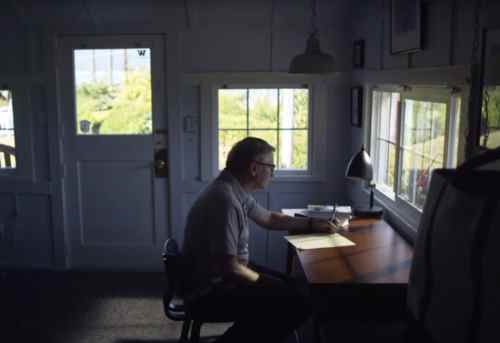
This helps clear our minds and makes us more focused and creative.
If we cannot manage a week, even a weekend can be enough.
Use the power of emotions
Emotion boosts creativity: seek and nurture it. Remember that it is emotions that distinguish us from machines and AI; in some cases, a good idea is also measured by its ability to move people.
Do you know how Rocky, written by Sylvester Stallone, came about?
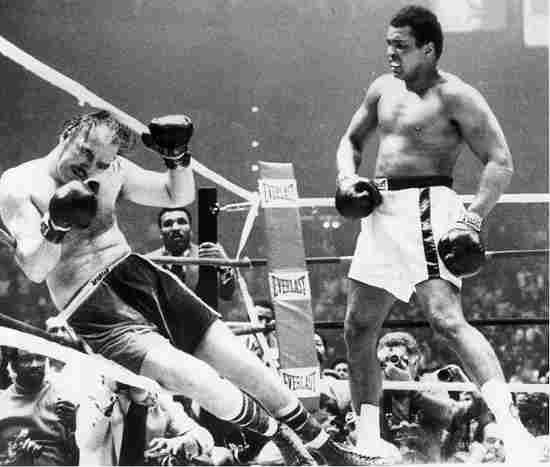
It grew out of the writer's emotional experience watching the fight between Muhammad Ali and Chuck Wepner. After returning home from the match, Stallone wrote the screenplay in just 3 days: the story of Rocky Balboa and Rocky Marciano.
More is better: creativity needs quantity!
Quantity creates quality.
Quantity is fundamental to creativity. We need a continuous flow and sooner or later a good idea will emerge by chance — or at least we hope so.
Quantity also sharpens the quality of your thinking.
"It is better to have enough ideas for some of them to be wrong that be always right by having no ideas at all".
"It is better to have enough ideas for some of them to be wrong than to be always right by having no ideas at all".
(De Bono)
The brainstorming technique
The word brainstorming automatically blocks my ideas: perhaps it is performance anxiety? When you want to hold a brainstorming session, do not announce it immediately. Approach it gradually and naturally. Warm up the atmosphere, perhaps by having fun first 😊
Brainstorming is sometimes overused and often overrated, but done properly in the right contexts, it can be useful.
Meditation 🧘 improves creativity
Meditation relaxes our brains and helps train imagination.
Techniques such as Mindfulness are fine; I prefer Autogenic Training. Five to ten minutes in the morning gets the mind off to a strong start.
Meditation is also excellent for activating Scatterfocus Mode.
David Lynch, the visionary director in cinema and contemporary art, known for his surreal, dreamlike approach, said:
Ideas are like fish. If you want to catch little fish, you can stay in shallow water. But if you want to catch big fish, you have to go deeper."

Lynch believed it was important to embrace mystery:
"You do not have to know everything. Some things happen in the subconscious."
His secret was transcendental meditation, which he practised consistently and considered essential for releasing creative potential and connecting with the subconscious:
"Through meditation, you enter an ocean of pure awareness and creativity. Everything is there, waiting to be discovered."
Lynch taught us that creativity is a form of exploration, a search without rules that allows us to dive deep and discover our true selves.
Spend time and play with children
Spend as much time as possible playing with children. They can teach us a lot because they have a high capacity for lateral thinking that adults have killed with mental patterns.
Children are magical: they awaken our imagination and help us be less serious!

Children's questions have the power to transform the world because they are free from conditioning.
The great genius Edwin Land knew this very well when holidaying with his family in Santa Fe, New Mexico, in the 1940s.
Like any father, he was taking photographs of little Jennifer when his curious 3-year-old daughter asked:
“Daddy, why can't I immediately see the picture you just took of me?”
This began the story of the first instant camera, with Edwin Land's launch of the Polaroid Model 95 and then, in 1972, the Polaroid SX70 with colour prints.
Randomness, chaos and disorder
When people suggested to Einstein that his cluttered desk might negatively affect his mental order, he replied:
“If a cluttered desk is a sign of a cluttered mind, then what is an empty desk a sign of?”
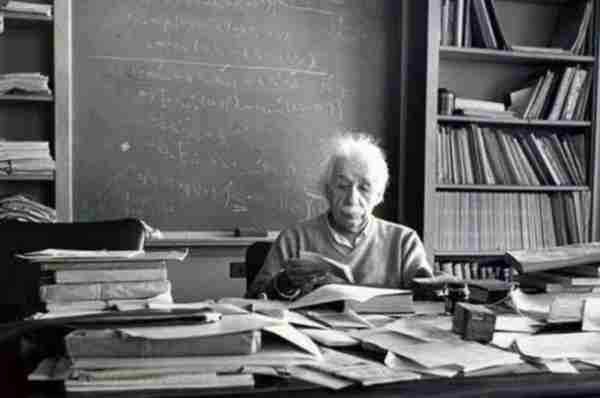
The legendary Albert seems to have borrowed this quote from psychologist Laurence J. Peter.
But perhaps the physicist's most famous quote is:
"Good ideas emerge from chaos" A. Einstein
Scientific studies by the Center for the Study of Mind and Behaviour at Princeton University found that creativity prefers disorder and randomness of thoughts, feelings and perceptions — just watch children play.
Be careful about using this as an excuse for our mess: other studies by the Center showed that visual clutter reduces productivity by distracting the brain.
These findings do not contradict each other: the creative process is inherently much less productive and follows an uneven course.
Chance is creativity's main ally.
It acts as a hidden force, suggesting unique combinations to our brains.
In my view, the quickest, most practical aid to creativity is using random-stimulus tools — the link leads to the one I created for myself.
The magic happens when you combine completely different concepts and ideas.
To innovate and stand out in modern business, we need to manage chance well. I like to call this approach "incidental marketing".
So we can say that every so often we need to learn to let go, reduce control and immerse ourselves in chaos.
A creative workstation: personalise your working spaces
Edwin Earl "Ed" Catmull is Pixar's co-founder, a winner of the Turing Award in 2019 and one of the fathers of computer graphics. In 2014 he wrote Creativity, Inc.: Overcoming the Unseen Forces That Stand in the Way of True Inspiration.
The book recounts his experience at Pixar, a company where creativity is the daily bread.
Catmull says that a good team matters more than a good idea. Never blame individuals for failures: always hold the whole team responsible.
An interesting recommendation in his book is to encourage employees to decorate their workspaces.

Creating a stimulating environment that reflects us increases creativity.
Today's workspace design focuses heavily on flexible desks in large open spaces, but these unfortunately do little to support personalisation.
Fortunately, there is remote and hybrid working which allow us to move towards a creative workstation.
If we can carve out a small space at home, we can personalise it far more than would ever be possible at the office.
This can help both creativity and productivity.
Personally, I have invested a lot in creating my workstation and it was money very well spent. BTW, I am selling a 110×80 wall whiteboard because I am upgrading my current one 🙂.
Continuous learning: always learn new things
Airbnb co-founder Brian Chesky says:
I try to learn something new every day. It could be anything! To be creative, you need to know how to connect different ideas.
Reading every day and cultivating broad interests increases the likelihood of combining different concepts, the foundation of creative thinking.
A simple, effective technique is to keep a diary in which we write every evening what we learned that day. If nothing comes to mind, I suggest a random Wikipedia search — I use this link to quickly fill the gap :-).
Metaphors and analogies
A childhood experience left a lasting mark on my life 😊. In middle school I had an exceptional maths teacher who could uncork our immature minds.
During lessons, he constantly used metaphors and analogies that surprised our brains and let us visualise and understand every concept clearly. I fell in love with it.
That mindset stayed with me. Whenever I think of a concept, my mind automatically sees metaphors. Unfortunately for those around me, I voice them too, although I am not as good as my teacher 😊.
Over time, I explored the subject to see whether I should break this habit or whether its side effects were not so bad after all. I discovered that metaphor is very useful for training creativity because it:
- develops imagination
- takes us out of our comfort zone and lets us see things through a different frame
- allows us to solve problems in original ways by comparing different concepts
As the following TED video explains beautifully, metaphor opens up new worlds!
Work and effort: only those who act create
A beautiful quote by Pablo Picasso about creativity says: “Inspiration exists, but it has to find you working.”
We could rephrase it: help yourself and creativity will help you!
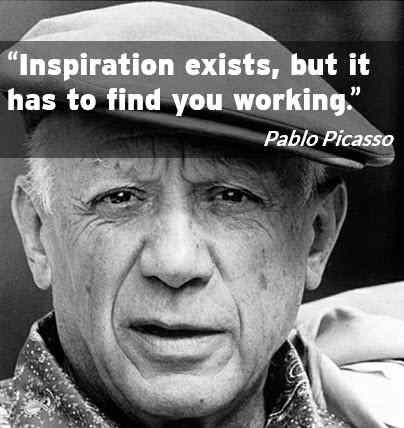
A musician spends days searching for the right sound, then inspiration appears as if by magic while shaving or driving. It comes because we worked beforehand! The brain was prepared. It is like a striker scoring thanks to the team's earlier work.
In any job that creates content or requires creativity, it is important to act and start doing, rather than wait for magical inspiration.
The Greek poet Alcaeus (Poems, IX, 15) said:
“Could nothing come from nothing?”
Niccolò Machiavelli wrote in his comedy La Mandragola:
“One thing leads to another, and time governs it.”
Conclusions
This is a living list that I constantly update as a reminder for myself — at least online I will not lose my notes :-) — recording useful techniques and resources. If you have one to suggest, write to me on LinkedIn.
Our lives are determined by the goals we set and the choices we make, but ultimately everything depends on the value of the ideas we generate!
So the best investment is improving the quantity and quality of our ideas!