
Major changes in society always result from a combination of factors, particularly external effects and favourable circumstances.
The great change in how we work that is sweeping the world through smart working is no exception.
The digital revolution provided favourable circumstances for the external event of the health crisis to prompt a reconsideration of standard ways of working.
The definition taken from Treccani says:
Flexibility provided for by law within an employment relationship, intended to increase productivity and accommodate employees' personal needs. | In practical terms, the type of work to which such flexibility applies.
When is work smart? 🤔
In Italian, it is often translated as “agile work”, but personally I find it reductive to confine this paradigm shift to agility alone.
What smart working is and is not, and how it differs from remote working, has sparked extensive debate. But what is intelligent work, and when can we consider it such?
My interpretation:
work is smart if it can combine professional performance with quality of life.
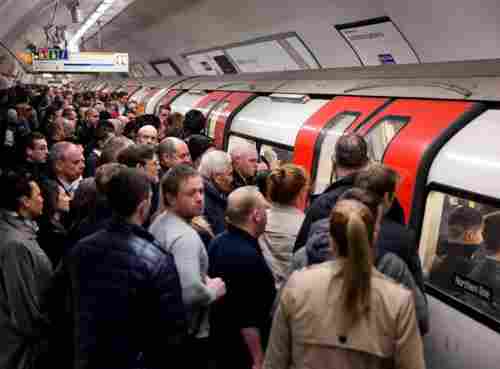
If, instead of spending two hours on the underground or ring road getting to work, we could spend that time with loved ones or exercising and enjoying the miracle of nature, how do you think it would affect our intellectual performance?
Higher-quality use of time translates into greater productivity and motivation.
Each of us can find a new balance, and it all begins with one key factor: FLEXIBILITY.
Flexibility in time and location.
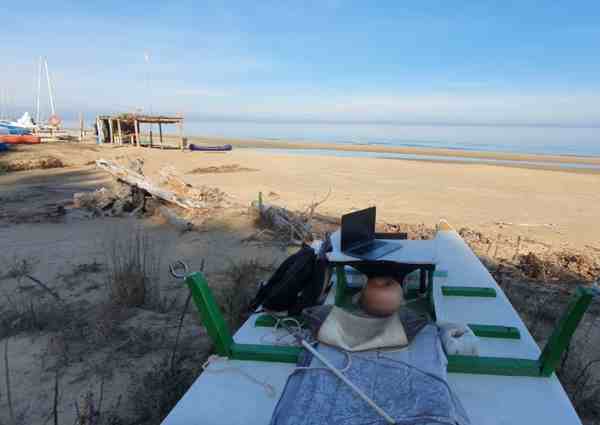
Companies' success and results will increasingly be linked to the quality of life of the people who work there.
Clearly, some companies are more ready for smart working than others, and some types of work are more flexible, but it is an unstoppable process.
The subjectivity of value 💰
We are not all the same, and we do not all have the same circumstances. A single 25-year-old has different needs and circumstances from a 45-year-old woman or man with a family.
Personally, I have worked in Milan since 1999. At one point in my life, my wife and I decided to have and raise our daughters in our home region, in a lovely seaside town on the Abruzzo coast. From then on I became a long-distance commuter, travelling up and down every week (600 km between home and Milan).
Now imagine what it meant to me to be able to do the work I love in the place I love, close to my family!
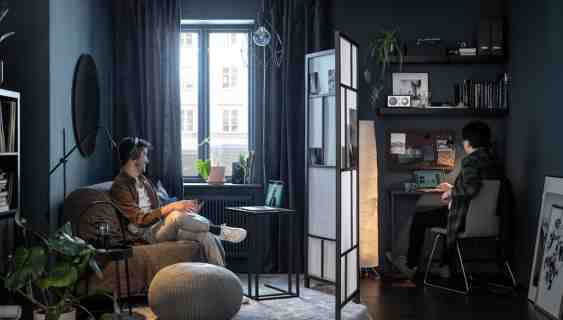
Conversely, for someone living in a small home and/or sharing with several people, not far from the office, the possibility of working somewhere other than the company is fairly irrelevant, if not a problem (except perhaps during holidays). During lockdown, these groups suffered more than others.
If we add that the offices are very welcoming and equipped with every comfort, the choice becomes obvious.
New awareness and work–life balance ⚖️
In every newspaper, we have read about the Great Resignation phenomenon (the Great Resignation, Big Quit), which began in the United States but also spread to Europe.
People preferred to leave their jobs rather than return to the office. According to McKinsey research, as many as 36% of them resigned without another job lined up.
But if we think the number of quits is entirely a result of COVID, we are profoundly mistaken.
Data published in Harvard Business Review (HBR) about the US market (shown below) reveal that voluntary resignations are a trend that began several years ago.
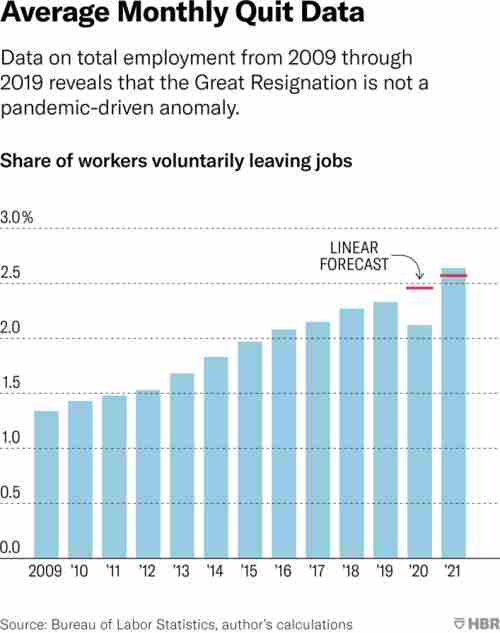
The phenomenon slowed in 2020 because of the health crisis, then resumed immediately in 2021 with greater force.
COVID further strengthened the driving force behind this phenomenon: a new awareness of the relationship between life and work.
A new process of understanding life's priorities and focusing on the most important values.
Another study, also in HBR, conducted between June and July 2021 found that more than 40% of US employees would start looking for another job or leave immediately if ordered to return to the office full-time.
Talent, purpose and non-monetary factors 🏄
Various surveys and analyses by recruitment firms have highlighted that pay alone is no longer enough to attract the best talent.
The most sought-after factors are:
✔️ flexible working hours
✔️ location flexibility (working wherever I want)
✔️ training and continuous skills development
✔️ services supporting everyday and family life (gym, childcare, and so on).
Companies need to realise that, to attract the best, they must work on what we might call non-monetary remuneration.
Large companies find it harder to address certain needs, and it is not uncommon for young people to prefer smaller, more dynamic companies. The old concept of security is perceived less and less (partly because even banks no longer offer all that much security).
Another rapidly growing factor is the search for purpose in one's work, within a corporate vision that goes beyond profit alone.

The search for meaning is strong among younger generations and is spreading to others too.
In the context of positive psychology, Martin Seligman clearly explains the importance of the M = Meaning factor for our happiness.
South Working 🌞🌞
Among the striking effects of smart working, we cannot fail to mention south working!
In particular, we should highlight the phenomenon of people returning to their home regions thanks to flexibility.
Many bright young men and women had to move to northern Italy to find work. They now have the opportunity to return to the south, bringing their knowledge and experience with them.
This leads to the emergence of new, highly skilled businesses that can give work in southern Italy a new face.
One lovely story is that of Alessio Lorusso, who founded Roboze in Bari (his interview with Montemagno is below).
Starting in his father's workshop, he developed the mechanical and electronics skills that enabled him to create a unique 3D printer we might call a “clockwork printer”: it has gears rather than belts, allowing it to print with a precision of up to 25 microns!
Today they have customers all over the world.
The wonderful thing is that they can now draw on the best talent in the field and help create an entire supporting industry.
Puglia is a striking example of growth in southern Italy driven by the service sector: tourism and new technologies.
Digital nomads ✈️ and New Life families 👪
The first to exploit the flexibility of the technological revolution were digital nomads (DNs). We can say they were the first to create smart work.
Clearly, here we are talking about consulting contracts and particular professional roles: designers, developers, copywriters, and so on...
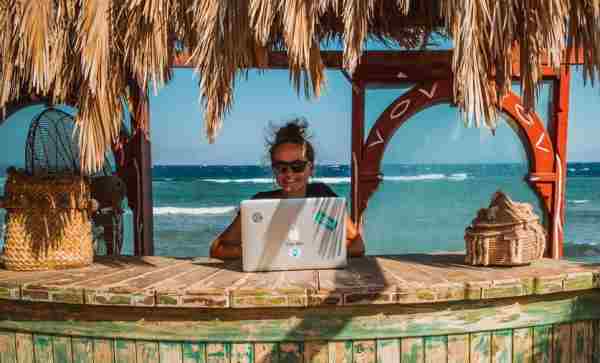
Typically, they are young workers and/or travel enthusiasts. DNs can travel the world, needing only a computer and an Internet connection to do their job.
As well as travelling the world, DNs seek locations with a lower cost of living, making their fees worth more in that context.
Today there are more than 30 million DNs worldwide.
In a model of complete flexibility and full smart working, the nomadic employee could emerge: someone with an employment contract who travels the world like a digital nomad.
Another interesting phenomenon (in which I recognise myself) is what we might call “New Life Families".
These are families seeking a new life centred on achieving work–life balance for the family as a whole.
I find a place with a better quality of life and move the whole family there, and thanks to smart working I do not have to change jobs.
I think this phenomenon, if supported by companies, could change our societies for the better and make cities more liveable too.
It would also be a great help to families struggling financially to get by in large metropolitan areas.
Clearly, these opportunities are feasible for all knowledge work that does not require manual activity tied to a physical location.
Brian Chesky, Airbnb's CEO, says: “People can go anywhere and work anywhere. There is a sense of freedom they have never had before.”
But if we move around while continuing to work, how important is a good Internet connection at our host's property?
Changes in lifestyles and behaviour create new needs and/or change the importance of existing ones. Airbnb picked up on these signals and understood that, in this context, a good Internet connection at hosts' properties is no longer an optional extra but has become essential.
To measure the quality of the data connection, the company that began with air mattresses launched verified host Wi-Fi.
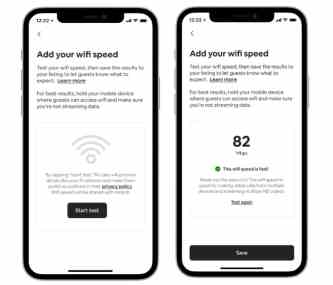
In each property's online listing, the host indicates Wi-Fi availability and speed. What is new is that, to ensure the speed figure is reliable, Airbnb's app fills it in after running a speed test inside the home.
Could working lives become longer? 👴
In 2022, at the age of seventy-seven, Howard Schultz returned (temporarily) as CEO of Starbucks. It was not his first comeback: after retiring in 2000, he had already returned in 2008 during the financial crisis (twice, like Michael Jordan 😂).
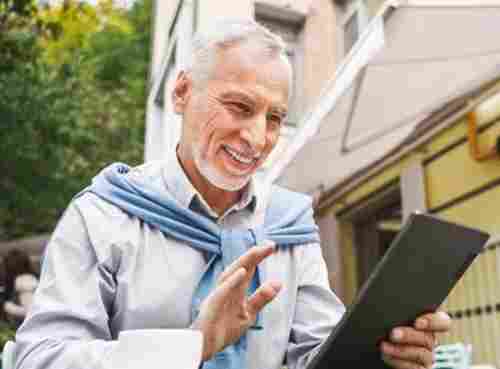
Schultz's case captures a phenomenon underway in the US: retirees returning to work 💪
The comeback can be explained in small part by the familiar need to feel active (and the associated adrenaline), but two other factors have joined and combined with it:
✔️ The need to fill the skills gaps created by the Great Resignation
✔️ New ways of working, increasingly independent of location, are leading people who were tired of spending their time travelling or commuting to reconsider their choices.
Work becomes less physically and mentally tiring.
In practice, smart working can greatly extend a person's working life.
New technologies and virtual reality 💻
Today's technology allows us to join meetings with several people through our camera, share documents and presentations, and work on them collaboratively.
But how might this evolve?
Through Meta, Mark Zuckerberg launched Horizon Workrooms, a free app allowing owners of the Oculus Quest 2 AR headset to hold virtual meetings using avatars of themselves (the image below shows a Facebook meeting) and enjoy a fully immersive experience.
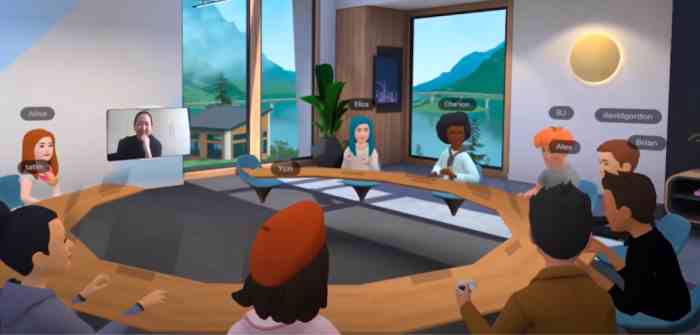
Users can see their computer screens and keyboards (they can even scan their desk), interact with colleagues and give presentations (up to 16 avatars and 50 participants), sharing their screen as shown in the image.
They can also use a virtual whiteboard, with the Oculus controller acting as a pen when turned around.
At the moment, the avatar is effectively a cartoon, but technology could soon allow us to scan our body and project it realistically into the meeting.
Horizon Workrooms should be seen within Mark's strategy to become the reference point for building metaverses.
So far, the best immersive experience I have ever had in a video meeting was with Cisco telepresence.
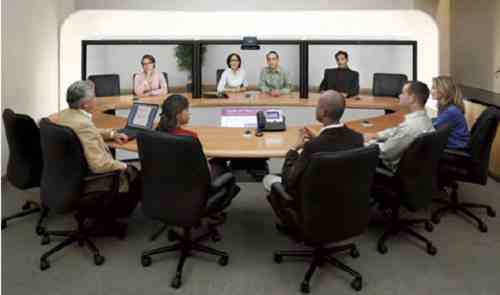
In practice, as the image above shows, there is a meeting room with two mirrored sides for participants connecting from two different locations, equipped with monitors and directional speakers. The effect is that it feels as though you are sitting next to one another, and the audio is directional.
Personally, though, I do not see it as a solution for the future because of its costs and the contexts in which we now hold meetings.
For meetings combining in-person and video participation, holographic projection is probably the best method, but today this technology is still very expensive and inflexible.
Personally, I think trying to reproduce a real experience digitally can be a limiting approach. What is interesting is being able to use functions in the virtual world that are not possible in reality.
Hybrid work 🧬
When we talk about hybrid work, we mean the possibility of combining office work with smart working.
This combination may arise from the employee's wishes or from specific company rules.
In the first case, the person decides whether to go to the office according to what needs doing, within a fully flexible employment agreement.
In the second case, the starting premise is that at least x% of working time must be spent at the company's offices.
After the full smart working required during the health crisis, there is fairly widespread awareness that there is no going back, and that the right degree of flexibility must be offered.
It should be said that some companies were already moving towards hybrid working before COVID, with one or two smart-working days a week.
Hybrid work is a reasonable post-pandemic compromise that works for most employees.
However, in-person activity must have a different purpose, otherwise we risk simply having people connect to meetings from a different location.
At the office, it is useful to hold team meetings, events, deep dives into particular topics, team-building activities or simply lunch together 🌭.
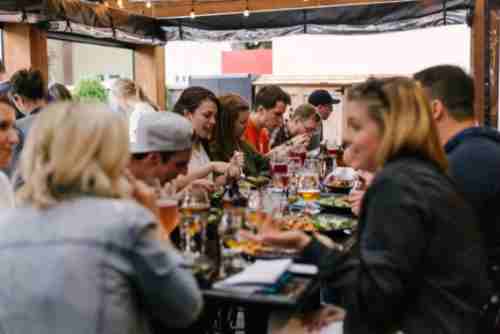
“New Life” families and digital nomads fall outside this model, and we need to understand how companies intend to accommodate them.
I am optimistic about this, because companies have understood the need for flexibility in managing employment relationships too, and different arrangements can be defined according to people's needs.
For young people, spending time at the company helps them absorb its culture and professional know-how. On the other hand, we must be careful not to create first-class employees (in person) and second-class employees (remote).
The model's critical success factors: goals, responsibility and self-discipline 🚴
Are we all ready to work remotely with complete flexibility?
This is a legitimate question for many companies and managers.
The answer is no!
To manage teams effectively, it is essential to think in terms of goals.
We could use a university analogy: the goal is the exam (in reality, it should be knowledge), and we use our time to be ready for the test.
But working towards goals is not enough. People need two important qualities: responsibility and self-discipline.
The first means, to borrow a term from the GDPR🤪, accountability: working on projects with the appropriate intensity and attention.
The second element is what, in my humble opinion, brings everything together:self-discipline.
Discipline is what you find in the military, for example: you must act and obey the rules, otherwise you will be punished!
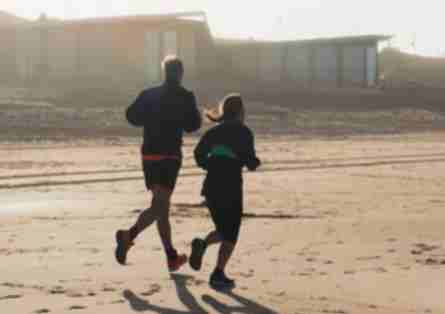
Self-discipline is something within you. It is the engine that gets you up early in the morning to endure the effort of exercise. Nobody forces you to do it, and there is no pay for the activity.
In smart working, you are on your own, and without self-discipline you will struggle enormously to move projects forward.
If you do have this ability, however, you can make the best use of your time, especially the time recovered from the overheads of office work (commuting first and foremost).
NOTE: these elements matter in office work too, but in a flexible, autonomous model they become essential.
New models of fluid work
The eight-hour working day was introduced in Italy in 1923. Little has changed since then, while productivity is incomparably higher.
What might the future of work look like?
I imagine a gradual shift from employment to consulting, with skills brought together from project to project as needed.
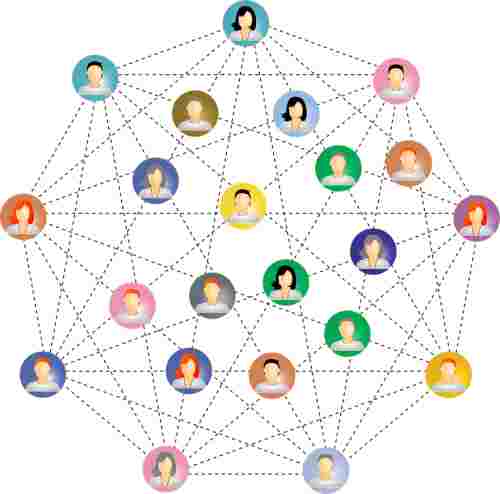
A vast network of people scattered around the world, able to decide how much time to work and from where.
In 1930, the great economist John Maynard Keynes predicted that by 2030 people would work no more than 15 hours a week.
In the future, with widespread robotics and artificial intelligence, the critical success factor will be creativity.
With more free time being created, we can imagine growth in travel, culture and entertainment.
A personalised smart-working workstation
Anyone passionate about cycling 🚴♀️ or other sports requiring specific equipment (skiing, tennis, kayaking) knows how important it is to adapt that equipment to their physical and technical characteristics, to perform at their best and enjoy the activity.
The wrong bicycle size and/or an unsuitable saddle can profoundly change the experience.
So why not do the same for our workstation?
Smart working offers us a great opportunity.
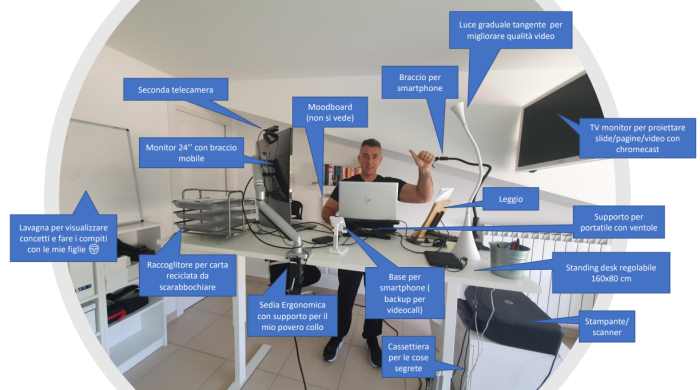
For legitimate reasons, the office gives us a standard bicycle, but at home, subject to practical constraints, we can let our imagination run free.
In the morning, I cannot wait to settle into my chair, switch on the monitors and get going. I feel as though I am at a spaceship's console, and my productivity has increased considerably.
Video communication fatigue 😓
Personally, I spend very little time in front of the mirror, and smart working has accentuated this (my theory is: out of sight, out of mind 😂). On the other hand, spending so much time in video meetings means I actually have to look at my face more than I would like.
Recent research by Michigan State University, the University of Central Florida and Stanford University offers an explanation for why some people seem to experience more fatigue in virtual meetings than others (now commonly called Zoom fatigue).
In essence, the study says:
if you do not like the appearance of your face, staring at it on your computer screen for long periods is psychologically exhausting.
If we do not have a good relationship with our face, the easy solution is not to turn on the camera, or not to keep it on all the time.
However, not showing yourself breaks the new online etiquette: it would be like talking to someone in the real world while covering your face or standing behind a wall.
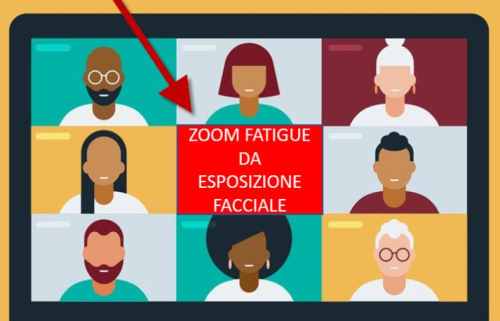
In this case, though, we could excuse ourselves by displaying a nice sign reading: “Zoom fatigue from facial exposure” 😂😂😂