
I remember years ago, outside a well-known gym in Milan, two instructors/personal trainers happily smoking at the entrance, with their rather prominent bellies on display 😂😂
I wondered how credible an instructor who is supposed to get me fit and healthy can be if he does not follow the rules required to be that way himself?
If you do not believe in it when it is your job, why should I!
I think I am an open-minded person rather than an extremist, but one thing I have learned is: an example is worth a thousand words.
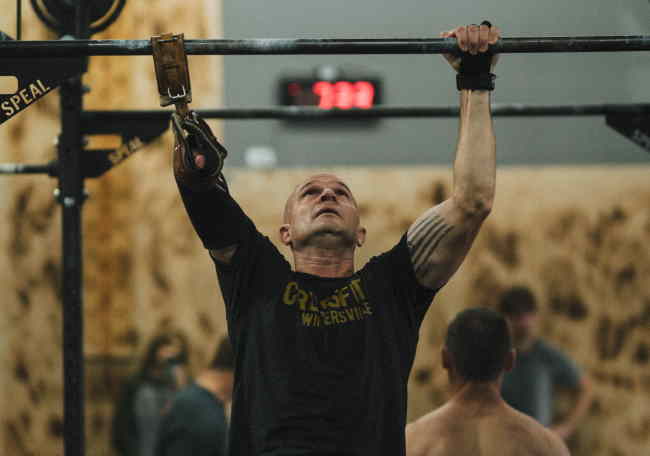
Advice is judged by results: both the results achieved by the person receiving it and those achieved by the person giving it (including past results). Otherwise, anyone could teach anything.
People learn more from what you do than from what you say!
Moreover, if you do something with passion, you will also convey why you do it, reaching not only people's minds but also their hearts and motivation.
These concepts can apply in countless contexts: raising children, managing a team at work, sport, a brand's reputation.
If we want our children to respect others and nature, read, play sport and so on, we must be the first to do those things consistently.
The highest expression of example is inspiration!
The story and actions of some people inspire others.
For those who love travelling ✈️, the decision to explore a new destination often begins with another traveller's story. These stories serve two purposes: making us aware of a new place and showing that the journey is possible (particularly for more complicated, adventurous trips).
Likewise, in many fields pioneers have opened new paths that many others have subsequently followed.
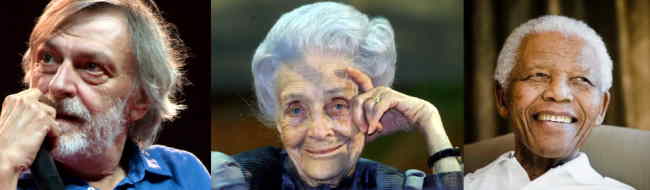
This is how humanity grows and progresses in every field.
“Senna was an inspiration and, although 20 years have passed, his spirit lives on in every racing driver.” — VALENTINO ROSSI
When I was a boy, the paths open to me in life were shaped by the context in which I lived and the information I took in.
Today there are far more possibilities, and many more stories and paths already mapped out that can inspire young people (and help them find new ones).
Many people do not know that certain paths exist. If they had the opportunity to hear others' stories and draw on their experience, they would discover new routes that have already been mapped out.
The unknown frightens us, but knowing someone has already been there gives us confidence and makes us realise we can do it too.
The problem is that positive stories do not get enough exposure. You have to be lucky enough to stumble across one, and it will help you find your way. Crime news and political conflict circulate far more widely (because of negativity bias) than inspiring life stories (not just professional ones).
Sometimes it almost seems as though we prefer to look at those who are worse off to console ourselves rather than look beyond.
In my humble opinion, based on what I have observed for some time, we need to make peace with other people's success (in everything, from a small task in the office to fulfilment in life) and criticise less, looking for the best in those who try and those who act, rather than eagerly awaiting someone else's defeat.
Life is not a race 🏃, it is a journey ✈️ we all take together.
I think we Italians have unique potential, an unmatched combination of history and genetics. But a Ferrari sitting in the garage with no fuel 🏎️ is less useful for getting us somewhere than a rusty bicycle.
We need to circulate as many inspiring stories as possible; we need to surround ourselves with positive examples.
Let us tell the stories of people who have found a purpose, follow a passion or nurture a dream; the stories of people who refuse to accept limits and cultivate their potential.
Let us fill schools with personal accounts: an example is worth a thousand words. These are not American gimmicks, and if they are, they are worth copying.
In world of marketing one of the most inspiring speeches is Gary Vee's, in which he shares his experience and the importance of consistency and perseverance. Everyone who wants to start something should listen to it.
Context and example
In 2022, the Nobel Prize in Medicine went to the Swede Svante Pääbo for his studies of the hominin genome.
What struck me is that his father won the same prize in medicine 40 years ago for his studies of prostaglandins (the only difference being that the son won it alone, while the father shared it with Bengt I. Samuelsson and John R. Vane).
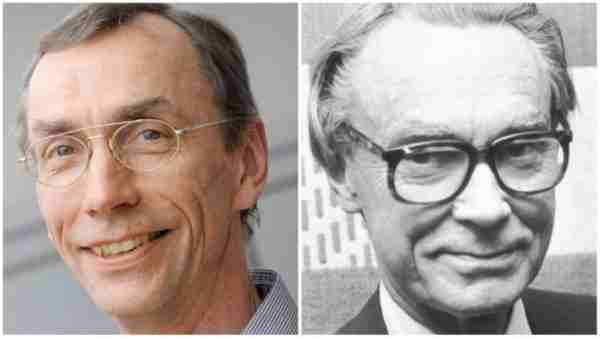
The probability of winning a Nobel Prize is extremely low; imagine winning two in the same family.
I thought this was very rare, but it turns out it is not!
The Curie family swept up no fewer than five prizes. The great Marie Sklodowska even won two (in chemistry and physics); her husband Pierre also won one, and 32 years later their daughter Irène Joliot-Curie, with her husband Frederic, won in chemistry for discovering artificial radioactivity.
Joseph John Thompson won the Nobel Prize in Physics in 1906, and his son George Paget received it in 1937 for his studies of radioactive particles (already studied by his father).
Aage Bohr was awarded the prize in 1975 for discovering the connection between collective motion and particle motion in nuclei, building on the discoveries of his father Niels, who had won the Nobel Prize in Physics 53 years earlier for his studies of atomic structure.
Hans von Euler-Chelpin won the prize in chemistry in 1929 for his studies of the enzymes responsible for sugar fermentation, and his son Ulf von Euler won the Nobel Prize in Medicine in 1970 (for his studies of noradrenaline).
Roger David Kornberg was awarded the chemistry prize in 2006; fifty years earlier, his father Arthur had been awarded the Nobel Prize in Medicine.
In 1915, a father and son even won the Nobel Prize in Physics together. They were William Henry Bragg and his son Lawrence. To this day, the latter, aged 25, is the youngest person to have won the coveted prize.
The brothers Jan Tinbergen and Nikolaas Tinbergen achieved an impressive double four years apart: the first won the Nobel Prize in Economics (1969), and the second the prize in medicine (1973).
All these cases support the theory of context and example (as well as genetics):
if I live in an environment that provides stimulation and knowledge, my level rises until it at least reaches that of the people around me.
In a company (but also in sport and society), this means having the best talent, because those people will raise everyone else's level too.
Kobe Bryant's example in changing a team's mindset
After the glory of the 1992 Olympic Dream Team (with Michael Jordan, Magic Johnson, Scottie Pippen, Larry Bird and Charles Barkley), the USA basketball team gradually lost its edge. The American champions were eliminated at the 2002 World Championship, the 2004 Athens Olympics and the World Championship in Japan (2006).
Although the United States always sent NBA champions (before the 1990s it sent college players), this was no longer enough to win.
What was missing was the right mindset, the desire to win, the desire to fight on the court.
Netflix has a good documentary called “The Redeem Team”: the team seeking redemption.
The documentary follows Team USA's preparations for the 2008 Beijing Olympics.
Once again, the team is made up of champions, and this time the great Bryant is among them.
Kobe is a solitary character, not known for being outgoing, and the team gives him a cool reception.
But at the first training session, the difference between him and the others becomes clear: he fights for every ball and dives as though it were the last ball of the NBA final (recall Borg's technique for improving concentration).
The effect is that everyone, seeing the champion's example, increases their intensity, and training sessions become much more productive and effective.
Kobe makes it clear that you need to work hard on every aspect of the game, not just offence but defence too, without shying away from the dirty work (meaning the less spectacular little things). He does this by setting an example in every training session.
As they prepare for the Olympics, the players move to Las Vegas to train. In the evening everyone wants to go out and have fun, and they all go clubbing except one: Bryant.
In the documentary, the USA national team players recount how, returning from a nightclub at 6 am, they met Kobe Bryant already drenched in sweat. Having finished an initial training session (at 5 am), he was ready to work out with weights! 💪💪
The players are struck by the champion's dedication and discuss it among themselves. The result?
First LeBron and Wade, and subsequently all the players, started getting up early to train, following Bryant's training schedule.
This is the power of example: there is no need to speak, just let actions do the talking.
Kobe had passed on his attitude, his mindset, to the whole team.
At that point, the results came, and the United States finally regained Olympic gold 🥇, beating Spain 118–107.
Good coaches build teams around their champions' attitude and example, because they know this will raise the level of the entire team.
The responsibility of setting an example
During the quarter-finals of the 2022 football World Cup in Qatar, after an extremely hard-fought match, Argentina beat the Netherlands on penalties.
As soon as the players realised they had won, many of them thought it appropriate to mock their Dutch opponents, as the following photograph shows (notice, in contrast, the behaviour of champion Messi, who is only thinking about celebrating).
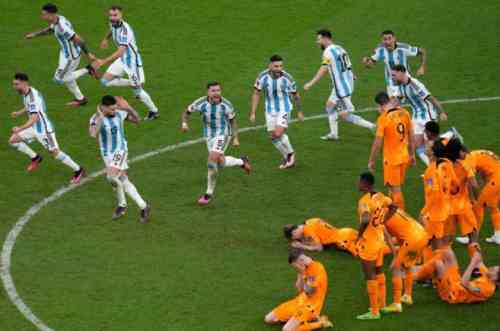
In the match before this one, Brazil had been eliminated by Croatia.
At the end of the match, Leo, the son of Croatian player Perisic, went to console Brazilian champion Neymar.
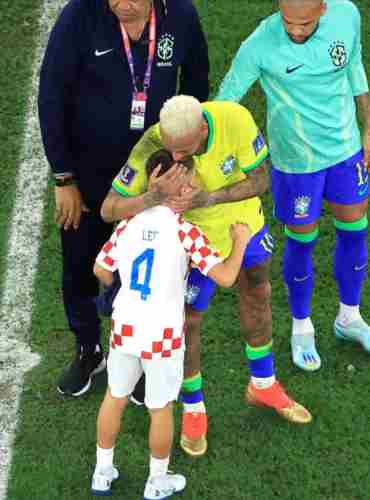
Two examples with opposite values.
The Argentinian players probably had their reasons for seeking revenge, but they set a bad example for hundreds of millions of people, an audience including huge numbers of young football fans.
They had an opportunity to show what respect means and how to separate competition from the individual.
Instead, it was a child who set the finest example, with a pure and wholesome gesture.
It is a fact that those who enjoy the greatest visibility have a great responsibility and must be aware of the impact their behaviour can have on others.
Unfortunately, because of negativity bias the Argentinian players' gesture received much more exposure than Leo hugging Neymar.
Young people are the future, and a better future requires positive examples.
Because young people absorb more from what they see than from what they hear.
We are all influencers
Each of us influences those around us. In particular, our example has an enormous impact on our children.
This effect is well illustrated by the video “Children See, Children Do” from NAPCAN (National Association for Prevention of Child Abuse and Neglect), the Australian organisation founded to combat child abuse and neglect and create a better social environment.
A positive example also generates what is called the domino effect of kindness, or Kindness Boomerang.