
The psychology of happiness is a recent approach to psychology developed by Martin Seligman. The underlying idea is to shift the focus towards human potential, rather than excessive introspection and the search for abnormal workings of the human mind.
We can also call it the psychology of positivity or psychology of personal development.
"The mission of psychology is to improve everyone's life” — Martin Seligman
In the video below, from a TED talk some years ago, Seligman presented his theories and the importance of introducing positivity into psychology.
What does the word happiness mean?
The Treccani dictionary definition:
The state of mind of someone who is serene, untroubled by pain or worries, and enjoys that condition.
In his latest book, "Flourish" ("Fai fiorire la tua vita" in Italian), Seligman presents his recipe for reaching this state: the PERMA model.
The model explains which elements lead to human happiness and well-being.
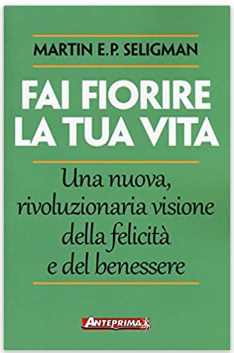 Link to the book on Amazon
PERMA is an acronym for 5 concepts that contribute to happiness:
- P — Positive Emotion
- E — Engagement
- R — Relationships
- M — Meaning
- A — Achievement
Let's look at them all, starting with P.
Creating positive moods and laughing at ourselves (P)
We need to inhabit positive states of mind, be able to focus on positive emotions, and have the capacity to be optimistic and see the past, present and future from a positive perspective.
A positive mood also has a considerable influence on creativity.
A very useful, practical tool for making life lighter is the ability to laugh at ourselves.
Training ourselves not to take ourselves too seriously helps put many seemingly problematic things into perspective.
Being engaged in activities (E)
In life, it is important to find activities that require our full engagement.
Everyone is different and finds pleasure in different things, whether playing an instrument, doing a sport, dancing, working on an interesting project or pursuing any hobby.
The activities that bring happiness are those that activate the state of "flow", that state of complete immersion and concentration in which time and space seem not to exist.
Good personal relationships (R)
Human beings are social animals and need strong emotional and physical interaction with other people.
Building positive relationships with your parents, siblings, peers and friends is important for spreading love and joy.
Having a purpose in life, a calling (M)
Having a purpose and a sense of why we are on this earth is important for living a happy, fulfilled life.
Such meaning gives people a reason to live and a sense that a greater purpose exists (see the Japanese concept of Ikigai).
Of the three questions — what, how and why — the last is the one that gives things meaning in the long term.
The concept of meaning is well captured by Phil Knight, Nike's founder, in his autobiography "Shoe Dog" ("L'arte della Vittoria" in Italian):
"I would tell those who are not yet thirty not to settle for a job, a profession or even a career. Instead, they should look for a calling. Even if they do not know what it means, they must look for it." (Phil Knight, founder of Nike)
The idea of a calling is wonderful (I think it applies to the over-30s too 😁) and helps raise the value of our work.
 Knight's book: the original title is Shoe Dog
Achieving goals (A)
It is important to have goals in life: achieving them allows us to fulfil ourselves and feel alive and satisfied.
We are, in fact, the goals we set ourselves.
Finally, let's have Seligman explain the PERMA model directly in this video from an event at the Royal Society for the encouragement of Arts, Manufactures and Commerce (RSA, a precursor to TED, founded in England back in 1754):