
Whatever you do, the best use of your time is to ask yourself first: what is the goal?
Our hectic lives often overwhelm us, and we lose the ability to step back and understand where we are heading and why.
About ten years ago, I came to understand the importance of setting personal goals.
I regret having done so late, but I am also pleased because it was a step that improved my life.
I would like to share my experience in the hope that it can help others.
How many times have we been asked the classic interview question: where do you see yourself in xx years?
To young people it may sound like a rhetorical question, but I believe it is very important for understanding a person's vision and their ability to set goals.
Even for a 77-year-old, as in the De Niro film.
Over time I have realised that we are the goals we set ourselves.
If we do not clarify what they are, someone else will do it for us and we will work towards their goals.
People often say we are the choices we make, but it would be better to say we are the goals we set ourselves.
To improve as people and as professionals, we need to cultivate the habit of setting goals.
Defining goals
How do you define your goals?
Personally, I create them twice a year, starting with these three categories:
❤️ Heart
🏃 Body
🧠 Mind
I define several in each category, then select no more than two.
The first category includes everything involving private life, family and love: for example, having a child, finding your soulmate, playing more with your children, supporting your partner in a goal, helping someone in difficulty, moving house to live near the sea, and so on...
The Body represents health. It is the most neglected area, yet paradoxically perhaps the most important, because without it we could do nothing. Typical goals might include starting to exercise regularly, running your first marathon, losing 10 kg, quitting smoking, and so on...
Finally there are goals of the Mind: skills, professional life and the world of work. For example, learning a new language, launching a blog (this very website was a goal 😂), becoming head of the world's leading cardiology centre, launching new product x, changing jobs, and so on...
“The greatest danger for most of us is not that our aim is too high and we miss it, but that it is too low and we reach it.” — Michelangelo
The most important part of defining goals is precisely to make our dreams and highest ambitions explicit.
This is also the hardest part, because our dreams may conflict with the current direction of our lives.
Our list must contain at least one highly challenging item.
If we are the goals we set ourselves, then we must aim high without being afraid of failure.
The best times to reflect on and write down goals are the Christmas holidays and August, so that we have a clear vision for the new year and our return to work.
Another good time might be our birthday. Of course, only if it falls at a different time from those mentioned: in my case, for example, my birthday is close to Christmas, so it does not work.
It is never too late to set a new goal, as the old Chinese proverb says:
“The best time to plant a tree was twenty years ago. The second best time is now.” — Confucius
Calendar and planning
Whatever the goal, it is important that:
- it is written down
- it has a date attached for achieving it
- there are details of what is needed to achieve it and what behaviours to adopt
Goals must be clear, measurable if possible, and have precise deadlines to meet (do not be vague).
Body goals are the easiest to monitor (weight loss, for example), while heart goals are the hardest.
Personally, I first scribble on paper and then transfer it to digital form.
For our goal to qualify as one, we need to set a completion date. This element is fundamental and distinguishes our list from a wish list.
The time needed to achieve a goal can range from three months to ten years!
That is normal: some activities take longer. Building your dream home, for example, takes more time than getting back into shape.
Finally, we need to write down what is required to achieve our goal: a little brainstorming about what we think we need.
For example, suppose I want to become a good cook and work in a restaurant within two years! I jot down a list: online cooking courses or evening classes, cookbooks, talking to someone I know who does this job, the equipment required, a list of restaurants where I would like to work, and so on...
It also helps to spell out what behaviours to adopt every day: for example, at 8 am I study a new ingredient, and in the evening I use it to try a new recipe.
These three elements are essential because our brain is an amazing machine once a destination and a few initial elements have been defined, it will start filtering all the information and stimuli it receives to make them useful for its purpose.
Remember the last time you decided to buy a car or another “important” item? Your attention focused only on those products and the information about them.
This is the phenomenon of selective attention which is triggered when we have a goal and some initial pointers about it.
The filter model developed by psychologist Broadbent explains how human beings are bombarded with messages and information every day. To save our brain's energy, we have a selective filter that regulates our attention.
Selective attention is the process of directing our awareness towards relevant stimuli while ignoring irrelevant stimuli in our surroundings. This is important because there is a limit to how much information can be processed at any given moment, and selective attention allows us to exclude insignificant details and focus on what matters.
When we set ourselves a goal and clarify the elements we need, we influence that selective filter.
Our brain will consider those elements worthy of attention and unconsciously retrieve all the relevant useful information, filtering out the rest.
With the help of this phenomenon and the first ideas that came to mind, we will build our action plan (for example, enrolling in an evening cooking class, helping a friend who owns a restaurant, putting our recipes online, making videos, and so on...).
Warren Buffett's 5/25 strategy for setting goals
- Write down the 25 most important goals in your life
- Circle only five of them, the ones you consider priorities
- Focus only on those!
This method reminds us that we must NOT let the other 20 goals we did not choose distract us. Once we have defined our priorities, our time must go only towards those.
Buffett starts from the simple premise that we have a limited amount of time and energy each day to achieve our goals. Yet, more often than not, we drive ourselves crazy chasing too many goals at once. This makes us lose focus and prevents us from following our plans.
Setting and tracking goals is a fundamental part of the art of improvement.
The times of year devoted to setting goals will also be devoted to checking progress on previous ones: some will have been achieved, while others (such as long-term goals) will still be in progress.
One tool that really helps me plan the year is a physical calendar!
I am a fan of digital tools, but I realise that for certain things the tactile element adds value.
Every year I print out a sheet containing all the days and months of the year and put it somewhere clearly visible near my desk (see the photo below).
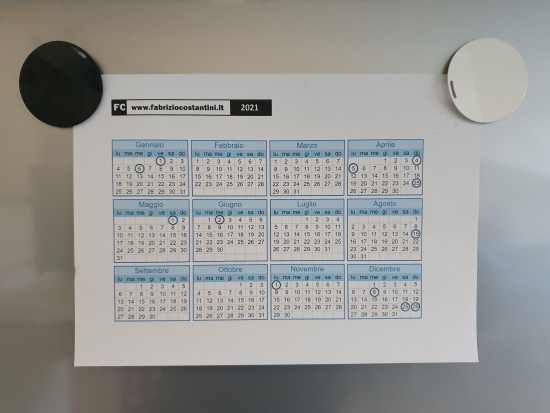
The “blank” calendar before adding notes and marking dates
This helps me a lot with planning my goals: I write on it and mark the milestones along my path.
If you think it might help you too, here is the printable 2025 calendar in PDF format (and the 2024 calendar). I have also added public holidays, so at worst it can help you plan trips!😁😁
The calendar helps us fight the procrastinator within!
Each of us can find our own techniques and motivations for filling the time until the deadline with action.
We all put something off, usually things we do not enjoy doing 😊, but the greatest sin is putting off our own dreams and desires.
One thing I have learned over time is that consistency and conscious, focused perseverance, combined with clearly defined goals, place no limits on our dreams.
A fun way to write down our goals and remember them is to receive an email from the future!😲
I love sport as a declaration of existence! I move, therefore I am.
Among the countless benefits of sport is the athlete's mindset. In particular, discipline and resilience.
A mindset that can make the difference in achieving our goals.
Discipline should be understood as self-discipline: the ability to keep going and remain consistent regardless of what is happening around you. Whether you feel like it or not, whether you are tired or not, you get up and run, swim, paddle, and so on...
This way the brain creates very strong reference points and beliefs: every goal is achievable, you just need to start running, one centimetre at a time, without ever stopping.
Life is a game of inches, as Al Pacino says in Any Given Sunday
That is why I believe we can say self-discipline sets us free!
Because it allows us to achieve the goals we want. We receive talent as a gift, but we can train discipline.
Our two greatest enemies, by contrast, are complaining and judging.
“Thinking is very difficult. That is why most people judge. Reflection takes time, so those who reflect already have no opportunity to express judgements constantly.” — Carl Gustav Jung
Both steal energy from action and are often excuses we create to avoid doing things and to procrastinate.
If you find yourself in this situation, I recommend watching this scene from the film Braveheart and everything will take on a different light: it is better to act and make mistakes than to regret not having done something.
Values and vocation
Our list of goals is strictly personal! It depends on countless factors, particularly our stage of life and our values.
When we are young, society and popular opinion influence us more. As we grow older, we free ourselves from conformity, but our family responsibilities increase.
Goals change over time, either because we achieve them or because we calmly realise they are unattainable (a serious injury for an athlete, for example).
But a fundamental element is our values: our deepest convictions, what we believe in and consider important in our lives.
Values are shaped within our country and our family, through the communities and people we spend time with, and through our view of the world.
Some values are widely shared, while others are more personal.
Before defining any goal, it is worth knowing and recognising the values within us.
Every destination must resonate with our values. We may ignore them in the short term, but in the medium to long term they will emerge.
Sometimes some values are more hidden, and it is important to uncover them so that they do not reveal themselves after we have invested time and effort.
“Make the unconscious conscious, otherwise the unconscious will guide your life and you will call it fate.” — Carl Jung
If I believe in open-mindedness and the stimulation of different cultures, I will struggle to live in a small provincial town; my goals should take me towards a major European city. Clearly, the opposite applies if I love nature, open spaces and silence.
“The two most important days in your life are the day you are born and the day you find out why.” — Mark Twain
The clearest example of values meeting goals lies in the definition of success.
Below is a wonderful scene from the 1987 film Wall Street (followed by a translation of the Italian transcript), in which a father confronts his son, an ambitious Wall Street broker fascinated by the great financier Gekko (whom the father refers to in the scene).
Translation of the Italian transcript:
Father: “He's using you, kid. He's got your d..k in his pocket, but you're too blind to see it.”
Son: “No. What I see is a jealous old machinist who can't stand the fact that his son is more successful than he is!”
Father: “What you see is a person who has never measured a man's success by the size of his wallet!"
Money is important for our survival, but we must take care not to let it become a value.
Unfortunately, cosmopolitan society needs a shared unit for measuring success, and money and fame are often used as metrics. But what will the wealth of the future be?
In my humble opinion, we should aim to increase our value as people and as professionals, and everything else will follow naturally.
Conclusions
Setting goals does not mean we have to become obsessive planners of our lives (especially when it comes to the heart). Goals should give us a direction, and we can change them if new opportunities emerge.
The perfect match happens when our values meet our talents and passions, and we use goals to follow our vocation.
In Japanese it is called Ikigai: reason to live.
We live for a short time, and it is important to give meaning to our time here. To do so, it is important to become good at filling our lives with worthwhile goals.