
Several times in life, we will have wanted to assess the relationship between the price, time, work and value of an activity.
For example, when we see a medical specialist for 5 minutes and it costs us 250 euros. Psychologically, we are less accustomed to associating value, and therefore payment, with intellectual time. Supply and demand then determine the market price for many activities, but not all.
If you are a professional or occasionally provide consultancy, it is important to understand how to determine the value of your work.
If we hire a helicopter for a day (excluding the pilot), we are willing to pay considerably more than we would to hire a bicycle or a car!
Its function is the same (transport), as is the duration (24 hours), but we know a helicopter costs considerably more than a bicycle or a car, and it is fair to reward the greater investment made in buying it.

Following the transport metaphor, the amount of experience and knowledge you have determines whether you are a bicycle or a helicopter.
Sometimes we forget the effort required to reach a certain professional level and be considered an expert: investment in education, years of work, successful and unsuccessful projects, all the experiments undertaken, and so on.
This true story of Steinmetz's consultancy for Henry Ford helps us find our bearings.
Charles Proteus Steinmetz's consultancy for Henry Ford
Henry Ford was building a new factory, and a gigantic electricity generator was installed inside it. Unfortunately, something was wrong: the machine had problems and did not work properly.
Ford did not know what to do, and his engineers could not solve the problem, so he asked Edison for help, specifically requesting electrical engineer Charles Proteus Steinmetz (who worked at Edison's General Electric).
Arriving at Ford's factory, the engineer looked at the generator and asked for a pencil, a notebook and a camp bed to sleep on.
Charles did not even touch the machine. He spent days and two nights beside the generator, listening to its noise, making notes and calculations in his notebook.
At the end of the two days, he asked for a measuring tape, a ladder and some chalk.
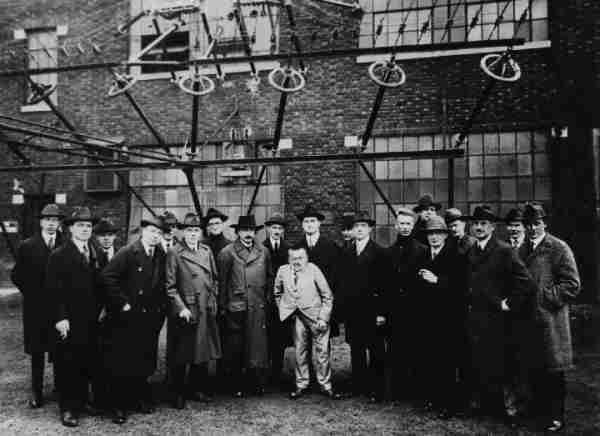
Steinmetz in a light-coloured suit at the centre, with Einstein and other scientists
Climbing the ladder, Charles carefully took measurements and, with a steady hand, made a mark at a precise point on the large generator.
After coming down, he told Ford's engineers to remove the generator coil and take out 16 turns of wire, starting at the exact point marked in chalk.
The stunned, puzzled engineers did as Steinmetz said and, to their amazement, the machine worked perfectly again: the earlier problems were only a memory.
For the engineer's work, Henry Ford received an unitemised invoice for $10,000 from Edison's General Electric, signed by Charles Proteus Steinmetz.
In today's money, that invoice would be worth over 10 million dollars.
Ford recognised the quality of the work but returned the invoice, wanting more details of the work performed for such an expense.
Steinmetz promptly answered the great American entrepreneur's request with a letter providing these details:
- Making a chalk mark on the generator: $1
- Knowing where to make the mark: $9,999
Ford, an intelligent man, immediately paid the bill and asked no further questions. Perhaps next time he would ask for a quote first 😂
Who was engineer Charles Proteus Steinmetz?
Steinmetz was a German electrical engineer born in Breslau in 1865, and also a mathematician and inventor. In 1888, he moved to the United States (where he became a citizen) and demonstrated his full talent and abilities.
He made several discoveries in mathematics and electrical engineering, and his name quickly became known throughout the industry.
Charles looked like a magical gnome: he had dwarfism, a hunchback and hip dysplasia.
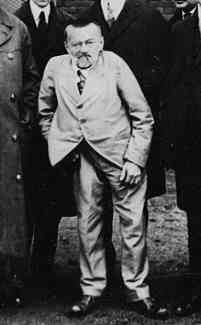
He was nicknamed the Wizard of Schenectady, and the greatest minds of the time travelled there to meet this brilliant "little giant". His friends included Einstein, Tesla and Edison.
Edison was determined to have him at General Electric and bought the company Charles worked for to secure him.
His impact at General Electric was immediate. His discoveries changed how engineers thought about electric motors and circuits.
He also invented a lightning generator to test electrical machines.
Get paid for your mind, not your time
The famous entrepreneur Naval Ravikant sums up Ford's story with these words:
Earn with your mind, not your time. Earn with your mind, not with your time.
Your mind is the sum of everything you have studied and applied, all the experience gained in a field.
If you have spent years studying and applying your knowledge, it is natural that you can understand a problem and provide a solution very quickly.
But the value, and therefore the price, capitalises on all the time invested in becoming an expert in your field.
In addition, it is important to keep improving because this allows us to stand out and become unique. Ultimately, people will choose you over others, just as Ford chose Charles.
How much should you charge? From free advice to investment
Personally, I am not very good at selling what I know how to do, and end up giving advice for free. But giving knowledge away often does a disservice to the recipient.
Let me tell you an anecdote from Brunson's book DotCom Secrets (the founder of ClickFunnels), about something that happened to him as a student.
The protagonist is Russell, a young college student who wrestles.
One day, while in his college room, he heard a knock. It was his wrestling coach, with whom he was due to have his first lesson the next day.
The coach gave him a videotape of wrestling techniques. Young Russell was surprised by the kind gesture, but before leaving, the coach asked for his wallet and took all the student's money.

Russell was stunned 😲
Some time later, he asked for an explanation.
The coach then said:
“Russell, if I had given you the video for free, you would not have watched it. But now you have paid for it, so you have made an investment. Now I am sure you will watch it and learn.”
Russell did indeed study those videos very carefully and became a very strong wrestler.
Advice given for free disappears into thin air, but when it becomes an investment, it will be studied and remembered.
Psychology teaches us that what costs more is always perceived as more valuable (particularly when information is scarce and the other person knows nothing about your subject).