
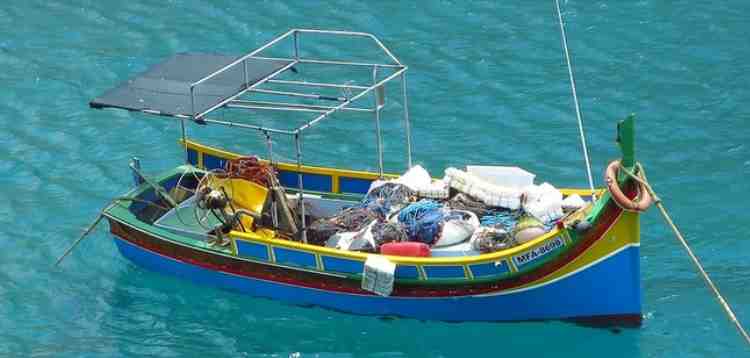
Let me tell you a story I love: the story of the fisherman and the businessman.
A businessman met a fisherman by the sea. He noticed with irritation that the fisherman was lying beside his boat, peacefully enjoying the sun.
"Why aren't you fishing?" asked the businessman.
"Because I have already caught enough fish for the whole day."
"And why don't you catch some more?"
"And what would I do with them?"
"You would earn more money. You could buy a motor to attach to your boat, go further out and catch more fish. Then you could have more money to buy a nylon net, and with even more fish you would have more money. Soon you would have enough to buy two boats, or even a fleet. Then you could finally become rich like me."
"And what would I do then?" asked the fisherman.
"Obviously, you could relax and enjoy life," replied the businessman.
And the fisherman, smiling... "What do you think I am doing now?"
We are increasingly realising that time will be the wealth of the coming years!
When wealth shifts from a social value to a personal one, the focus will move from possessing money to possessing time.
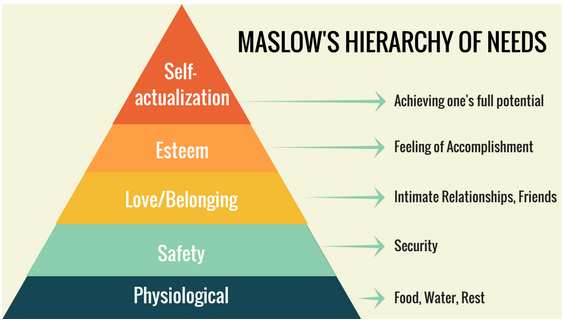 Maslow's hierarchy of needs
Reaching the top of the hierarchy of human needs means self-actualisation; increasingly, this involves investing time in our growth and personal development.
For some, wealth satisfies the needs for power and social recognition.
Today, work has a problem of divisibility: we can rarely decide how long to work. In my view, however, this too is set to change in the future, shifting from a contribution of time to one of expertise.
Which factors help us evaluate our job? These are the ones I have identified: The 6 elements for evaluating a job.
Awareness of the value of time is also demonstrated by the growth of downshifting (particularly in English-speaking countries): people leaving "important" roles for jobs better suited to human needs in terms of time and location.
The Italian dictionary term for downshifting is "voluntary simplicity", which reveals the importance of living more simply.
From this perspective, we can see how the amount of money we need is closely linked to lifestyle.
A simpler lifestyle, close to nature, probably greatly reduces the need for monetary wealth.
Excessive work leads to the paradox of having plenty of money but no time to enjoy it!
Unfortunately, this is often not a problem that even arises: people end up working hard and still not having enough money to live on. If we can choose, we should never work only for money!
We should choose work according to our passions; money will follow.
When you do work you enjoy, the value of time changes. If you love your job, you are inclined to keep studying and experimenting even at unlikely hours, but you experience that time as an investment in your passion, not as work.