

Before discussing improvement, let's read a beautiful story from Cherokee tradition.
One evening, an elderly Cherokee chief told his grandson about the battle inside us.
He said: "My son, the battle is between two wolves living within us. One is unhappiness, fear, worry, jealousy, sorrow, self-pity, resentment and a sense of inferiority.
The other is happiness, love, hope, serenity, kindness, generosity, truth and compassion."
The boy thought for a minute, then asked: "Which wolf wins?"
The elderly Cherokee simply replied: "The one you feed."
Personally, I see life as a great journey, with a beginning and an end.
It does not matter where we start (clearly, some are more fortunate than others). What matters is exploring and nurturing our improvement as people.
The aim is to arrive at the journey's end as a better version of ourselves.

That is the meaning of life. It does not matter how much money or power you have accumulated: what counts is overcoming your limits and changing to become a better partner, professional, athlete, friend or parent.
"A better planet is a dream that begins to come true when each of us decides to improve ourselves" (Mahatma Gandhi)
We must master the art of enjoying the journey, discovering new paths so that we reach the end without regrets.
The writer Mark Twain said:
"Twenty years from now, you will be more disappointed by the things you did not do than by those you did. So cast off the moorings, sail away from the safe harbour. Catch the winds of opportunity in your sails. Explore. Dream. Discover."
What it means to pursue a goal without regrets is captured by the wonderful motivational speech from the film Braveheart
To improve, we must change, but changing does not necessarily mean improving!
Experimentation helps distinguish changes that make us grow from those that serve no purpose.
"If you want more, you must become more" — Jim Rohn
The change process has 4 stages:
- Awareness
- Decision and motivation
- Strategy and Action
- Building habits
The first stage is becoming aware that we need to improve!
If I am out of shape and significantly overweight, I will realise I need to improve my health. Deciding to lose weight is not enough: I need motivation to do whatever is required. Motivation can come from different sources, such as fear of becoming ill and not seeing my children grow up. It usually comes from seeking pleasure or escaping pain.
Once motivated, we begin researching an action plan: joining a gym, walking or running for an hour every day, and so on.
The final stage is decisive. For change to last, we need new habits that become integral to our lives, such as going to the gym or running 3 or 4 times a week, or removing sweets from our diet.
"If the rules are such that you cannot make progress, then you must fight the rules!" (Elon Musk)
Sometimes our context is the greatest obstacle to improvement (including other people's expectations and beliefs). In that case, we either change the rules or find other settings with new stimuli.
Kaizen and continuous improvement
One concept I love is Japanese Kaizen: the word means changing for the better or continuous improvement.
Kaizen does not involve instant revolutions but renewal through small steps, little daily gains that can transform our lives over time.

Human beings naturally resist change, but small doses can slip beneath our resistance's radar and produce great results over time.
Small habits can change our lives.
For mathematics lovers, we can demonstrate the effects of a small daily improvement (for example, 1%) with this formula:
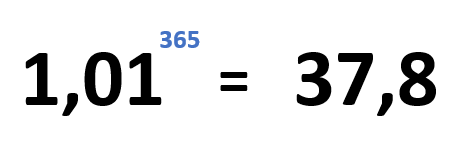
In practice, improving by 1% one day takes us from 1 to 1.01. Continuing consistently brings compounding: one day's improvement multiplies with those of subsequent days, until by year's end (1.01 raised to the number of days in a year) we are almost 38 times "better"!!!
Jannik Sinner is certainly a master of Kaizen, and even after major victories his words focus on improvement:
The boiling frog phenomenon
During a laboratory experiment, researchers at America's Johns Hopkins University noticed that a frog thrown into boiling water immediately jumped out to save itself 🐸🐸
Conversely, if placed in initially cold water whose temperature was gradually increased, the poor animal was boiled.
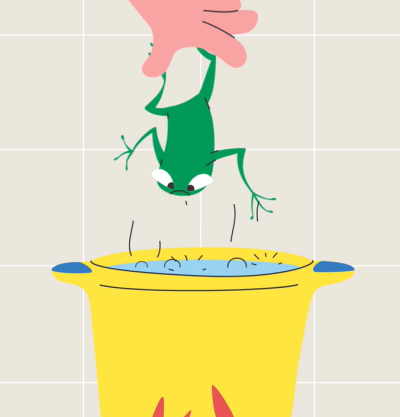
While biologists debate the experiment's validity and the gradual temperature increase, the phenomenon retains its powerful metaphorical value:
if we make small, gradual adjustments to our surroundings, we will not notice the major change at the end.
The concept is usually cited negatively, even being called “boiling frog syndrome”.
For example, it appears in the process through which an honest person becomes corrupt. Initially, they fail to notice small favours received and return others, eventually doing illegal things.
In companies, people stuck in jobs they dislike spend their energy complaining rather than acting, eventually losing the opportunity to change.
I prefer to see the boiling frog phenomenon as an opportunity: we can use it in reverse, to improve rather than perish.
Human beings naturally oppose change (even when saying they want it). If they see the water is too hot, they jump away like our frog.
But by making positive, consistent changes every day, we gradually raise the temperature.
Few changes happen overnight (sometimes painful external events cause them). The best path is slow, progressive change.
It takes time and is less glamorous, but it is certainly lasting and repeatable.
Companies often risk pursuing change too abruptly, provoking rejection. We need to work over the medium to long term, and to meet the market in time, it is best to start when change is not yet necessary!
We are the average of the 5 people we spend time with
Our environment influences who we are and the decisions we make, especially through the people closest to us.
Studies in neuroscience on mirror neurons show how the moods and attitudes of people we spend time with affect us considerably.
If we associate with negative people who constantly complain or are unwilling to do more, they will negatively influence our growth.
American entrepreneur and philosopher Jim Rohn illustrated this well with the law of averages:
we are the average of the 5 people we spend the most time with!
The average can apply to anything.
When I began playing basketball as a boy, I was hopeless (not that I later became a champion 😊). But regularly playing with stronger friends gradually raised my level until I matched theirs and no longer embarrassed myself on court.
I like to call the law of averages the micro-context theory. In practice, to improve professionally, morally or in any other setting, we should spend time with people who are better than us,
Studies in who set an example and inspire us.
In a company's human-resources management, this effect can lower or raise the overall level, depending on how many "good" people (in skills and attitude) we encounter, internally or externally, and how they are networked with others.
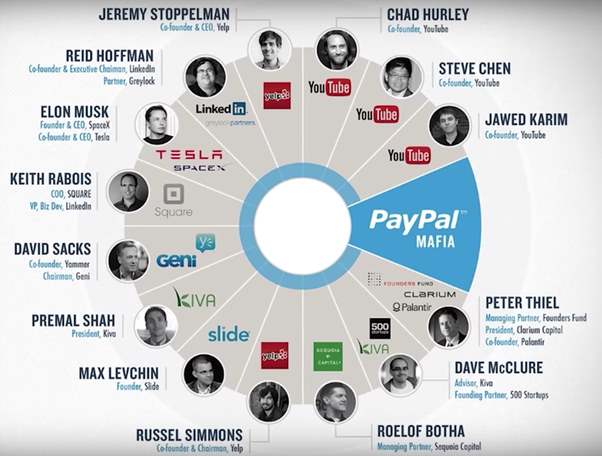
The image above shows what industry insiders call the PayPal Mafia. The company's micro-context was so positive that its co-founders and employees went on to create many other successful businesses: Tesla, Inc., LinkedIn, Palantir Technologies, SpaceX, Square, Slide, Kiva, YouTube, Yelp, and Yammer.
An interesting book exploring network effects in detail is Connected by Nicholas A. Christakisd, which shows how even friends of friends can affect our choices.
Regularly comparing ourselves with stronger, more capable people is the fastest route to improvement.
The power of feedback
Feedback is one of the most powerful tools for supporting our growth.
American mathematician and computer scientist Alan Kay, 2004 Turing Award, observed:
"I do not know who discovered water, but it was not a fish."
The reasoning behind this observation emphasises how difficult it is to see ourselves from the outside.
Our blindness comes from personal beliefs and cognitive biases, and the only way around them is to ask people who see us from outside for help.
If we want to improve, the most constructive approach is to ask for feedback, welcoming negative feedback too.
Identify one or more people you respect and ask their opinion about a project, idea or behaviour of yours.
Applying the micro-context theory and spending time with more capable people naturally gives us abundant feedback, including negative feedback, highlighting the gap between us and others.
Clearly, managing all this requires a definite will and motivation to improve; otherwise it wastes time and energy.
“Feedback is the breakfast of champions.” — Ken Blanchard
In the Hack Life section I have tried to gather tools and research that can help us explore ourselves and knowledge.
In our activities, we must remember time is finite, so we should use it well and decide which goals to focus on.