
The concept of the flow state or simply Flow was coined in 1975 by Hungarian-born psychologist Mihaly Csikszentmihalyi.
In psychology, flow is defined as:
A state of consciousness in which a person is completely immersed, focused and involved in an activity, and mind and body are in perfect symbiosis. In this state everything flows: we are perfectly in harmony with and in control of our task, with maximum gratification and positivity.
Csikszentmihalyi came to define the flow state during his studies of happiness and creativity. Indeed, people's ability to remain in a flow state has a strong impact on their happiness.
In the following video, the Hungarian psychologist discusses his research and describes musicians' experiences of immersion and flow.
We have all experienced a flow state in our lives: in study, work, relationships, the arts or sport.
In the last case, it is also called: competitive trance.
On 20 April 1986, I watched the game between the Boston Celtics and the Chicago Bulls in which the young, 23-year-old Michael Jordan scored 63 points, the current playoff record (the video shows footage from that game).
That day Jordan was clearly in a flow state. Every shot went in, he dunked over everyone and never missed. He looked like an adult playing with children, and these were the magnificent Boston Celtics (who went on to win the 1986 NBA title).
After that game, the great Larry Bird said: “I saw God disguised as Michael Jordan.”
That performance left its mark, and we remember it being recounted in the famous Netflix series “The Last Dance”.
When you are in flow, it shows! Because your performance improves considerably.In Italian, people say you are in a State of Grace while in the US they talk about “being in the zone” almost to emphasise that it is a metaphysical space, an alternative reality.
Csikszentmihalyi explains how intense mental focus brings a sense of ecstasy and clarity: you have complete control of the situation and forget yourself. You feel part of something greater. In this space, even the perception of time changes.
Have you ever worked, studied or played so intensely that you lost track of time? Forgot to eat? If so, you were probably in a flow state.
When our nervous system is completely immersed in something, it does not have enough attention left to think about anything else: time, our body, tiredness, problems.
Our body disappears, our identity vanishes from consciousness, because we do not have enough attention to do something with intense concentration and feel that we exist at the same time. Existence is therefore temporarily suspended.
Scientifically, it is called “transient hypofrontality”. In a flow state, part of the prefrontal cortex (PFC) switches off.
Since this area of the brain houses most of our higher cognitive functions, including our sense of self and existence, even partial deactivation makes us lose our sense of time and space.
It is said that during an event dedicated to Albert Einstein, a senior official gave a solemn speech in his honour. But instead of listening, the great physicist entered his own world, picked up a pen and began working on equations on the back of the programme (flow had kicked in).
At the end of the speech, everyone stood and applauded, turning towards the guest of honour, who was completely absorbed in his numbers. At that point, his secretary told Albert to stand up (to be seen and acknowledge the applause). The physicist sprang to his feet and began clapping too, until someone told him the applause was for him! 😂😂
Flow is typical not only of great athletes but also of great scientists, musicians and artists in general. In music, this state is also called being “in the groove”.
How to enter the flow state
We have seen how powerful flow is. Now let us look at techniques for activating it.
Challenge and skill
The first two conditions are:
- perceiving a sufficiently high level of challenge in carrying out our activity
- having the capabilities and skills to tackle it
We can represent combinations of the two factors by placing our skill level on the horizontal axis and the challenge level on the vertical axis.
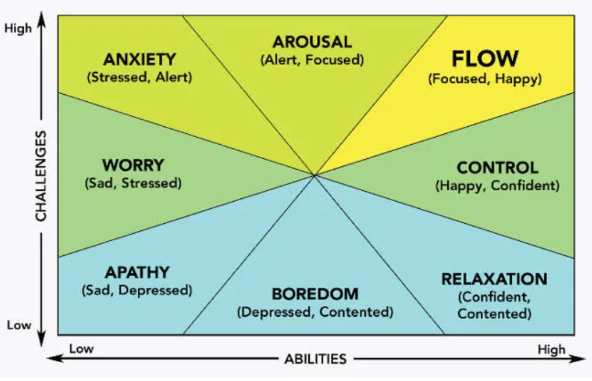 Csikszentmihalyi's model
The upper-right quadrant contains our desired scenario. At the opposite extreme, low levels of both factors lead to a state of apathy and depression.
In Michael Jordan's case, he had both the skills and the challenge: playing in the playoffs against the legendary Boston Celtics at Boston Garden.
If our skills are not up to the challenge, we will experience anxiety and stress; in the opposite case, we will be too relaxed.
When we have an average level of knowledge but few challenges, boredom comes into play. It is a barometer that can tell us we need new opportunities.
 Csikszentmihalyi's book on Amazon
In any field, from mathematics to art, it takes years to reach the right level of experience and knowledge: this is the foundation for activating flow.
“It took me four years to paint like Raphael, but a lifetime to paint like a child.” Pablo Picasso
As we improve our skills, we will need new, more demanding challenges to keep entering the flow state.
One trick is to keep creating challenges for ourselves!
At work in particular, we should not wait to be given a challenging task: let us invent one.
MJ was famous for this. The Netflix series “The Last Dance” describes how he managed to use every criticism to trigger a challenge and give his best.
Here are other factors I have found useful in my exploration of how to trigger flow.
Motivation, passion and meaning
Motivation is a fundamental factor.
Motivation is closely related to two elements:
- the passion: you do something you love and derive pleasure and reward from doing it (painting, for example)
- the meaning you give to things, your higher purpose, your reasons why.
This last aspect also underpins the psychology of happiness: meaning.
Think of someone studying to become a good doctor in order to save the lives of children with a particular disease.
A lengthy study by consulting firm McKinsey involving thousands of executives found that IQ (intelligence quotient) and EQ (emotional quotient, which measures our emotional intelligence) are not enough to increase the likelihood of flow and peak-performance experiences. MQ (meaning quotient) is essential.
Here is a summary of the research: Increasing the meaning quotient of work
MQ is precisely the meaning quotient, the meaning we give to the work we do.
When building leadership, it is important to work on this point: conveying a different meaning to what we do. We do not work only to put food on the table, but to leave our mark, improve the lives of customers and colleagues, and improve the community in which we live.
To understand the power of motivation and a higher purpose, just think of the story of Lorenzo's Oil.
Lorenzo was a happy child with a lovely family. When he was five, his parents discovered that he had an extremely rare degenerative disease affecting brain cells: adrenoleukodystrophy.
Doctors estimated that the child would live for at most another two years. His parents, Augusto and Michaela Odone, refused to give up and could not understand how medicine could do nothing.
Although they were not doctors, they began studying and investigating the disease and managed to formulate a remedy capable of stopping its progression. The new medicine consists of olive oil and rapeseed oil (hence the name Lorenzo's Oil).
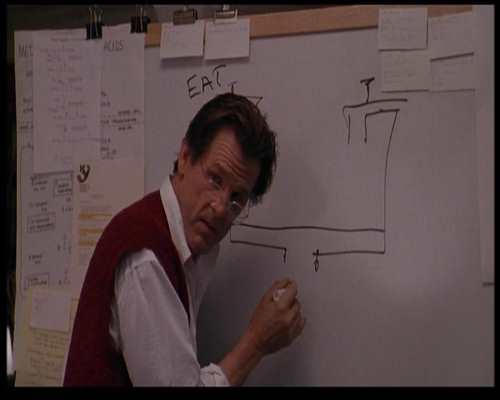 Scene from “Lorenzo's Oil”, starring Nolte and Sarandon
Lorenzo's father spent nights studying in a complete flow state, sustained by strong motivation fuelled by a higher purpose: saving his son's life.
If, alongside passion, we also have talent our skills will grow quickly, increasing the likelihood of finding ourselves in the flow zone.
If we do what we enjoy and can give it deep meaning, we will certainly be “in the zone” often and achieve superior performance.
Clear goals
We need well-defined goals because they help us understand what actions must be taken to complete our activity.
Purpose gives us a vision, but getting into action requires clear goals.
Concentration
To ignite flow, you need to stay focused.
We must be in the present, without thinking about the past or the future only what we are doing now exists, and all our attention is focused on it.
Do one thing at a time
Concentration is the starter motor that takes us into flow. Without an initial phase of intense concentration, entering flow is practically impossible: it would be like trying to swim without getting into the water!😁
There are various techniques for improving our concentration: meditation, sport, removing distractions, diet, and so on...
While a noisy, crowded environment does not help concentration, it is also true that, if we are good at entering flow, all external factors will disappear. It is as though the volume of the noise were suddenly turned down and nothing could distract us any more.
Curiosity and novelty
Curiosity is an ally of creativity but it also helps flow.
When we are interested in discovering something new, our attention increases and the challenge rises.
Let us seek out new things, and if our surroundings offer no opportunities to test ourselves, let us create them.
States of mind
An international consulting firm interviewed 740 business leaders around the world to identify the states of mind they experience at work and how frequently they experience them.
Eighteen states of mind were identified, with the aim of understanding how they affect performance.
The results (published in Harvard Business Review) are shown in the following chart and clearly tell us that 94% of respondents reported that Calm, Happy and Energised (Calm, Happiness, Energy — CHE) are the three states that drive the highest levels of effectiveness and performance.
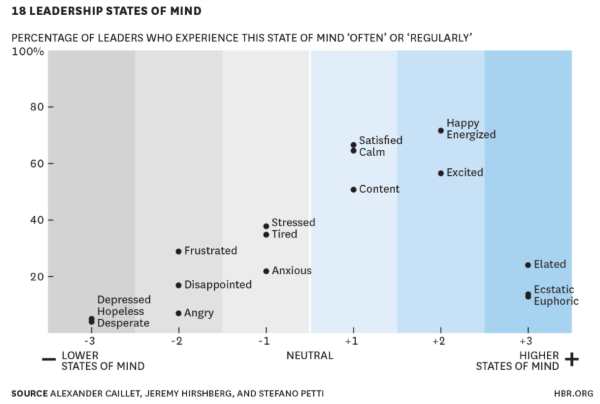
Calm is an important element of concentration.
Happiness and energy increase motivation, and fun is the key to activating them.
 Smile and have fun: your brain will work better
“I wanted my work to be play.” (Phil Knight, founder of Nike)
These studies emphasise the importance of having positive, highly enthusiastic people in business organisations, because the energy they bring to the system enables others to give their best.
Improving performance and productivity
Great minds and great athletes enter flow more easily than others, gaining a considerable advantage.
The McKinsey research I mentioned earlier found that when managers worked in a “flow state”, their productivity rose to five times the average. Other research suggests an increase of as much as seven times!
On the other hand, managers only managed to enter flow 10% of the time. This is a very high figure, considering that some people never experience it in their daily work. It should be said that we are talking about extremely high-level professionals here.
Flow and creativity
Harvard Business School studies found that our creativity increases considerably during flow, and that this effect continues over the following days, keeping our creative thinking alive.
Essentially, the flow state trains us to be more creative.
The dorsolateral prefrontal cortex is the area of the brain devoted to self-control, sending signals of doubt and contempt. In practice, it is the critic inside our mind.
During flow, this part of the brain quietens down. With this area switched off, we become less critical and braver, we put ourselves forward more, and our ability to imagine new possibilities increases.
During flow, the brain is flooded with large quantities of dopamine, endorphins, serotonin and noradrenaline. All these substances are responsible for increasing our performance and have a considerable impact on creativity.
Both noradrenaline and dopamine increase concentration and our ability to imagine, connect ideas in new ways and develop lateral thinking.
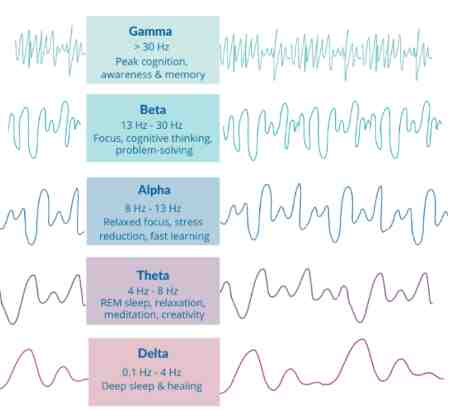
In flow, our brain works differently: brain waves shift from the higher frequencies of normal waking consciousness (gamma and beta) to lower frequencies such as alpha and theta.
Alpha is associated with daydreaming: our mind is relaxed and wanders freely from one thought to another.
Theta frequency occurs during REM sleep or just before we fall asleep. The magic of this phase is that ideas combine in new and original ways; old information meets new information, generating creative visions.
When we reach these frequencies, we enter something like a trance. It is typical to feel that we are seeing ideas rather than thinking as we do in a dream.
When Einstein developed the theory of special relativity, he imagined himself riding a beam of light with a mirror in front of him.
The great Albert knew the effects of flow well. It is no coincidence that he placed great importance on the ability to imagine.
People who develop the visual part of the brain more may have an advantage in entering and exploiting flow. Einstein, for example, had language difficulties as a child and was left-handed (but was corrected, as was customary at the time).
Conclusions
Personally, I love flow: it is one of the most important forms of hacking our brain and our lives.
Intellectually, to get more things done, you either sleep less or increase your intensity per unit of time.
How often do we rack our brains for days trying to do something, only for 30 well-spent minutes to resolve everything? If we always worked “in the zone”, we could work less and produce more.
The effect of flow I love most is the increase in our creativity.
It is wonderful to lose yourself in your thoughts, stop time and enter new dimensions. A dimension where we are happier and more aware.

With his theory of “special relativity”, Albert Einstein introduced the concept of four-dimensional hyperspace (x,y,z,t), adding the dimension t (time).
I like to imagine that in flow we move through Einsteinian spacetime and, like the spacecraft in Star Trek and Star Wars, can travel through hyperspace.
Another side effect of flow is that it helps you lose weight! You lose your sense of hunger: the brain has no time to send signals to your stomach, and your relationship with food becomes incidental 😂😂😂😂
Happy flow, everyone!