
In 1971, psychologist and professor Philip Zimbardo (the same researcher behind the broken windows theory) conducted a test at Stanford University that went down in history as the "Stanford prison experiment".
To study people's behaviour, Zimbardo converted the basement of Stanford University's psychology department into a mock prison.
For the experiment, 24 students were recruited from the candidates who responded to the professor's advertisement (a reward of 15 dollars a day made participation attractive).
The selection criterion was to choose the most stable, mature and psychologically balanced students, with no history of antisocial behaviour.
The experiment began by simulating a prison in every respect. Half the participants were randomly assigned the role of guards and the others the role of prisoners.
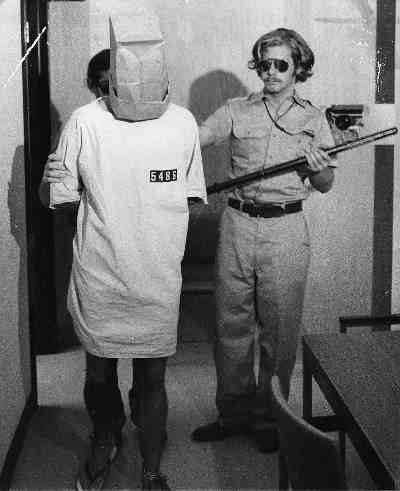
The student "criminals" were taken from their homes (without prior warning), blindfolded and brought to the university basement, where deindividuation began: they were stripped, deloused and given a white garment with an identification number (to erase personal identity and make them feel anonymous).
The guards were also standardised, with khaki uniforms, whistles, batons and sunglasses preventing eye contact with the prisoners.
The guards were told to maintain order, enforce the law in the prison and gain the prisoners' respect, but no physical violence was permitted.
Zimbardo himself acted as prison superintendent.
Within hours of the experiment beginning, participants had fully entered their roles. The guards in particular began giving orders and pointless tasks to make prisoners feel subordinate, such as doing push-ups.
On the second day, the prisoners rebelled, and the rebellion was quelled by placing its leaders in isolation.
Preferential treatment was introduced for prisoners who had not joined the protest, reducing solidarity among them.
As time passed and the guards gained more control, the prisoners became increasingly submissive.
This increase in power also translated into increasingly harassing behaviour by the guards.
After two days, the first students began to break down emotionally. The entire experiment was stopped after 6 days instead of the planned 14 because of the prisoners' instability and the guards' excessive aggression.
Results of the experiment
The test aimed to understand what happens when good people are placed in a "difficult" setting, and how power can affect behaviour.
The main findings were that:
- people conform very quickly to social roles assigned by their context; in this case, both guards and prisoners immediately displayed certain attitudes
- the power and authority enjoyed by the guards led them to behave differently from their normal lives: they became aggressive and ready to mistreat the prisoners.
- people identify with group norms to the point of losing their own identity and consequently their personal responsibility. Belonging to a group gives a feeling of anonymity and reduces the sense of responsibility.
In light of this experiment, Zimbardo defined the Lucifer Effect as:
the process through which being evil is influenced by an individual's context; in particular, anyone given substantial power can adopt oppressive behaviour regardless of their personal predispositions.
Confirmation also comes from post-experiment interviews with students who played guards: they said they would never have imagined behaving that way or displaying so much brutality.
In the TED Talk below, Zimbardo summarises the psychological definition of the Lucifer effect as:
Evil is the exercise of power!
The results closely echo the famous obedience experiments by Stanley Milgram (those involving electric shocks), which show how people tend to behave unethically when authority provides legitimacy.
Over time, academics heavily criticised Zimbardo's experiment for how it was conducted, particularly the selection of students and Zimbardo's own role in the test.
Despite the criticism, the findings inspired further work and research.
Looking at the corporate world, some of these dynamics also appear in the workplace, particularly in large organisations.
Roles and power can lead people to unexpected choices and behaviour that differ from their personal predispositions.
The film The Stanford Prison Experiment (Effetto Lucifero in Italian)
A film about the famous experiment was released in 2015, directed by Kyle Patrick Alvarez and starring Billy Crudup, Michael Angarano, Ezra Miller, Tye Sheridan, Olivia Thirlby and Nelsan Ellis.
The trailer is below: