
Let's start with the definition of a mind map to understand its meaning, then explore how to build one and what to use it for.
A Mind Map is a visual representation of our thoughts, ideas and everything that revolves around a concept.
It is as though we printed out our thoughts to observe them from the outside.
We start with a blank sheet and write the topic or concept we want to map in the centre of the page.
The choice of topic depends on our goal, but there are no limits to its applications (personal, professional, educational, family-related, etc.). We could write the name of our next travel destination, a project we want to carry out or an area we want to explore in detail (for example, "Creative Thinking").
Once the topic is defined, we let our brain expand all the subtopics and concepts and associate them with the main theme.
The structure we create is hierarchical and associative: it branches across several levels, and we can use arrows to connect subtopics from different branches.
Below is an example by the English cognitive theorist Tony Buzan (who formalised mind mapping), with himself as the central topic.
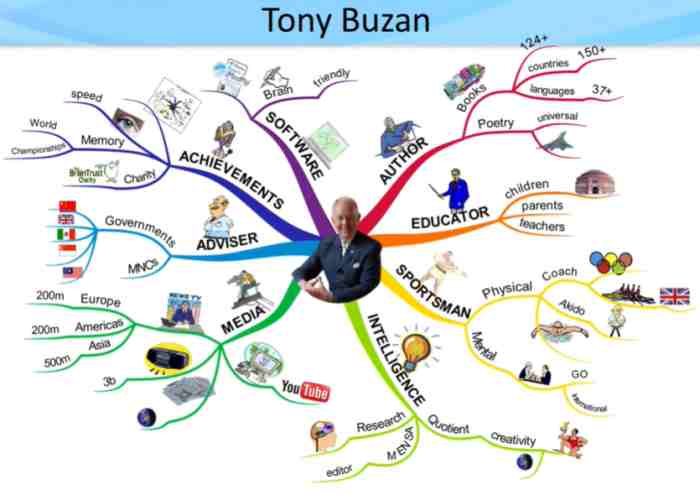
As you can see, each branch expands the elements that represent him personally and professionally (notice that family and romantic relationships are not indicated).
Similarly, we could do the same for ourselves to explore ideas for building our personal brand and understand whether there are areas and combinations that could bring value to others.
Another feature of Buzan's maps is the use of colours, images and drawings to represent concepts (in the example, swimming is represented by a drawing rather than the word).
In general, this visual tool can structure information, helping you analyse and find solutions, summarise and understand a phenomenon (for example, using "Advertising" as the theme would give us a map of the key factors in how the market works), and remember.
Personally, however, I find the most powerful function of a mind map is to support creativity.
Putting down a cloud of associations using words and images is a perfect exercise for creating new connections.
To boost creativity, we could also use lateral thinking techniques by adding random words or random images.
For example, when writing an article for my website, I use a mind map to jot down ideas associated with the chosen topic, combined with the needs of people searching online.
The strengths of this tool are:
- simplicity: all you need is a pen and a sheet of paper, without worrying about consistency between branches; perhaps the only precaution is to avoid duplicating entries
- it helps us "see" new ideas
- it organises concepts using a neural model like the one in our minds
- it engages the brain more because it is fun and artistic, bringing out our emotional side
Online mind maps and tools
All online visual collaboration tools have mind-mapping systems.
These tools are especially useful when working in a team and wanting to generate a mind map from a brainstorming session.
A well-designed tool is Miro.com, which offers a mind-mapping tool among its features.
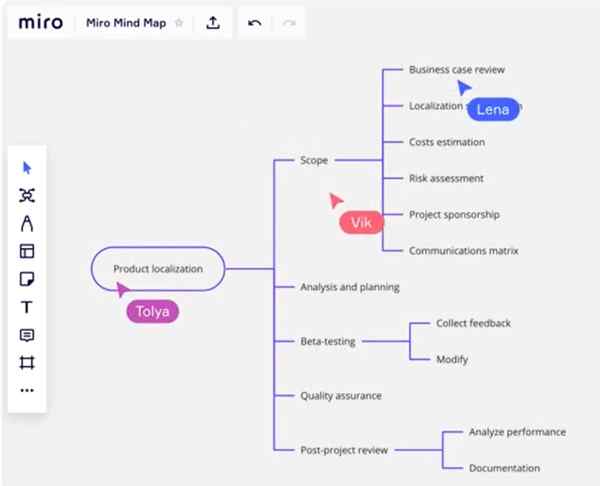
Personally, I prefer the tactile sensation of pen and paper and feel much freer and more inspired in analogue mode 😉
After creating our diagram on paper, we can use our smartphone (or a scanner) to capture the map and turn it into a digital image.
If we need to collaborate with others, we can use a whiteboard and then photograph it.