

We live in an exciting period of history, full of opportunities offered by the digital revolution, so many choices are possible.
One simple diagram (please forgive me, I cannot draw) that I used, and still use, to find my bearings brings together: passion, talent and market.
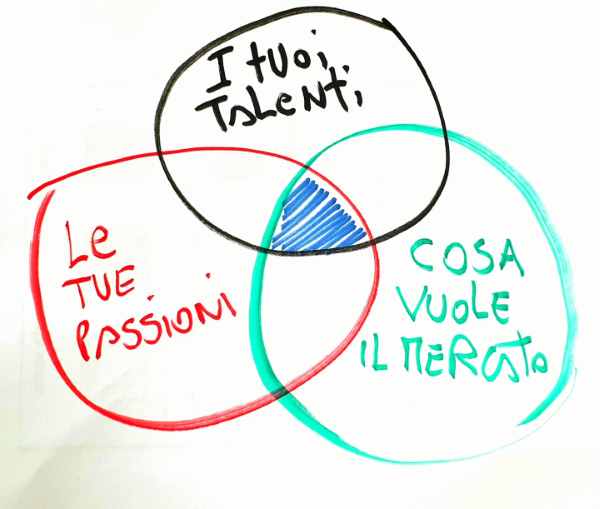
The magic zone (in blue) is where our talent coincides with our passion and is a skill highly attractive to the market (in practice, we can make a living from it).
Keeping this diagram in mind is essential to marketing ourselves; we can call it our first strategic positioning map.
So far, so easy. The difficult part is understanding our talents, our passions and the new professions/opportunities offered by the market.
In discovering the first two (especially among young people), family, teachers, managers and our own curiosity play a fundamental role.
A very good film about talent and the choices it entails is Gifted (Il dono del talento), which tells the story of a young mathematics prodigy (available on both Netflix and Amazon Prime).
Official trailer for Gifted
We need to explore before finding our island. Families usually look at the market (with good intentions, advising us what to study for jobs with the best prospects), while teachers and managers pay more attention to talent (if we are lucky). We ourselves are generally more focused on identifying our passions.
The Ikigai model
While studying the subject, I discovered that Japan has a similar model called Ikigai (生き甲斐) a term meaning: "reason for existence" or "reason to live".
Its meaning reveals the conceptual model's very high aspirations (diagram below).
Compared with my simple diagram, Ikigai provides more detail on the right-hand side relating to the market. It distinguishes remuneration (the possibility of being paid for what we can do) from contribution to the world and humanity. Passion becomes what we love doing, and talent becomes what we are good at.
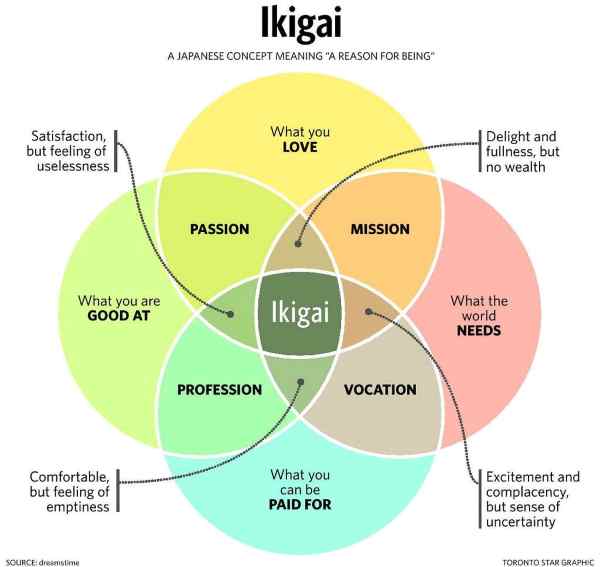
For example, if I have talent and passion for woodworking, I could earn a good living as a carpenter, but my impact on the world would be smaller than that of a paediatric surgeon (with the same aptitudes) saving children with serious illnesses.
I like the Ikigai model because it reminds us to consider the value we bring to humanity. It strongly reminds me of the concept of "meaning" in the psychology of happiness.
Competence and passion
The relationship between passion and competence is like that between the chicken and the egg: which came first?
The conventional view is that passion drives us to build competence. Absolutely right! The greatest experts love their subject, and you can spot someone fuelled by passion for what they do from a mile away.
However, there is a less obvious reverse path, starting with competence and leading to passion.

In practice, increasing our competence brings us to a level of knowledge that changes the subject for us, turning it from uninteresting into fascinating.
As a student, this happened to me with mathematics. Initially, I was completely indifferent, but when I began to understand it better and master it without fear, everything changed. I came to love it so much that I chose it as a subject for my school-leaving examination.
The moral is not to stop at a superficial assessment. There may be subjects, activities and topics we could become passionate about, but know little of because we have not explored them in depth.
The world is full of stories of successful people who happened to study something that did not interest them, only to fall in love with it over time.
Goals and action
In a world where we must constantly study, transform ourselves and learn (we live in a lifelong-learning society), the diagrams above help guide change and build our personal strategy.
But that is not enough: once we identify our magic zone or Ikigai, we must work hard to reach it. Strategy must be followed by execution.
We need to set ourselves short-, medium- and long-term goals and have the perseverance and determination to achieve them: talent without perseverance and goals is like a car without fuel or a destination.
I suggest watching the video of Jeff Bezos's speech in which he discusses the "gifts" we receive (our talents) and the choices we make to honour and use them. Bezos highlights the importance of action and learning to set ourselves goals in life.