
Do you know what Groundhog Day is?
Every year on 2 February, the US and Canada celebrate Groundhog Day 🦫, a tradition passed down through time to predict the length of winter and the arrival of spring.
In practice, people observe the groundhog's shelter (particularly in Punxsutawney, Pennsylvania): if the animal emerges and cannot see its shadow because it is cloudy, winter will end soon. If it is sunny instead (and the groundhog is frightened and returns to its burrow), winter will last another 6 weeks.

Weather lore is a traditional practice based on empirical observation of natural phenomena to predict the weather. It interprets environmental signs such as animal behaviour, cloud shapes, wind direction and sky conditions to make weather predictions without modern scientific instruments.
This ancient practice was used primarily by farming, seafaring and pastoral communities to anticipate weather changes and organise their daily activities.
In Italy, 2 February is Candlemas , associated with several sometimes contradictory proverbs. Most resemble the Groundhog Day tradition, such as this Tuscan saying:
"On Holy Candlemas, if it snows and pours, winter is over; but if there is sunshine, even a little, we are still in the midst of winter"
If it snows or rains on 2 February, we are out of winter, but if there is some sunshine, we are still in winter.
My favourite is the saying about the "bright fourth", referring to 4 April. Tradition says that if it rains on 4 April, it will rain for another 40 days.
Whatever people say, I have watched this saying with curiosity since I was a boy, and I must say it has proved true more than 90% of the time.
But my memories of this tradition take me straight to a film I loved: Groundhog Day from 1993, starring Bill Murray (renamed “Ricomincio da capo” in Italian).
The film's entire premise centres on a spell that affects the protagonist, forcing him to relive the same day every day in a diabolical loop 🔁.
Even suicide does not stop the cycle: the next morning, he wakes up and lives through the same experience as the previous day.
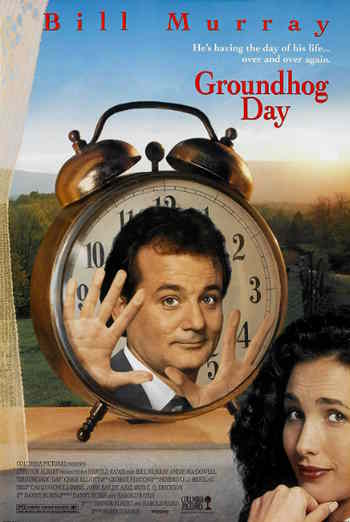
In our working and private lives, it is easy to run into the “Groundhog Day effect” (I invented the name with little imagination 🙂, inspired by the film).
What is this effect?
If you work in the same industry and/or company for many years, you see a whole series of recurring cycles and patterns, much as Bill Murray relived his days.
You relive the same dynamics, the same proposals and the same results.
The effect is a kind of abstract, medium-term routine that reappears, perhaps with different actors and circumstances, but is essentially always the same (for example, project x that keeps resurfacing).
I have learned through personal experience that, depending on the company, cycles repeat every 2–3 years.
From one perspective this can be an advantage, because you can draw on your experience (you are in your comfort zone), but from another it becomes a cage for your growth: the boundary between capitalising on experience and slowing improvement.
There are several ways to counter the intellectual stagnation caused by repetition:
- change roles after x years
- change the type of work you do
- embark on new projects
- cultivate interests alongside work
- travel
- finally, change company 😁
In our private lives, the Groundhog Day effect leads us to keep doing the same things, and we struggle to introduce something new, meet new people and travel to places we have never seen.
The film also highlights the mirror effect and how we need to work on ourselves to elicit different behaviour from others.