
I have always wondered why some little dogs bark and rage at dogs 10 times their size without the slightest fear!
Looking into it, I discovered that, besides the animal's temperament, there is a simple scientific reason called perceptual distortion: dogs have no perception of their own size! 🐕🐕
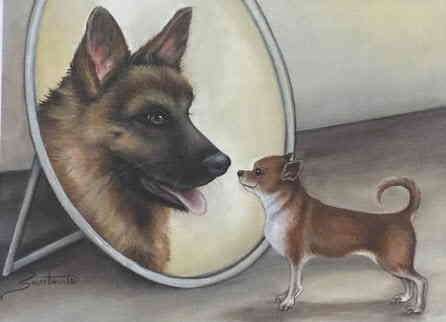
So a Chihuahua cannot assess that attacking an Abruzzese sheepdog might not be a good idea (it probably feels like one itself).
For the same reason, we also see large dogs running away from smaller ones.
We can transfer this effect to the business world and call it the “dog effect” (not to be confused with poor professional quality 😂).
As described, the dog effect can take two forms:
- I am a large, strong company with great potential, but I become frightened of smaller businesses, letting that fear shape my strategies
- I am a company that overestimates its own value and thinks it can compete on equal terms with others (or even outperform them), with disastrous results.
Similarly, we can apply the effect to our professional abilities, oscillating between two extremes depending on our perceptual distortion:
- Effect: Dunning–Kruger
- Effect: Impostor syndrome
What is the Dunning–Kruger effect?
In 1995, McArthur Wheeler did something astonishingly naive: he robbed two banks in Pittsburgh, in broad daylight, with his face uncovered (pictured). Not only was he not wearing a disguise, he smiled at the security cameras. Why? He was convinced he was... invisible.

His conviction rested on an absurd idea: he believed that lemon juice, used as invisible ink, could also make his face invisible. He had even tested it at home, spreading it on his face and taking a photograph. Since he could not see his face in the picture (probably because of poor lighting or a camera problem), he convinced himself that the “technique” worked.
This curious incident caught the attention of Professor David Dunning and his student Justin Kruger. Intrigued by how someone could be so self-assured despite an obvious lack of awareness, they conducted a study on the perception of one's own competence.
The result was the famous 1999 paper, “Unskilled and Unaware of It”, describing a fascinating paradox: people with limited skills in a particular field also tend not to recognise their limitations. In other words, the less competent we are at something, the more confident we may feel, simply because we do not know how much we do not know.
This gave rise to the Dunning–Kruger effect which we could summarise as follows:
A phenomenon of perceptual distortion in which an individual considers themselves more expert than they really are.
In practice, someone with professional knowledge in a field overestimates themselves and considers themselves an expert.
What is impostor syndrome?
Impostor syndrome presents the opposite case: here, someone is highly knowledgeable and competent in a subject, and the more they know, the more they realise there are further areas to explore, to the point of doubting their abilities and feeling like a fraud (in the sense of being unsuited to their role as teacher, manager, professional, etc.).
In practice, we become Socratic: as Socrates said:
The more I know, the more I know that I do not know.
Or as Shakespeare put it in As You Like It:
The wise person knows they are foolish; it is the fool who believes they are wise
The true expert even questions what they already know.
In this search and exploration of knowledge through a Socratic approach, an expert begins to doubt whether they know as much as could be known about a particular field.
In reality, their knowledge is well beyond what is necessary.
This syndrome usually affects successful people more strongly, making it difficult for them to accept their achievements.
No one is immune to the Dunning–Kruger effect, particularly when first studying a discipline. Then, over time, if we become good at it, impostor syndrome comes into play 😁
These perceptual distortions are actually self-perceptions, and we can reinterpret them through the famous phrase of the Polish philosopher and mathematician Alfred Korzybski (who later influenced the entire field of Neuro-Linguistic Programming):
The map is not the territory
This means there is a difference between our representation of things (the map) and reality (the territory).