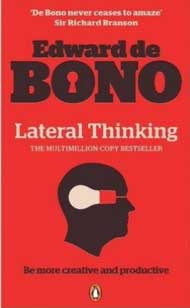
Lateral thinking is a mindset, a way of thinking that aims to see things differently and generate new ideas and alternative solutions to problems.
It starts with the idea of exploring new paths, focusing on feeding, activating and letting thoughts flow to see what happens. It seeks to make use of the randomness of thought. As De Bono says:
Vertical thinking is a finite process; lateral thinking is probabilistic!
This concept is very close to the broader idea of Incidental Marketing as a business’s ability to master chance!
We could define it as the first mindset for being consistently creative!
Lateral thinking contrasts with vertical/linear thinking, which starts at point A and reaches C by passing through B, seeking a direct solution to the problem and logical correctness at every step.
The term was coined by Maltese psychologist Edward De Bono (a professor at Cambridge, Oxford and Harvard) back in 1967. Today, however, in a world moving towards AI and automation, it is a mindset more alive and relevant than ever.
For a striking example of what lateral thinking is and how it works, I suggest trying 👉 the nine-dot exercise: click and try to solve it, look at the solution, then come back to this page and continue reading (see you shortly 😁).
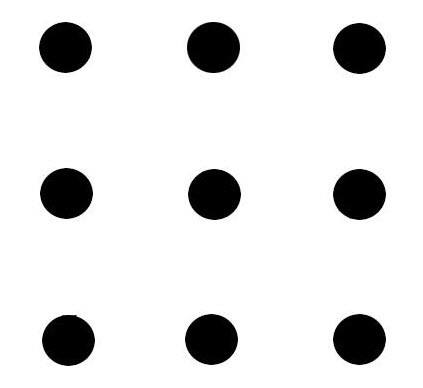 You need to connect all the dots with 4 consecutive lines without lifting your pen from the paper (solution)
The exercise demonstrates the existence of limiting paradigms.
As the solution shows, it comes easily once we remove a constraint that exists only in our linear mental model.
After all, we were taught to stay within the lines from our first years of primary school, and woe betide anyone who coloured outside them.
Because of the education we adults have received, we tend to see rules and conditions even where none exist, effectively blocking our ability to explore new paths of thought.
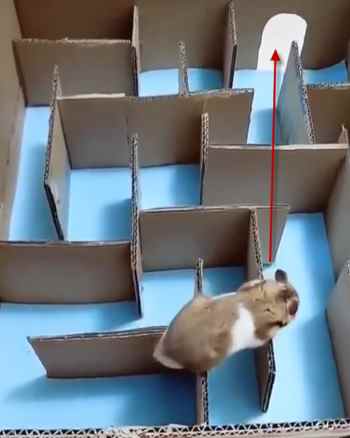
Constraints are not always rules!
Understanding the difference makes a difference.
Overcoming self-imposed constraints or those imposed by society is the essence of lateral thinking.
Let’s look at another example of non-linear thinking through a story.
Years ago, an English merchant was in debt to an old moneylender, ugly and shady, who threatened to send him to prison unless he repaid his money with interest.
The merchant had a beautiful daughter whom the moneylender had fallen for, to the point of making a proposal: he would put a white pebble and a black pebble in a bag and draw one at random without looking. If the pebble was white, he would cancel the merchant’s debt; if it was black, the moneylender would also marry the girl.
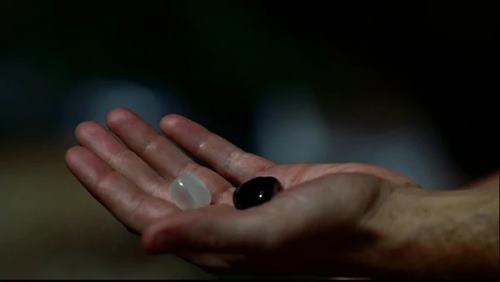
Given the situation, and considering that people who failed to repay debts went to prison in those days, father and daughter accepted the game.
The girl noticed, however, that the cunning moneylender had secretly put two black pebbles in the bag, ensuring that he would win.
There were 3 scenarios under linear thinking:
- refuse to continue and send her father to prison
- play, knowing she had already lost
- expose the cheat, but with the same outcome as point 1
The girl thought laterally. She chose to play, but when she took the pebble from the bag, she dropped it among other stones (so it could not be identified) and told the moneylender there was no need to find it: its colour could be deduced by checking what remained in the bag!
The young woman used the entry point technique, which we will explore later, changing her point of entry into the game. It allowed her to win and save her father.
On paper it does not seem difficult; in practice it takes a lot of training.
The greatest obstacles are our cognitive biases and our habit of thinking linearly, from the classroom to the workplace.
The cognitive biases are constructs based on mistaken perceptions, clichés, prejudices and ideologies, used to make decisions quickly and effortlessly. Biases affect both decision-making and problem analysis and, unfortunately, the thinking process itself.
The study of biases is due to psychologists Kahneman and Tversky and their research programme called the “Heuristics and Bias Program”, which earned the former the Nobel Prize for behavioural economics in 2002.
Their studies also consider “heuristics”, which are likewise used for quick decisions, but without prejudice or mistaken perception, as they are based on intuition drawing on experience.
George attended statistics classes with Professor Jerzy Neyman during his degree at UC Berkeley.
One day he arrived late to class and saw two problems on the blackboard, which he thought were homework assigned by the professor.
George was a good student and worked hard to complete the exercises. It took longer than usual, but he managed to solve both problems.
George handed them to the professor, apologising for the delay and admitting that he had found them a little harder than usual.
Some time later, Neyman rushed to George’s home to tell him, to both their amazement, that he had found solutions to two previously unsolved statistical problems!
The young man was George Dantzig , who went on to become a famous mathematician and Stanford professor (he invented the simplex method, a well-known algorithm in linear programming, which I studied years ago in Operations Research).
Years ago, Dantzig said in an interview:
“If I had known that the problems were not homework but actually two famous unsolved problems in statistics, I would never have solved them.”
The moral of this story is clear: because George did not know the nature of those problems, he imposed no constraints or boundaries on himself (like those of the nine-dot square).
Sometimes creative solutions are obvious, but our biases make us look elsewhere or create constraints 😲
What can we use lateral thinking for?
As a mindset for seeing things from different perspectives, we can use it both in business and in private life to:
- Solve problems, with the aim of finding an original solution
- Generate new ideas in innovation and design thinking processes
- Generate new ideas for products and services
- Question existing systems to improve them and design new approaches. In business, for example, we might discover a different way of doing things and redesign our activities to generate a competitive advantage
- Produce new ideas in advertising, such as an original idea for an advertising campaign
- Find inspiration for artistic creation: music, painting, sculpture, etc.
- Help with reframing: the ability to frame a problem differently
Contents:
- Lateral thinking techniques: how to use lateral thinking in practice
- Reconstructing the paradigm: negation and substitution 🚫
- The reversal method ↩️
- Brainstorming 🌩️
- The analogy technique 🤲
- The entry point or attention technique 🧐
- 🚀 The random stimulation technique 🚀
- Combine several elements 🧬
- Think of the dream 💭
- Exaggerate, amplify or reduce 🔎
- Change the context or purpose 🗺️
- Pretend to be someone else: practise new perspectives 👽
- Lateral thinking exercises and riddles
Lateral thinking techniques: how to use lateral thinking in practice
There are various techniques for practising lateral thinking, designed to force our attention and thought along different paths.
We need to suspend judgement and stop trying to be right all the time. Along the way, we must accept being a little crazy 🤪 to reach different conclusions.
In vertical thinking, you have to be correct at every step; logical thinking would not work at all without this requirement.
In lateral thinking, however, you do not have to be correct at every step, provided the conclusion makes sense.
The concept is captured well by the following metaphor coined by Edward De Bono:
It is like building a bridge. The parts do not have to support themselves at every stage, but when the final piece is put in place, the bridge suddenly supports itself.
Let’s look at the most effective techniques, bearing in mind that some overlap considerably.
Reconstructing the paradigm: negation and substitution 🚫
If we want to innovate in an existing business, one technique is to start by reconstructing the market’s current paradigm. We need to understand the dominant ideas and what De Bono calls the crucial factors.
For example, we can start by reconstructing a business’s value chain or the buying process. Sometimes it helps to interview customers in a particular market to understand which factors are considered crucial.
This is the hardest part, because we are often part of the paradigm 😃
When identifying the elements, we need to consider everything that comes to mind, even if some aspects overlap with others.
A very useful tool for this purpose is mind mapping: discover what it is and how to use it.
If I think about a training course, for example, I can consider the lesson, enrolment, materials, teacher, classroom experience, PC, blackboard, etc.
As this example shows, the classroom experience is contained within the lesson, but the purpose of lateral thinking is not to describe or organise things, but to find new paths.
The next step is to question the elements of the model by making them no longer necessary (the process of negation).
What happens if we negate the presence of that factor?
For example, in the 1930s and 1940s, brothers Dick and Mac McDonald 🍔 revolutionised American dining by applying these very concepts (even before De Bono formalised them 😁).
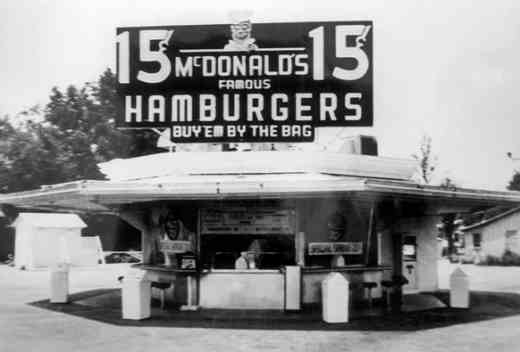
The American “popular” restaurant had a fairly standard paradigm:
- people sat at a table or waited in their car
- they ordered from a menu with a long list of dishes
- they waited for their meal
- finally, the waiter served them
- they paid
The McDonald brothers challenged this by “negating” several elements previously considered untouchable, effectively inventing fast food:
- No waiter or table service: customers collect their own food (this also connects with the reversal method).
- No trays, plates or cutlery: food is served in a bag and eaten by hand.
- No waiting: instead of placing an order and waiting to be served at a table or in a car, customers get their meal immediately (when reconstructing the paradigm, waiting is an element just like the meal).
- No menu: there is no need for a menu. There are only a few dishes (hamburger, fries and a drink), and the menu is visible directly where you collect your meal.
- No paying afterwards: customers pay straight away.
Removing rather than adding brought fast food worldwide success.
The tendency is always to lengthen the menu, but the real art is removing and simplifying: less is more!
Many businesses could be reconfigured using a different perspective and new technologies (with the value network model).
Often a market’s crucial factors remain unchanged for a long time, and everyone follows the same direction without questioning them.
In business, going in a different direction and trying to change the rules is certainly riskier, but it can also be the most profitable strategy: we may “create a new market” and gain a substantial competitive advantage.
McDonald’s created the fast-food market. Almost 80 years have passed, and it is still there 🍔🍔🍔
When breaking a paradigm, we can use substitution as well as negation.
As you can imagine, in this case we do not remove an element: we replace it with another.
Using fast food as an example, we could change the product, replacing hamburgers with vegetables and fruit. In practice, we could create a chain for vegetarians and healthy-food lovers who have little time.
The reversal method ↩️
Once we have captured a phenomenon, a problem or a single aspect (which may be an element of the paradigm reconstructed earlier), we try looking at it in reverse.
In the training-course paradigm, for example, the organiser chooses the teacher and defines the programme with them.
Reversing this, we could imagine students choosing their teacher and deciding which topics to cover.
In his book Lateral Thinking, De Bono explains the reversal method through Aesop’s fable of the thirsty crow that finds a pitcher of water but cannot drink because the level is too low for its beak.

By reversing its approach, the crow realises that to take something out, you have to put something in and starts dropping pebbles into the pitcher until the water level is within reach of its beak.
In the following video, we see a child find the solution and get free of the gate using precisely this reversal approach.
Another classic example of reversal is IKEA: furniture is assembled by the person buying it, not the person selling it!
At McDonald’s, the waiter does not bring the food: the customer goes to collect it.
The reversal method also moves our thinking and creativity forward, allowing us to take further steps: we start with a provocation to arrive at a good idea.
For example, start with a familiar use case: the phone rings when we receive a call.
Now apply reversal as a provocation: the phone rings all the time except when we receive a call.
From this absurd provocation we can extract useful concepts. A continuous sound, for example, tells us the phone is working. We could obtain that benefit with a lit LED instead of a ring. Or we could extend the concept to other sounds, such as the television, and mute it when a call arrives (which is what now happens with videos on our smartphones).
Brainstorming 🌩️
The brainstorming technique is very well known. Its 3 key elements are:
- Mutual stimulation of ideas: everyone can build on others’ thoughts to move in new directions.
- Suspending judgement: do not challenge other people’s ideas; let them flow. We have seen that the secret is not necessarily to be right at every step. I might say something silly, but following it (without judging) could lead us to an innovative idea!
- Being informal while following a format, with a moderator and a staged process with precise timings.
Different viewpoints often cause problems and misunderstandings, even without preconceptions. But the ability to change perspective can be an important tool for improving creativity and solving problems.
Below is a guide from Harvard Business Review on setting up an effective brainstorming session.
The analogy technique 🤲
What is an analogy?
Analogy (from the Greek analogía, meaning correspondence) is a figure of speech that brings together two images or situations that are different and apparently have no logical connection. It establishes similarities by connecting elements through free associations of thought or feeling.
It is the perfect figure of speech for encouraging different viewpoints.
Analogy has two important roles in lateral thinking:
- Moving thought: it starts the creative process. We set off for the pleasure of doing so, then see where we land.
- Taking us away from stereotypes.
Given a topic or problem, we can reformulate it through an analogy, then continue developing it using the same analogy to see where it leads, before translating it back into the original problem.
For example, we can take the first analogy that comes to mind (fishing) and apply it to our problem (selling a product to the public, for instance).
I analyse the fishing process: I go to a lake, a river or the sea, cast a hook with a fishing rod or a net from a boat, use bait, wait to see whether anything bites, or return the next day.
In sales, could the lake or sea be the place where I find more customers? Is the bait the benefit or the sign attracting attention? Where could the fishing net lead me? Does it represent several salespeople working together (a network)? Or several sales channels (omnichannel)? And so on.
The entry point or attention technique 🧐
Choosing the point from which to observe a problem is fundamental.
An example explains more than a thousand words: what is the minimum number of matches needed to complete a singles knockout tennis tournament with 111 people?
With classic vertical thinking, most people start (their entry point) by counting combinations to see which winners go through.
But if we choose a different focus and concentrate on the losers instead of the winners, the answer comes very quickly: 110 matches are needed to eliminate the losers and establish the tournament’s single winner.
Attention follows patterns we need to make an effort to try entry points other than the usual ones.
John is an American truck driver carrying a load from Los Angeles to San Francisco. On a busy highway, while concentrating on manoeuvring his huge vehicle at an interchange, he fails to notice the height of a bridge and gets completely stuck underneath it.
Traffic grinds to a halt; the truck will not move from under the bridge.
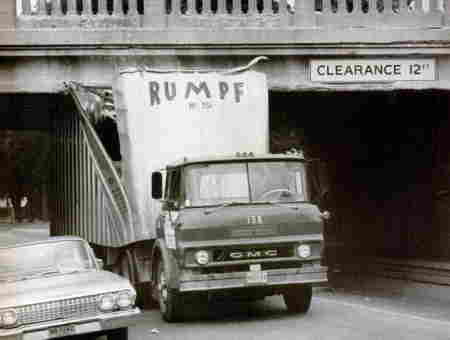
The police arrive and call in technicians and firefighters to free the articulated truck.
The rescuers discuss what to do: dismantle or saw off the top of the truck, use a lever to relieve pressure at the contact points, or grind away part of the bridge. Everyone suggests a solution based on their own knowledge.
On the other side of the road, a boy stuck in traffic with his family watches everything carefully. Quite naturally, he winds down the window and says to an officer: “Why don’t you let the air out of the tyres?"
This is a famous story (true or a legend), and it also appears in jokes, with the officer (or whoever is being mocked) replying: “What are you talking about, kid? The truck is stuck at the top, not the bottom!” 😂😂😂😂
This anecdote is an example of the attention technique, used unconsciously by the boy.
The problem is Functional fixedness: we get used to seeing things in a certain way and finding solutions using familiar elements (sometimes producing overly complicated proposals).
It only takes a little practice to learn to see things from several viewpoints (even apparently bizarre ones).
🚀 The random stimulation technique 🚀
This is one of the techniques I love, although it requires an effort of abstraction.
Most innovative ideas and inventions arise from chance elements!
Christopher Columbus set off for the Indies and happened upon the Americas, fortunately for him, otherwise he would have died in the middle of the ocean.
Alexander Fleming’s discovery of penicillin came about because a sample had not been disinfected properly.
In 1968, after several experiments, 3M employee Spencer Silver created what was theoretically a super-strong glue. The final result was quite different: the product came off every surface with little effort.
But this glue had a distinctive characteristic: it did not make a mess. You could stick it to and remove it from any surface without damaging it or leaving residue.
For several years, the accidental invention of “weak adhesive” remained in the laboratories, filed among failed experiments, until Arthur Fry, a colleague of Spencer’s, found the right idea.
The idea came from a chance external stimulus.
Fry noticed that choristers at his church used slips of paper to mark pages in their hymn books, but these often fell out or moved.
Applying the clean, weak adhesive to the slips of paper created the famous Post-it notes!

If Fry had never gone to church and had not observed carefully , the little yellow notes would probably never have been invented.
Chance is very powerful. History shows us that fate generates the most powerful ideas.
So why not reproduce randomness deliberately?
How can we use chance to come up with new ideas?
Simply reproduce random stimuli from which associations can generate new ideas.
A random stimulus can come from any source.
For example, suppose I want ideas for new online content for this blog (topics: marketing, digital and various others).
I go out and visit a supermarket, bookshop or clothes shop. I look at the products and, wherever my attention lands, start making associations with my goal/content.
For example, I see a pair of basketball shoes and think of Nike, the United States, sport and entertainment, and Michael Jordan. Then I think of The Last Dance, and of writing articles and making videos about lessons from the series in marketing, management, personal improvement, performance, team building, talent management, etc.
Even easier is to use random words from a dictionary, or open a book at a random page and try making associations.
De Bono recommends practising with random words for 3 minutes every day.
Random input alone is not enough. Our minds must be truly intent on finding something in the area we are exploring, and we need a good ability to make associations.
To practise quickly and practically, I created for my own use (but am happy to share 😉) a tool that quickly provides random input (see the following video).
There are 4 different stimuli (I recommend using them once a day, combining them):
- a random word from the dictionary
- a random image
- a random Wikipedia page
- a random place in the world
When using random images or Wikipedia pages, choose an element that catches your attention as the starting point for associations.
With a random location you can navigate, you can simulate wandering through a city or a place in the world: a sign, a shop or a landscape can provide a random stimulus. This is also a good exercise for training your powers of observation.
You get the most out of it by combining two stimuli: for example, a random word and a random image.
The practice develops the art of finding connections between the stimulus and the area for which we need an idea.
In this way, we develop our creativity, which we could also define as the ability to see new connections between things (random stimulation is also perfect when combined with the mind map.
Our brains evolved to find connections and patterns among different elements.
Random stimulation forces us to leave the usual path and existing paradigms, increasing the likelihood of finding new routes.
This technique is also perfect when we have a creative block. Think of people in advertising, who constantly need to produce new communication ideas.
A random stimulus is better than analysing what others have done!
Combine several elements 🧬
Watching the slam dunk contest at the latest NBA All-Star Game 🏀, I reflected on what an intensely creative event it is: every player has to invent an aerial routine before putting the ball through the hoop.
Like diving, but in reverse, defying gravity rather than using it 😂
The contest began in 1984, and its evolution since then has been extraordinary.
When the little great Spud Webb was winning, players threw the ball against the backboard, caught it again, and boom! Dominique Wilkins introduced windmills with the ball. Later, players started jumping over anything before dunking: people, cars, motorbikes, etc. Then came the trend for passing the ball under the legs.
Watching recent editions, I reflected on the creativity of the move after almost 40 years of dunks, and on its strong analogy with many other fields.
The model of evolution has been the MIX.
So we see a player throw the ball against the backboard (or jump over someone) while simultaneously performing a windmill and passing the ball under the legs (which says it all about what athletes they are!).
It is an application of the technique of COMBINING several elements.
We can combine elements from the past, from other areas, or generated at random.
This technique is widely used in the arts: music, dance, painting, etc.
American tourist Bernard Sadow was returning from a family holiday in Aruba. While struggling terribly to carry his suitcases, he saw a man at the airport moving bulky objects with ease using a wheeled platform!
Bernard’s brain (or perhaps his aching arm 😂) immediately made the association, and he told his wife: “That’s what we need! We need wheels for our luggage.”
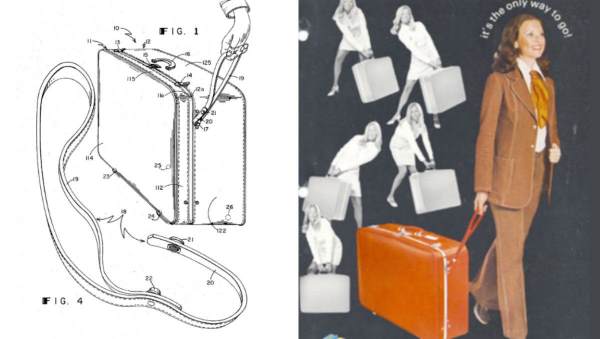
In 1970, Sadow filed a patent celebrating the combination of wheels and a suitcase, calling it Rolling Luggage.
It was a success (sold in major American supermarkets), born of need, combination and powers of observation (a pillar of marketing soft skills).
The following photo shows the patent drawing and the first advertisement, with the suitcase on 4 wheels and a sort of leash for pulling it.
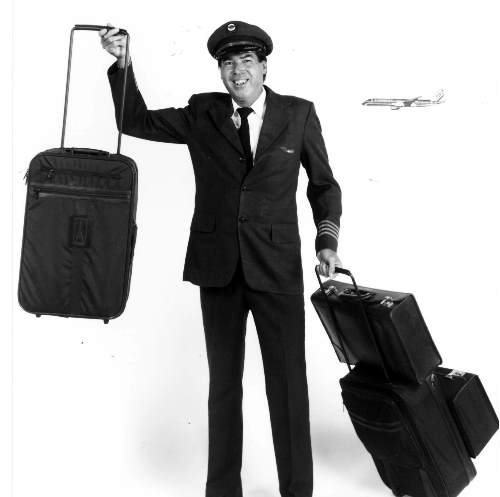
Another keen observer was Robert Plath, a Northwest Airlines pilot. As you can imagine, luggage was essential to him, and he found Sadow’s suitcase very awkward to pull (it often tipped over sideways).
In 1987, he started working in his garage in Boca Raton, Florida, changing the suitcase’s usability. He added just two wheels and a long folding handle on top: to roll the suitcase, you simply tilted it.
He called it Rollaboard , and the first units were distributed among his fellow pilots and flight attendants.
It was a kind of product test, and the results were so impressive that Robert Plath left his job as a pilot and founded TravelPro, his Rollaboard manufacturing company (the case we now all call a trolley).
What might the future of the suitcase be? Another combination?
The following photo shows a suitcase combining wheels and an electric motor.
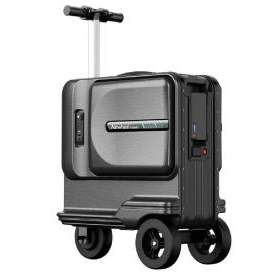
These suitcases can also incorporate a mini-scooter capable of carrying not only the luggage but its owner too.
Think of the dream 💭
We create a provocation to move our thinking by imagining what we would like to happen if there were no limits. What would our fantasy be?
When I was a boy, one of my dreams was to attend lessons from the back row while lying in my bed 🛌, arriving by air through the window 😃
If we were looking for new ideas in training and education, that route is easy today: distance learning lets us attend classes from bed without leaving home.
But we could also think, for example, how wonderful it would be to get paid to travel!

This provocation could lead us to launch a travel programme in which we recruit travellers (who are paid) to bring friends or acquaintances (who pay), using a network model.
Or the traveller could be paid according to the content and visibility they can provide among potential customers of the travel agency hiring them (through social media, blogs, etc. – which is what influencers do today 😎).
Exaggerate, amplify or reduce 🔎
This technique works on the quantitative dimensions of products and processes, such as duration, length, weight, height, frequency, temperature, volume, etc.
Here, the provocation is to increase or decrease a quantitative dimension dramatically.
For example, again in training and education, we could imagine hugely increasing the frequency of tests and exams for students: a test every hour!
Various ideas could follow: creating an app that sends a question or problem to answer, with students gradually earning points and passing exams through a gamification model.
We can combine this technique with breaking the paradigm: take an element and change its scale. In catering, for example, we could exaggerate the quantity of food provided and tell customers they can eat whatever they want for a fixed price (how “all you can eat” came about).
Change the context, purpose 🗺️ or use
The technique is very simple: transfer a process or concept to a different context.
It is probably one of the techniques most widely used in world of marketing.
Some examples:
- Apply babysitting to dogs, and it becomes dog sitting.
- Apply the cloud concept to a kitchen, which becomes a cloud kitchen/dark kitchen
- Transfer the Airbnb concept from your home to your car, boat, bicycle, time, etc.
- Apply IKEA’s model to cooking: buy a kit of recipes and prepared ingredients and cook them yourself at home (capable of generating the IKEA effect)..
- Transfer “buy 3, pay for two” from consumer goods to hotels.
- An All-Star Game in football and/or a shooting-accuracy contest for Serie A players (transferring what happens in the NBA with three-point shots).

Another interesting example of changing context is innovative Italian company Roboze, which is applying the concepts of zero-kilometre sourcing (familiar from the food supply chain), Software as a Service (SaaS) and the cloud to 3D printing.
In practice, it has created a worldwide network of 3D printers (who are also its customers) able to produce and deliver according to proximity to the customer, all in the cloud. I activate it online and use it like any other software as a service. It has created MAAS (Manufacturing as a Service) , managed entirely online.
A very powerful exercise for training creativity is to imagine different uses for any object or product (or service).
For example, a water bottle can become a watering can or a funnel.
Pretend to be someone else: practise new perspectives 👽
In the workplace, recruiting people from other sectors and businesses is common practice. The aim is to gain a new viewpoint, unaffected by the layers of thought that build up over time.
Without bringing in new people, we can achieve the same result by pretending to be someone else.
Think of a friend or colleague, and consider a project by putting yourself in their shoes.
Because this is an imaginative technique, we can broaden our horizons and even imagine being an object or someone from the past.
For example, we need to solve a problem or design a new style of trousers.
We can pretend to be our grandfather, a well-known writer or scientist we know a lot about, or even a tree or a fish, then try to solve our problem or think of a new idea.
In the following video, I gave my smartphone to my dog 😂🤪 to make a video and understand his perspective when we go for a walk.
If we were creating new shoes, could a dog’s viewpoint be useful? 🤔
The character I personally love for pushing creative thought is the alien 👽: if someone came from Mars and saw a pair of trousers for the first time, what would they think? How would they make a new design?
This technique comes naturally to children, who practise it a lot through play: “Let’s pretend I’m xxx and you’re yyy.”.
After all, creativity ultimately is the art of connecting different points and worlds (real or imagined).
Lateral thinking exercises and riddles
At the beginning, we looked at the nine-dot exercise Here are some other fun exercises:
- The lift
- The trees
- The man in the bar
- The puzzle of Juliet and Romeo's deaths
- The naked man dead in the desert
- The car with its lights off
- A man arrives at a hotel
- The condemned man and the three rooms
- The bus driver
- The miraculous jump from the skyscraper
- Arresting the murderer playing poker
- The driver's dilemma
- The eggs and the basket
- The storm and the henhouse puzzle