What are cognitive biases? What is a bias? What is a heuristic?
We live with information overload: our brains receive countless stimuli, and we have seen how this affects our concentration.
To adapt to the volume of information and handle as much as possible, our minds look for shortcuts; otherwise, they would immediately use up all their energy.
Cognitive psychology identifies two types of shortcuts:
- heuristics
- cognitive biases
Heuristics are shortcuts: efficient strategies learned through experience and knowledge that let us handle information and problems and make decisions quickly.
We only need to extrapolate from a small piece of reality to form an accurate idea, or one that is not far from the truth.
For example, an experienced sailor can work out the direction and strength of the wind in seconds simply from how the sail vibrates, without needing measuring instruments.
Cognitive biases, on the other hand, are mental shortcuts that produce subjective distortions of reality and incorrect judgements. In practice, they are ineffective heuristics: heuristics with errors😁
The spread of the term dates back to the early 1970s and the work of the two psychologists Kahneman and Tversky on human decision-making processes.

Historical photograph of Tversky (left) and Kahneman (right)
The word "bias" comes from English, and before that from French and Provençal, and means distortion, inclination, error or prejudice.
We hear the term Cognitive Bias more and more often, while distortions and mistaken perceptions in decision-making are increasing in today's society.
For people working in the world of marketing, in digital marketing and sales, it is very useful to invest time in exploring the subject and understanding the main cognitive distortions.
There are a great many cognitive biases, and nobody is immune to them.
Let's look at some of the best-known and most interesting.
Confirmation bias
We seek and interpret information by giving more attention and weight to what confirms our theories, hypotheses or beliefs.
What human beings do best is interpret all new information so that their previous conclusions remain intact. (Warren Buffett)
This is a selective perception that filters in the direction we want.
For example, if I think drinking wine increases life expectancy, I will pay much more attention to research that confirms my view and filter out studies that might challenge it.
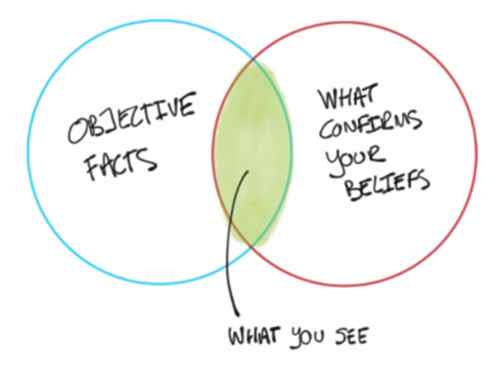
Confirmation bias also operates after we buy a product or service, reassuring us that we made the right choice.
In marketing, it can therefore help to anticipate the customer's needs by providing data and details that reassure them about their decision.
This is one of the most common distortions and often limits our personal and intellectual growth and the development of scientific research.
Personally, I see it as a combination of:
- selective perception
- filter bubble
- a pinch of personal pride
Sometimes this bias can also be useful, because it is very efficient at finding examples and applications to support a theory of ours.
To avoid its negative effects, we should try to validate and compare our ideas against something that is their exact opposite, or turn to randomness.
Loss aversion and the scarcity effect
Human beings are more motivated to avoid a loss than by the possibility of gaining something of equal or even greater value.
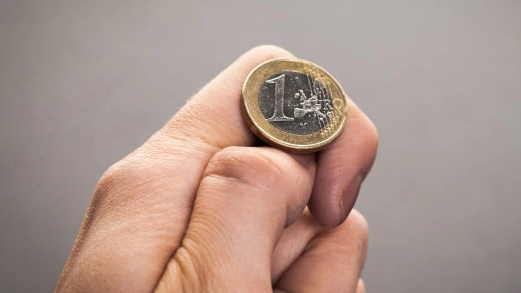
Kahneman's coin test to measure this phenomenon is well known.
People had two options to choose from:
- if the coin lands tails, you receive €100; if it lands heads, you get nothing
- receive €40 immediately without playing
The vast majority chose the second option.
This happened because the risk of losing everything outweighed the €100 prize, even though, taking the random variable into account, the first option offered a €10 greater advantage.
Loss aversion is also one of the main reasons why classical economics based on rational behaviour needs revising: according to economic theory, everyone would have chosen option 1.
Have you ever experienced FOMO (Fear Of Missing Out 😲)?
This is a form of social anxiety that makes people fear missing an opportunity or being left out of exciting or interesting events.
Social media have intensified this phenomenon, and several studies suggest that around 60/70% of millennials experience it!
FOMO anxiety stems directly from the psychological principle of loss aversion.
A study published in the scientific journal Computers in Human Behavior investigated the link between individuals' levels of FOMO and social media use.
The results were clear: people with higher FOMO also showed more problematic social media use.
People with high FOMO were also more depressed, anxious and neurotic than those with lower FOMO. High FOMO was also linked to greater fear of negative evaluation.
Conversely, people with lower FOMO had a higher level of self-discipline than those with high FOMO.
People with high FOMO check friends' and family's social media feeds to avoid missing what happens in their lives. The reverse is also true: someone who constantly checks other people's feeds may develop FOMO because they see others doing amazing things and always having fun.
They also fail to perceive that these images often look better than the real experience. This opens another area of psychological analysis: people sharing to create an impression of themselves that differs from reality.
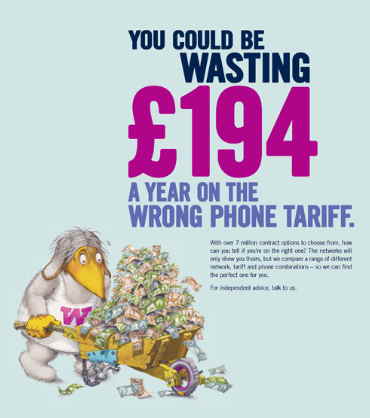
In marketing, this bias can be used by communicating the loss the customer would face if they did not make their choice.
In the following example, a British telecommunications company shows how much money a user would lose each year by choosing the wrong tariff.
Copywriting makes extensive use of the phrase "don't miss...". For example, an advertisement selling an online course might say: "Don't miss the chance to improve your career and find your dream job. ...sign up for our course in...".
For a travel agency, it might be: "Don't miss the trip of your dreams. Don't wait: set off now on this adventure to Brazil's Fernando de Noronha islands."
At a personal level too, we can motivate ourselves to do something simply by thinking that we cannot miss a particular opportunity, because it may never come again.
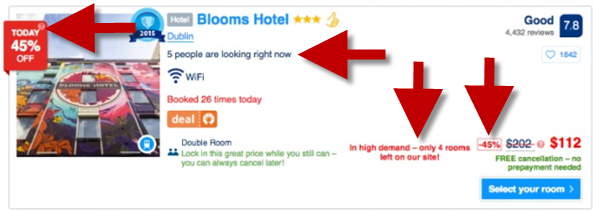
In neuromarketing, however, the way to make the most of the urge to act generated by loss is undoubtedly to combine it with the scarcity effect.
As the term suggests, this creates a perception that a product or service is in short supply.
The effect is intensified by drawing on the following elements:
- an unmissable opportunity, typically a promotion
- a limited number of items or a limited time to take up the offer, for example an expiry date of xxx
- competition with other buyers: knowing that other people might get the benefit instead of us
It is established that combining these factors significantly increases a potential customer's likelihood of buying.
It is no coincidence that major online ecommerce platforms use it extensively, especially in travel.
Modern pricing models, particularly online, make extensive use of the freemium model and free trials. The latter is particularly effective at drawing on loss aversion.
The sense of loss when a trial period expires, for example after 30 days, statistically increases conversions. This assumes the value provided remains the same; tests are usually run with and without the trial.
Drawing on loss aversion is also very effective in commercial negotiations, particularly where knowledge is asymmetric or there is no time to investigate further.
For example, a company selling online advertising can show a prospective customer how their competitors are already investing profitably in online ads.
The claim at that point might be: "By not investing today, you are missing opportunities that your competitors are taking!"
If the proposition is made to a CEO, who obviously does not know the technical details, it may have a very positive effect on sales.
Similarly, many salespeople claim substantial improvements in sales performance that the customer would miss without using the proposed solutions 😉
Context bias (Framing)
Human choices also depend on the context in which an option is presented to us.
Let's take a practical example.
https://www.fabriziocostantini.it/en/marketing/cognitive-biases.php#framingMario works on an assembly line. One day he asks his supervisor, "Can I eat a sandwich while I work?" The supervisor immediately says no.
The next day Mario rephrases his request: "Can I work while I eat a sandwich?" This time the supervisor agrees without hesitation.
The action is the same; only the context has changed.
Another very interesting marketing example concerns how context affects the perceived benefit of a promotion.
For example, if a PC costs €600, we can express the same discount in two ways:
- 20% off
- €120 off
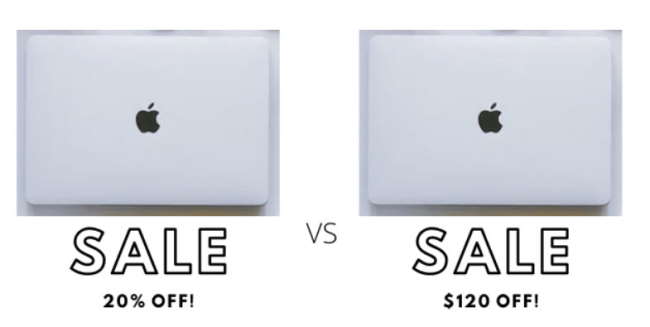
Research has shown that customers will be much more interested in the second option.
This effect is called "the rule of 100".
All benefits below €100 are more attractive to customers when expressed as percentages, while above €100 it is more effective to state the discount's absolute value.
The same principle works in reverse: for a product costing €10, saying 20% off is more effective than saying €2 off.
Halo effect
Our perception of a person, a brand, an object or a company is influenced by other characteristics of the same entity in a different area.
A classic example is a good-looking person who generates a halo that leads us to judge their other characteristics positively too.
The Halo effect is widely used in marketing and business strategy.
For example, endorsers who are highly respected in their field can create a halo around the products they promote.

A company with a strong sustainability and environmental policy can create a positive halo around its products and brands too.
We could also call the Halo effect the projection effect, because positive characteristics, or negative ones, are projected into different areas.
How can we use the halo effect in business presentations?
Two aspects are fundamental:
- our slides should be well designed and error-free, much like the effect of a good-looking person. For external presentations to an audience, the classic technique is a warm-up with an engaging emotional video!
- put the positive aspects of the project at the beginning, leaving critical points and problems until the end
Negativity bias
You have done many good, valuable things, but one day you make a mistake. Negativity bias tells us that the mistake will certainly attract more attention than the things you did right.
When I messed things up, my grandmother used to tell me: only those who do things make mistakes!

Negativity bias creates the cognitive distortion that makes us pay greater attention to negative elements.
Related to this effect is the phenomenon of positive–negative asymmetry: people remember negative news and information better, mention and share it more often, and rely on it more when evaluating something.
For a company, this means that when customers have equal numbers of positive and negative experiences, the negative ones have a much greater impact. People who have had problems are also typically more inclined to share their experience.
I like to call this combination the coffee-and-milk effect: just a few drops of coffee are enough to stain a glass of milk!
Facebook's algorithm knows this asymmetry phenomenon well.
If the algorithm rewards content that attracts more notice, comments and shares, and if negative content is what does this, perhaps we should call Facebook's algorithm: the negativity algorithm.
Cashless effect
I was looking at my Amazon orders and realising how much stuff I buy, especially books. All it takes is a recommendation or an interview, and I go looking at Jeff's place. With one click, one damned click 😂, I have already bought it.
A pump draining my card!
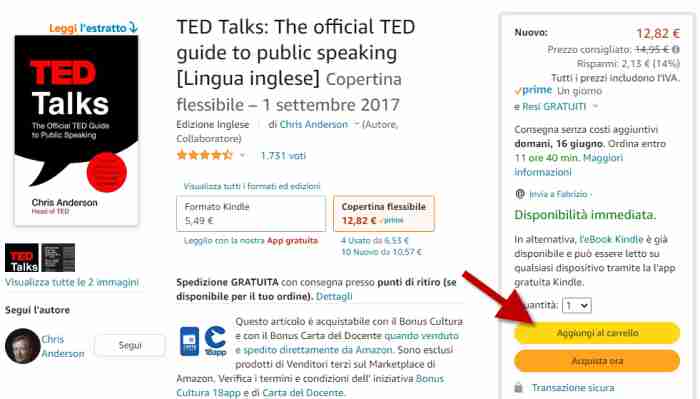
But if I paid cash on delivery, as we used to, or a cashier appeared at checkout to whom I had to hand over cash 💰💰💰, would my willingness to spend be the same?
Science tells us it would not.
It is called the Cashless effect.
This is the effect whereby we spend more when paying electronically rather than in cash: by credit card, contactless smartphone, PayPal online, online wallet and so on.
We can connect it to loss aversion: when we do not see money physically leaving our hands, our perception of the outlay decreases.
The phenomenon exists both online and in physical retail. Online, however, we need to distinguish the first purchase from subsequent ones.
The first purchase presents the greatest barrier: however simplified the payment process is, it largely neutralises the cashless effect.
On the other hand, once we have registered and created a wallet, as with Amazon, the willingness to spend encouraged by electronic payment reaches its highest level.
We can make two observations:
✔️ for an ecommerce business, securing the first purchase is fundamental, and incentives to encourage it are money well spent
✔️ unfortunately, one-off ecommerce purchases do not benefit from these dynamics — an online Internet subscription, for instance
Managing cognitive biases
Knowing these distortions is very useful for applying them in marketing, as we have seen in the examples, but recognising them also makes us more aware personally.
If this awareness activates the more rational part of our brains, we can often reconsider our decisions and reduce our mistakes!
Summary video