
Over the last twenty years, technological developments have changed the world and, for better or worse, people's behaviour and purchasing processes too.
These changes have considerable effects on the market and marketing strategies.
In my view, two broad elements are transforming the market:
- Interruption
- Information
By interruption, I mean all the moments or micro-moments when people shift their focus from one thing to another.
In everyday life, we experience a series of what I call “natural” interruptions and a series of “commercial” interruptions.
The former include a friend's call, an incoming email, and so on; commercial interruptions are all those produced by push advertising.
Advertising, after all, is the attention market.
In this market, the supply of attention is determined by the number of interruptions a person can absorb.

Over time, natural interruptions have grown exponentially: mobile calls and text messages joined landline calls, then growth accelerated with social networks, instant messaging and the spread of smartphones.
In practice, there are more channels, devices and moments when new messages reach us, all multiplied by an ever-wider social circle.
Today, we face a problem of excessive natural interruption, with sociological consequences for people's ability to concentrate and relate to others.
From a marketing perspective, this is a major problem because commercial interruptions must compete with natural ones; moreover, the proliferation of technology platforms and media channels has also greatly increased commercial interruptions.
The end result is that people adapt and begin ignoring less important interruptions, naturally starting with commercial ones.
Push advertising and interruption marketing are becoming less and less effective.
The data on display advertising clearly demonstrate this: people not only ignore banners but block them before they appear.
Trust in advertising is also declining, both in the medium and in the brand using it. Overpromising, broken promises and corporate self-centredness are particularly unpopular.
Mainstream channels such as television (linear and on demand) still hold up thanks to their ability to build brand awareness but their impact risks being short-lived unless supported by something else.
Another factor transforming behaviour is access to information!
Consumers today have an enormous amount of information they did not have before.
When I have a need, I can find out which products or services meet it and with what results.
Today, it is unthinkable to buy something in a shop without first researching it online (research on infocommerce reports figures very close to 100%).
Or to book a hotel or restaurant without first reading other customers' ratings and comments.
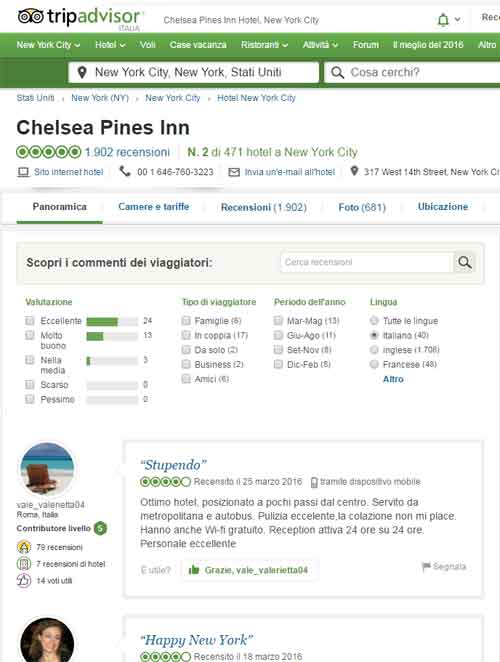
Hotel review results on Tripadvisor
Another widespread phenomenon is searching for product information while in the store.
What are ROPO, webrooming and showrooming?
Definition of ROPO: Research Online, Purchase Offline. People first research a product online (making extensive use of search engines), then, once they have gathered the information they consider useful, buy through a physical channel.
Definition of webrooming: similar to ROPO, but focused on content on the website of the brand we want to buy; the purchase again takes place offline.
Definition of showrooming: the opposite of webrooming. I go to a shop, examine and try the product, then buy it online (sometimes on my smartphone while still in the store). Amazon is one of the leading beneficiaries of showrooming, to the point of creating a scanner in its app to make products easier to find on its platform.
This scenario requires us to rethink how we approach the market. Strategies must evolve towards more aware marketing that considers the new dynamics and the importance of pull activities.
Information asymmetry is gone, and customers who passively receive messages are disappearing (and those remaining are the least interesting target).
Today, 90% of promotional investment is push-based!
Let us see why the marketing of the future must shift towards pull activities.
Pull strategies are now grouped under the name Inbound Marketing in contrast to outbound marketing (based on interruption).
The metaphor I like to use for push and pull is that of the farmer and the hunter.

Inbound marketing is precisely the farmer's strategy!
What is inbound marketing?
It is an approach, a methodology that uses marketing techniques to attract customers instead of focusing on push.
To attract customers, we need to create content or services that are useful to potential customers, building trust, confidence and authority.
The channels through which customers reach us will mainly be search engines and social media.
This strategy does not end at customer acquisition but continues by nurturing the relationship. The aim is to make customers love the brand so much that they become ambassadors, or at least positive influencers.
The inbound funnel
Looking at the acquisition funnel from the company's perspective, we identify these steps:
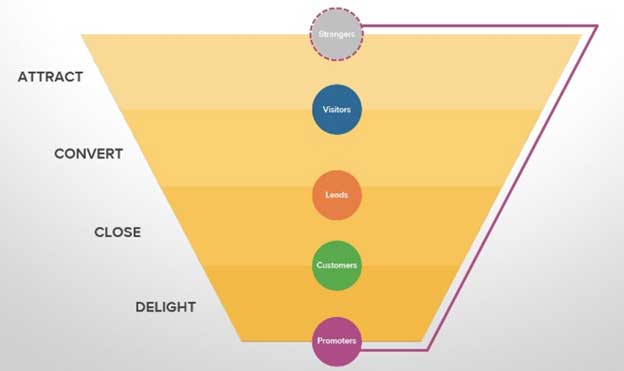
The first step is to identify the right segment within the audience, among the “strangers” (the land to cultivate, or the hunter's target).
Attraction is the most strategic stage: we need customers to come to the company and turn from strangers into visitors. We will see how shortly.
In the convert stage, visitors may immediately become customers and jump to “close”, or turn into leads.
A lead is like a seed to water and grow into a customer (a healthy plant).
But as good farmers, we know the field needs careful tending, and we must “delight” our customers to turn them into “promoters”.
Inbound applies to both online and offline channels and makes full use of omnichannel opportunities.
How do we attract and delight visitors? Extended value!
To attract and delight customers, we need to create what I call “Extended value (EV)".
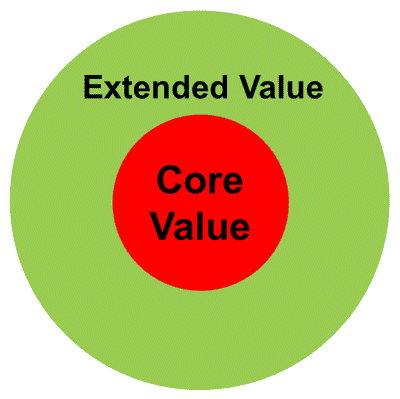
Extended value (EV) is added on top of a product or service's core value and enriches it.
Core value is the fundamental factor; it is the value we offer the customer, without which even a good digital and inbound strategy has little impact.
Extended value is built by creating content (content marketing), applications and added-value services that both attract visitors and nurture customer relationships.
Let us take an example to better understand the concept.
Consider an online mountain bike retailer.
It could create extended value by building a blog or an area within its website (or even a dedicated website) containing useful information for mountain bikers:
- a guide to buying an MTB
- how to repair xxx
- bike tests and reviews
- MTB routes across Italy
- downhill techniques
- a guide to technical equipment: saddle, handlebars, gears, etc.
- training programmes
- a forum for MTB enthusiasts
- etc.
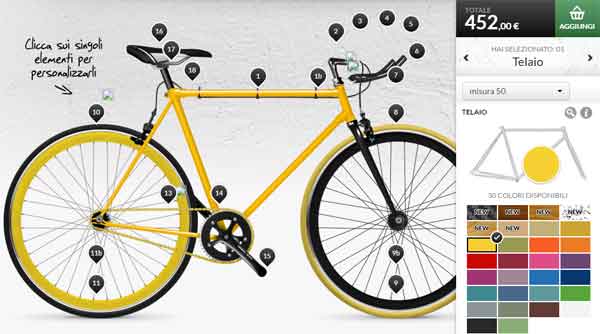
Content should also be distributed in other formats, particularly photos, videos and infographics.
Besides content, we should also try to create services, for example:
- an MTB configurator based on the visitor's characteristics (even better, create a stand-alone website)
- an MTB comparison tool
- a virtual trainer integrated with GPS monitoring systems
- a geolocation app suggesting routes
- etc.
Content marketing plays a fundamental role here, helping us identify the topics and services to develop.
It is important to analyse our visitors' needs and intentions so we can build content and services that answer their questions.
Once extended value has been created, we must use inbound marketing channels to distribute it:
- Search engines (organic and paid)
- Social media (organic and paid)
Search engines play a central role because the basis of inbound is that visitors come looking for us.
This is where SEO (search engine optimisation) comes in, allowing search engines to find us. SEO has evolved considerably and now merges fully with content marketing, becoming inbound marketing's most important strategic tool.
Social media and Social Media Optimisation activities let us reach additional visitors through sharing and a presence on the main platforms (the choice depends on the type of product or service).
Among paid advertising tools, search engines and social media currently offer the best options.
I listed email as a general channel because inbound marketing relies heavily on being able to write directly to visitors' or customers' email addresses.
Indeed, lead generation focuses on acquiring email addresses (through newsletter subscriptions, document downloads, access to private areas, etc.).
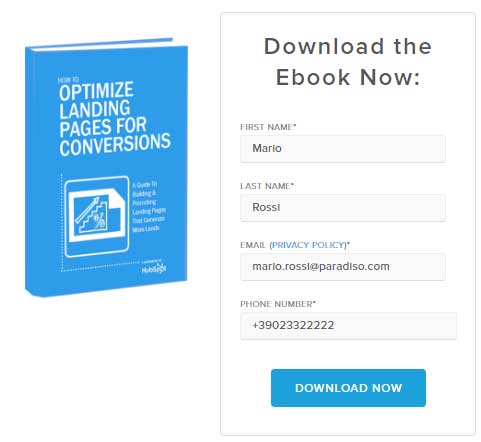 Example of a landing page for lead generation
Returning to the MTB example, I can nurture visitors who subscribe to my newsletter by continuing to send content and links to useful services (e.g. a PDF guide to MTB routes). Once a lead becomes a customer, extended value must be focused and personalised.
EV and the buying cycle model
Besides value, an inbound marketing strategy must consider two other important factors: context and platform.
Context means the moment (or even micro-moment) the customer has reached in their purchasing process.
The platform is the physical or technological place where that moment unfolds. From a digital perspective, it is important to distinguish between platforms so we communicate according to each one's rules (YouTube, for example, follows different principles from Pinterest).
The Buying Cycle model, which illustrates every stage in the customer's purchasing process, is highly useful for analysing context and for strategic analysis in general.

The customer's buying cycle
Let us look at the various stages:
- Brand awareness Awareness of the brand and/or product refers to knowing them regardless of purchase intent. For example, I know the Pampers brand and its SoleLuna nappies even though I have never bought them because I do not have children.
- Recognising a need This is when customers begin to recognise a need or a problem to solve. For example, I want to start exercising and consider buying a mountain bike, or my MTB is now old and it is time to replace it.
- Information search I have decided to buy a mountain bike, so I begin gathering all the information needed to make my choice. Access to digital sources now runs through search engines, which lead me to specialist websites, online videos and photos, manufacturers' official websites, blogs and product reviews. I will also use my online social network and, of course, offline contacts (a chat with a knowledgeable friend).
- Evaluating alternatives Once all the information has been gathered, we evaluate the alternatives based on economic, cultural, psychological, social and personal factors. The final outcome is a shortlist from which to choose.
- Purchase decision and purchase At this stage, we act and choose from the list. Online, this can be a critical stage because technical or usability obstacles may arise between the decision and the purchase, preventing customer acquisition.
- Evaluating the purchase Finally, we evaluate the choice, with all its consequences for loyalty and the ability to create a good or bad reputation for the brand or product.
The buying cycle described above is typical of “complex” purchases, as opposed to impulse purchases. A mountain bike is a complex purchase, while consumer goods such as crisps or a snack are typically bought without extensive prior research.
In the information age, TRUST is the critical success factor!
Inbound marketing works precisely on trust and authority.
In particular, creating extended value makes us known before a need is recognised (for example, mountain bikers using GPS routes and advice on our website), through pull rather than push. Search engine optimisation and high rankings reach visitors as they evaluate alternatives.
Have you ever taken a photography course? During it, you will certainly develop a need or desire to buy a new camera (that is how I bought my first DSLR), and the first person you will ask for advice is your teacher! They have authority and your trust.
Returning to the MTB example, the brand offering the greatest extended value will rank at the top both on Google and in customers' trust.
Transparency and keeping promises are fundamental to building trust (overpromising is a typical problem in advertising).
In addition to the tools mentioned so far, inbound also uses:
- Landing pages
- Acquisition forms
- Calls to action
- Social proof
- Marketing automation
- CRM
- Social publishing and monitoring
- Surveys
Paid tools that do not interrupt people are also used. The most common is search engine advertising, buying relevant keywords according to the purchasing process. Buying social advertising formats is also very effective. In particular, it is worth watching new platforms closely so we can invest in less competitive spaces and achieve a high return on investment.
Analysis, analytics and personalisation
Analysis plays a strategic role in identifying the field to cultivate and what to sow.
We try to analyse every stage of the buying cycle, along with needs and desires, in advance, using the intentions expressed in search engines.
The analysis tools I suggest are:
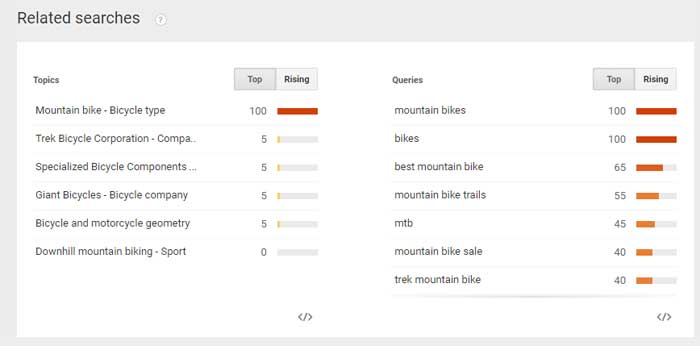
Google Trends results
An initial simple worldwide Google Trends search for “mountain bike” already gives us an idea of the most searched terms. We can see the strong desire to compare and find out which MTB is best. Trail versions and the Trek brand are also frequently searched.
We will explore these tools in detail when discussing EV, Content Marketing and SEO.
Analytics are fundamental for analysing visitors and their behaviour and optimising the acquisition funnel's conversion rate (CRO).
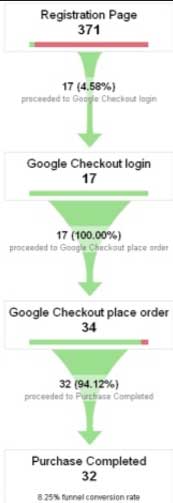
Example of a Google Analytics conversion funnel
The process involves continuous fine-tuning to improve engagement channels, methods and the value to create.
Segmentation and personalisation maximise benefits for both customers and the company. Lead nurturing in particular requires the ability to identify distinct visitor/customer clusters (building personas associated with segments is very useful).
Consider clusters such as MTB beginners, experts, triathletes and touring riders: we need to build a different experience for each and nurture them with different care. It therefore makes sense to give practical guides to beginners and summaries of new technology to experts. Measuring the lifetime value of different leads and customers is important. For example, experts have a higher value than beginners, so we can consider spending more on looking after the former.
Conclusions and the limits of inbound
The market and customer behaviour are changing quickly; interruption/outbound strategies are weak in terms of trust and transparency.
Companies' inbound investment today remains very low, particularly compared with outbound.
There are several reasons:
- limited knowledge of all the digital tools available
- a strong attachment to the traditional promotion chain, whose participants favour outbound over inbound. A butcher will never recommend a vegetarian diet! :-)
- difficulty shifting investment from push to pull
In business terms, much inbound investment lasts, while advertising investment's effects fade quickly.
As Kotler argues (watch the video) companies that make their customers love them need to invest much less in advertising than others.
Returning to the example, the sections and services for bikers will attract visitors and potential customers throughout the company's life.
Inbound also has its limits:
- It requires a different working model and takes time to produce results! Farmers must first prepare the soil, sow and tend it, and only months later can they see the fruits of their labour. Unlike hunters, who leave in the morning and return in the evening with their catch :-)
- Difficulty finding people within the company with the skills to put pull strategies into practice
Inbound marketing also certainly offers much higher returns on investment for products and services involving complex purchases.
In the marketing of the future, we need to be more like farmers and less like hunters!