
On Friday 17 November 2023 came the bombshell news of Sam Altman's dismissal.
The CEO of OpenAI , after leading the company to dominate the world of artificial intelligence (with a valuation of 80 billion), was removed by the board of directors. Following a very brief interim period under Mira Murati (chief technology officer), he was replaced on 19 November by new CEO Emmett Shear (former CEO of Twitch, former co-founder of Justin.tv and a partner at Y Combinator).
Murati and Shear will probably be remembered as the two CEOs with the shortest tenures at OpenAI.

The officially stated reason for Altman's dismissal is:
“Altman was not consistently candid in his communications with the board, hindering its ability to exercise its responsibilities. The board no longer has confidence in his ability to continue leading OpenAI.”

Reading this explanation makes it seem as though Altman might have done something questionable or failed to communicate something dangerous for the company, such as a security problem.
But is that the case? What are the real reasons?
Besides being compelling, this is a story worth following because it could affect not only business but the very future of humanity.
Chaos broke out after Altman's departure: Greg Brockman (OpenAI's president) resigned, quickly followed by 3 other senior researchers.
What may seem astonishing on paper is that Microsoft , OpenAI's main financial backer, knew nothing about the decision by the board of directors and, although it does not sit on the board, nobody informed Satya Nadella.
Immediately after the dismissal, Sam Altman and Brockman began working to create a new company to compete with OpenAI.
The two have a queue of investors wanting to join the new company and talented people wanting to follow them out of OpenAI. Remember that Altman was president of Y Combinator, the world's leading startup accelerator, so few know the capital market for funding a new business as well as he does (just think of the deal he secured for financing from Microsoft).
Within just a few days, OpenAI realised the disastrous impact of the dismissal on the company's future and rushed to negotiate Sam Altman's return to the company.
Microsoft said it would continue supporting and funding OpenAI, while its CEO, Satya Nadella, was also working to persuade Sam to return.
The following video, taken from the November 2023 DevDay, shows Microsoft's CEO's enthusiasm for OpenAI.
The talks between Nadella and Altman led to a surprising turn of events.
On 20 November Satya Nadella posted the following tweet:

As the tweet states, OpenAI's former CEO and former president, Brockman, will join Microsoft to lead a new advanced artificial intelligence research team (with an amusing comment from the ever-present Elon Musk).
In practice, Microsoft will remain OpenAI's main investor while developing its own research team in parallel.
The news created considerable instability, and most OpenAI employees expressed a desire to move to Microsoft to follow Altman and Brockman.
New CEO Emmett Shear had barely found his office when another piece of news arrived.
On 22 November came news of Altman's RETURN, announced with the following tweet:

Now that all the drama is over, I remain intensely curious about why there was so much commotion and what the consequences will be for our society in the short, medium and long term.
Why was the undisputed leader who took a startup into the elite of global business, reaching a valuation of 80 billion, fired? 🤔
What happened, and who wanted Altman out? 🕵️ Is there something we do not know that could affect our future?
Let us start with what is certain.
The scientist who instigated the dismissal is Ilya Sutskever, OpenAI co-founder and chief scientist, as well as an important board member (if, like me, you are unsure about how to pronounce his name, here is a little help).
But why? Does Ilya dislike Sam?🤔
To understand, we need to look more closely at who Ilya Sutskever is and what OpenAI's mission is.
Who is Ilya Sutskever and what is OpenAI's mission?
Sutskever was born in Russia and grew up in Israel; he became interested in artificial intelligence from its earliest days.
He studied at the University of Toronto in the Machine Learning Group led by AI pioneer Geoffrey Hinton.
 Ilya Sutskever on the left, Professor Geoffrey Hinton on the right
In 2018, Hinton won the Turing Award (essentially the Nobel Prize of computing) for his work on deep learning and the use of neural networks. His research underpinned the new language models.
In 2013, Geoffrey was hired by Google following its acquisition of DNNresearch Inc., the company he founded. In May 2023, Hinton left Google for a specific reason that he stated himself:
the fear that artificial intelligence would become more intelligent than humans.
After leaving the Mountain View company (an experience the scientist still describes as wonderful), Geoffrey devoted himself to raising public awareness of the serious risks he believes may accompany the technology he himself introduced.
To describe the current situation, Hinton says:
“These things are totally different from us.
Sometimes I think it is as though aliens had landed and people had not noticed because they speak very good English.”
Words that give us pause, especially coming from a scientist with “a little” authority on the subject.
In his deep learning work at the University of Toronto (which earned him the Turing Award), Hinton worked with two brilliant students, one of whom was Ilya Sutskever.
Ilya absorbed all of Geoffrey's knowledge and, very probably, his vision of AI's future too.
After his doctorate, Sutskever spent time at Stanford University with Andrew Yan-Tak Ng, another major expert and recognised leader in artificial intelligence, as well as a co-founder of Coursera.
Following in the footsteps of his mentor Hinton, Ilya worked for 10 years at Google contributing to the development of Brain.
The natural evolution of his career led him to leave his brilliant career at Google to join the newly founded OpenAI.
It is important to read his reasons for the move:
“I joined OpenAI partly because of a very strong group of people and, to a large extent, because of its mission."
Sutskever is a highly regarded scientist: Altman referred to Ilya as one of the world's most respected researchers, while Elon Musk (an OpenAI co-founder) described him as:
the “linchpin” of OpenAI's success
So let us investigate the OpenAI mission that attracted Ilya and what has happened over time.
Mission: OpenAI is a non-profit company whose objective is to build safe artificial general intelligence (AGI) that benefits and is advantageous to humanity.
 Photo of OpenAI's early, underground days
There are 3 fundamental elements in the mission: a non-profit company, the creation of AGI and a guarantee of safety.
It is important to remember that, unlike traditional companies, OpenAI's board of directors is not tasked with maximising shareholder value, and none of its members owns OpenAI shares.
The original board, naturally before the latest events, consisted of: Greg Brockman (Chairman and President), Sam Altman (CEO), Ilya Sutskever (Chief Scientist), Adam D'Angelo (CEO of Quora), Tasha McCauley (former CEO of GeoSim Systems) and Helen Toner (director of strategy at Georgetown's Center for Security and Emerging Technology).
The first 3 have operational roles in the company, while the last 3 do not and are external.
In 2019, OpenAI reached a crossroads: as its website explains, the large investments required for research led it to create OpenAI LP, a new for-profit company, albeit with “capped profits” (the cap is no more than 100 times the value of partners' stakes).
The company's official statement is:
"We want to increase our ability to raise capital while still serving our mission, and no pre-existing legal structure we know of strikes the right balance.”
Two entities have therefore coexisted since 2019, but the founders maintain that OpenAI LP will be “governed” by the non-profit OpenAI Inc., which guarantees safety and prioritises improving humanity over profit.
We know that the new corporate structure enabled the arrival of Microsoft with substantial capital (over 10 billion dollars) and a 49% stake in the for-profit company, but no seat on the board of directors (consistent with OpenAI's mission).
Microsoft provided the means to continue development and the cloud and computing platform needed by OpenAI's laboratories; in return, it obtained exclusive licensing rights to GPT-X.
Shortly before this restructuring, one of the non-profit company's greatest supporters and co-founders left: Elon Musk.
The official reason for the Tesla CEO's departure was incompatibility due to a potential conflict of interest with Tesla's AI research and development for self-driving technology.
But reading the outspoken Musk's tweets over time is enough to understand that the reason is quite different.
For example, in the following tweet he criticises OpenAI for starting as non-profit and open source and no longer being either; for this reason, he also blocked GPT's bot from analysing content on Twitter, or rather x.com.
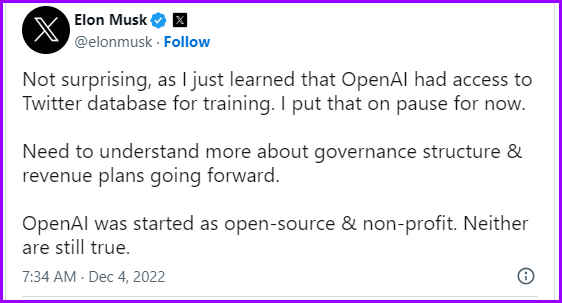
Elon disagreed with creating a for-profit company to raise the necessary capital.
He apparently proposed funding OpenAI directly himself and taking full control, with the aim of countering the most powerful for-profit company of the moment: Google.
Clearly, Musk's “centralising” proposal did not appeal to OpenAI's board, and they parted ways, but he remained convinced of the dangers of AI (and AGI in particular) driven by economic and financial demands.
Why Altman was fired and what it means
Having provided the necessary background to better understand what is happening, we can move on to what, IMHO, might be the main reason for Sam Altman's dismissal.
We read the official reason at the beginning of this article, but there do not appear to be problems with Altman's conduct (in practice, he has not screwed up); rather, the underlying issue is a different vision of the future.
Altman and Sutskever disagree on how to develop the technology while generating profits.
The former is greatly accelerating development and the launch of products and services (just look at what was presented at the latest DevDay); the launch of GPT-5 even seems to be ready already!
Ilya, however, considers this speed very dangerous: there is a risk of losing control over the evolution of artificial intelligence.
If we consider OpenAI's mission and Sutskever's technical and philosophical background, we realise this is not a personal conflict but a clash of different visions of the future.
Like Elon Musk, Ilya clearly has a strong-AI vision: this means that, unless we are careful, in the near future machine intelligence will not only surpass human intelligence but become sentient, making choices that could harm humanity.
From this perspective, we should proceed more slowly than Altman wants to.
According to reliable sources within OpenAI, the spark that triggered the dismissal was a letter signed by several internal researchers warning the board of the discovery of a new AI, codenamed Q* (Q-Star), capable of threatening humanity.
Q* appears to be artificial general intelligence (AGI), capable of learning any subject independently without training, surpassing humans in many activities.
Anonymous sources say it was able to learn on its own and solve mathematical problems.
This letter ignited the board's fears, prompting its decision to remove Altman.
What is unclear is whether Sutskever knew about Q*, as he should have as chief scientist.
Or perhaps the problem is not the existence of this technology but the speed at which Altman wants to bring it to market, which he did not share with the board.
This would make more sense, since Sutskever does not oversee marketing and commercial matters.
Adding to this situation is the possible stock market listing of OpenAI LP, which I imagine Altman supports to fund rising costs.
Indeed, ChatGPT Plus subscriptions were recently suspended temporarily because of excessive load on infrastructure that requires further expansion and investment.
OpenAI's platform is estimated to cost almost a million dollars every day.
Although it may seem very strange from the outside, especially to those accustomed to normal business dynamics, I find it very healthy that this dismissal could happen.
If the board had included members with direct financial interests, it would have been impossible to fire a CEO with his results.
The stories of Altman and Sutskever reveal two somewhat different characters: the former more pragmatic and focused on business and finance, the latter more of a scientist and futurist.
Conclusions and reflections
I have been studying AI very intensively for some time and, selfishly, I hope that with Altman at Microsoft and the new CEO at OpenAI, there will be many more interesting developments to play and experiment with over the coming months.
On the other hand, I take a longer-term view: great scientists and minds far more brilliant than mine (not only Musk, Hinton and Sutskever) are deeply worried about humanity's future unless we control the development of artificial intelligence.
I strongly recommend that everyone read this MIT article/interview with Turing Award winner Geoffrey Hinton.

As an analogy, we could think of AI's impact as what might happen if we travelled back to Roman times and gave rifles to hunters.
With these weapons, they could certainly hunt better and faster, producing an immediate increase in prosperity.
But if we gave everyone access to these weapons at low cost, with constant innovations (repeating rifles, bazookas, machine guns, etc.), who is to say they would not be used to conquer territory instead of hunting?
Clearly, our vision of the future depends on our faith in humanity and our level of optimism.
Altman's return to OpenAI is the best solution, theoretically ensuring a safer path for AI's evolution, hopefully in keeping with OpenAI's original mission.
Satya Nadella emerges very well from this story and strengthens his influence in the partnership.
Altman showed genuine love for the company he co-founded, as his touching tweet demonstrates, reciprocated by all his employees who were ready to follow him to Microsoft.
Sutskever's tweet, reproduced below, paints a positive picture and expresses his regret: “I deeply regret my participation in the board's actions.”
If this is what he truly thinks, then he was either careless or excessively scrupulous.

Sutskever will no longer sit on the board but will retain his role in the company.
This story, which unfolded in less than a week, will probably strengthen OpenAI and Altman's leadership and, I hope, also the importance of staying true to the original mission.
Although I consider myself a very optimistic person, I realise the extreme complexity of future developments and think it is important to form an opinion for the sake of the next generations.
Will they tell us what Q* is? Has AGI already arrived?
PS: if you have read this article to the end, you are a curious person. Let us stay in touch (let us connect on LinkedIn) so I can keep you updated on developments.