
You are a brilliant computer scientist who has developed a new algorithm or protocol. For example, you are Vitalik Buterin , the inventor of Ethereum.
Or think of Vint Cerf and Bob Kahn (who created the TCP/IP protocol that carries data packets across the network), or Tim Berners-Lee (inventor of the World Wide Web, which allows me to publish this post). These gentlemen created ‘the Internet’.
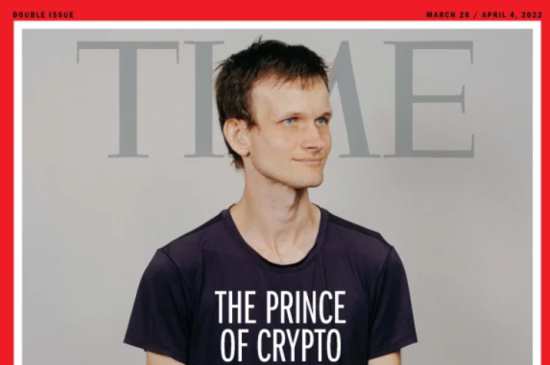
Well, despite their enormous contribution to humanity, they will never be able to win a Nobel Prize!
Why?
Simply because there is no Nobel Prize for computing! 😟
Just as there is none for mathematics.
Fortunately, though, since 1966 there has been the Turing Award , which is effectively the Nobel Prize for computing.
In memory of the great Alan Turing , the visionary mathematician who theorised the first algorithms and the Turing machine (the first abstract computer).
The Nobel Prizes were established according to Alfred Nobel’s wishes. In his will of 1895, he specified the award categories: physics, chemistry, medicine, literature and peace.
Computing was not yet a defined field of study at the time.
For mathematics, a widespread but unconfirmed theory says that Nobel did not want to reward the field because of a personal rivalry or an offence suffered at a mathematician’s hands. Another hypothesis is that Nobel considered mathematics too abstract and not directly applicable to humanity’s progress, unlike the other disciplines rewarded.
As with computing, mathematics established its own equivalent of the Nobel Prize, called the Fields Medal. Like the football World Cup, it is awarded every four years, to mathematicians under 40 (major discrimination 😧😂).
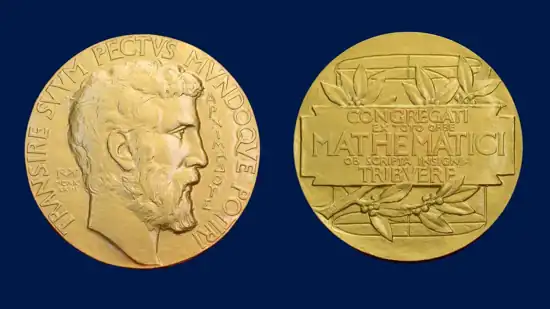 The Fields Medal for the world’s best mathematicians
Vint Cerf, Bob Kahn and Tim Berners-Lee won the Turing Award in 2004 and 2016 respectively (as with the Nobel, recognition takes time: TCP/IP was invented in the late 1970s).
The only Italian to have won the Turing Award is Silvio Micali , in 2012 (together with Shafrira Goldwasser), for his contributions to the creation of modern cryptography.
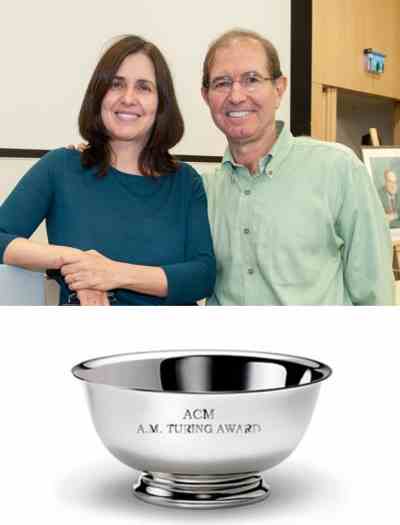 Silvio Micali and Shafrira Goldwasser
Among the winners (1975), Herbert Simon deserves a mention: he was the only one also to have won a Nobel Prize in Economics (1978), for his research on decision-making in economic organisations.
Simon’s model completely overturned the rationalist theories of the early twentieth century, stating that consumers do not follow logical, rational paths. Emotion and reason are stimulated simultaneously, and the integrated combination of these two variables determines human behaviour.
Herbert was one of the fathers of artificial intelligence and neuromarketing.
Since 8 October 2024, Simon is no longer the sole holder of the two-award record: he must share the podium with Geoffrey Hinton.
Hinton received the Nobel Prize in Physics for his research on neural networks and machine learning, after winning the Turing Award in 2018, also for his work on AI and deep learning.
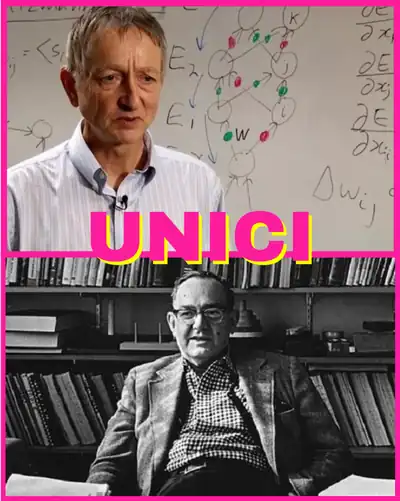 Geoffrey Hinton (above) and Herbert Simon
Interestingly, since 2006 Turing Award winners have also received a cash prize. Since 2014, it has amounted to one million dollars (provided by Google), matching the Nobel Prize (nine million Swedish kronor, which fluctuates above or below a million depending on the exchange rate).
In 1968 (two years after the Turing Award was created), the Nobel Prize in Economics was established, with the first award in 1969. In this case, however, it was established by Sweden’s central bank, so it is technically not one of the original Nobel Prizes.
When will we see Nobel Prizes for computing and mathematics too?
But perhaps, given the introverted nature of computer scientists and mathematicians, a dedicated award that is prestigious but less widely known is better 😉
Who Alan Turing was and the decryption of Enigma during the Second World War
Born in London on 23 June 1912, Turing was a British mathematician, cryptographer and philosopher, considered one of the greatest mathematicians of the twentieth century and the father of computing (to the point that, as we have seen, computing’s most important award is named after him).
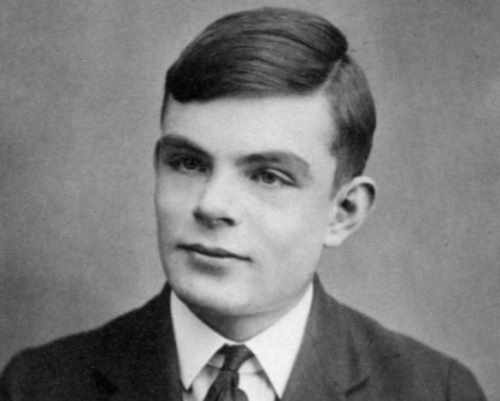
When Britain entered the war, Turing moved to work at Bletchley Park.
Here, the British government brought together the country’s best minds for an important intelligence operation: deciphering the naval messages used by the much-feared German submarines (U-boats).
Germany had a machine called Enigma to encrypt and decrypt its messages. Understanding how it worked was crucial to the outcome of the Second World War.
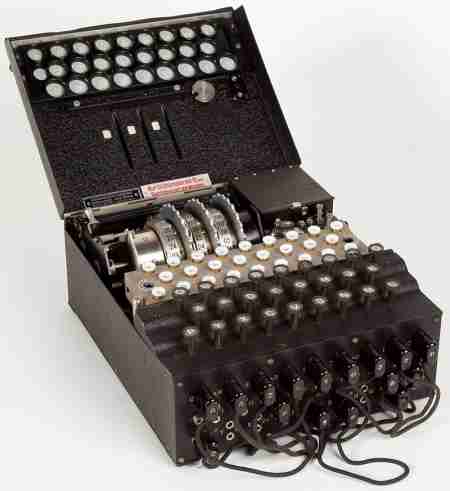
The Enigma I machine held at the Leonardo da Vinci Museum in Milan
Thanks to Turing’s genius, a device capable of understanding German encrypted messages was built in 1943, making a fundamental contribution to the outcome of the world conflict.
Winston Churchill said that Turing:
was the man who made the greatest individual contribution to victory in the Second World War.
The Turing machine and the birth of the algorithm
The Turing machine is not a physical machine, but a theoretical one: it imagines an infinite moving tape containing adjacent squares or cells that can hold encoded information in symbols from any finite alphabet (including, for example, the 0s and 1s of the binary system).
A control unit examines this tape, can take on different states and can act on its cells by reading their content, erasing it or writing new symbols.
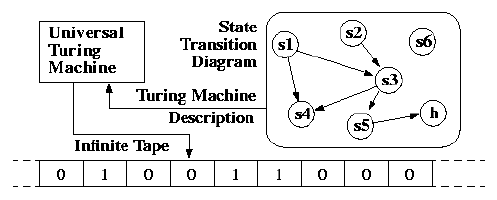
For every machine state, there are instructions the control unit can execute: for example, if the cell contains symbol x, move to the next cell and write symbol y.
In effect, Turing had invented algorithms and the first abstract computer capable of executing them.
In 1953, John von Neumann built the first programmable computer.
The Turing test
In 1950, Alan published an article in the journal Mind that was as provocative as it was revolutionary, entitled: Computing Machinery and Intelligence.
The key question Turing posed in his writing was: ‘I propose to consider the question: can machines think?’
The paper introduced the following test: three players are shut in different rooms and cannot see each other, but have a keyboard and screen.
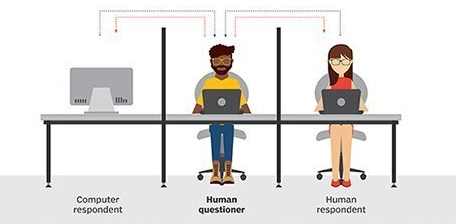
One of the three participants must determine, by asking a series of questions, which of the other two players is a man and which is a woman. The participants are free to lie however and whenever they want.
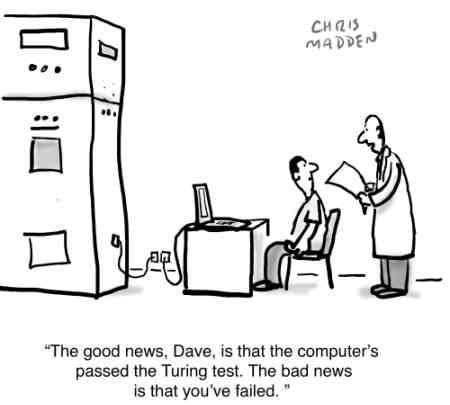
The next step is to replace one human player with a machine.
What would the result be? Would the questioner be able to identify the machine at the same rate as they identify the humans?
If not, or if the examiner needed a long time to recognise the non-human, we could say that the machine is intelligent?
These observations opened a debate in the scientific community and were the first steps towards Artificial Intelligence (AI).
The three-player test went down in history as the famous Turing Test.
The marathon runner
When we think of a scientist, we do not imagine them physically fit (except physicists 🤪), let alone an Olympic athlete.
Well, Turing should also be remembered for another exceptional quality: he came close to taking part in the 1948 Olympics as a marathon runner (an injury may have prevented him from qualifying).
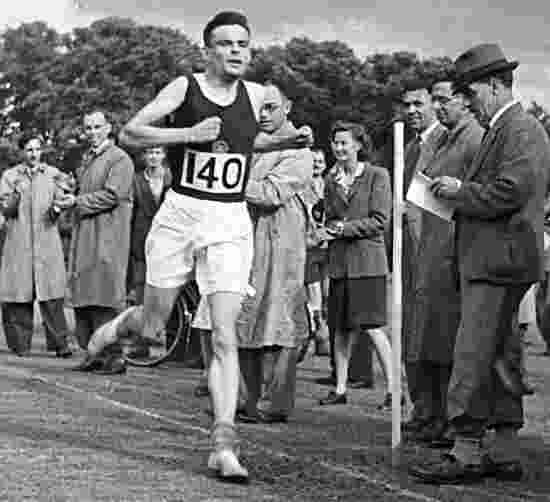
At 35, he trained in his spare time, and in 1947 achieved a personal best of 2h 46m 3s, exceptional for those days: the winner of the 1948 Olympic marathon ran 2h 35m!
During training, Alan let his mind wander, entering the famous ‘Scatter mode’.
Sporting education is not a standalone factor but is closely connected to a person’s intellectual and character development. Let’s play sport and encourage our children to do so, perhaps by telling them Turing’s story 😉.
The full film about Alan Turing: The Imitation Game
Turing’s story is extremely interesting and has also inspired cinema.
A film worth watching is The Imitation Game (2014), which tells Alan’s whole life up to his tragic death by suicide on 7 June 1954, at just 42.
The film is based on the book Alan Turing: The Enigma, a biography by mathematician and gay activist Andrew Hodges.
As well as the protagonist’s achievements, the film brings to public attention the issue of gender inclusion in those years and the British government’s homophobic persecution.
It is outrageous to think people went to prison for being gay! This was also surely one of the factors that led Turing to suicide.
Directed by Morten Tyldum, the film stars Benedict Cumberbatch, Keira Knightley and Matthew Goode. Below is the link to watch it on Netflix.
Below, you can watch the film free at this link thanks to Rai Cinema.