What is comment marketing?
It is the activity of commenting on online platforms, actively participating in social media and social networks to achieve a marketing objective.
We can use this technique in B2C and B2B business as well as in Personal Branding, which in turn connects back to those areas.
We consider commenting platforms to be all those offering this feature. Clearly, the largest are social networks, but there are also forums, blogs, websites and all the Q&A platforms, such as Quora, Reddit, Stack Overflow and wikiHow.
LinkedIn is one of the most important platforms for B2B, but not only that: the strong presence of opinion leaders also offers great opportunities for the B2C market.

Comments on LinkedIn are an excellent way to contribute to the conversation, meet new people and exchange ideas and opinions.
Unfortunately, I increasingly see ‘borderline’ use of this tool. Under the heading of ‘comment marketing’, it seems any tactic is acceptable as long as it gets you noticed.
Observing the different behaviours, I had fun creating a few ‘Commenter personas”.
🥊 The Contrarian
If you say white, they say black; if you say black, they say white. They disagree with everyone. It is the technique that guarantees the highest visibility in the short term, but the cost is an identity that is not very ‘welcoming’ or open to discussion.
🧛♂️ The Piggybacker
Their goal is to gain as much visibility as possible by exploiting other people’s posts. They offer no value, and their comments are self-centred and self-promotional.
Typically, the Piggybacker does not like the post!
As part of my own netiquette, I never write a comment without liking the post first. I allow an exception for the contrarian, who by definition cannot like the post.
🦜 The Parrot
Someone who simply paraphrases what you wrote in the post without adding any real value.
☁️ The Distracted One
They write a comment without properly reading the post, driven by the urgency to say something.
🥱 The Lazy One
They make no effort to create value, writing one to at most three words: excellent, agreed, brilliant, very interesting, well said, etc.
🤫 The Super Lurker
They visit LinkedIn daily, read posts and articles and watch videos, but would rather walk all the way to the North Pole 😂😂 than comment (or even like a post).
It is not a lack of thoughts, but a choice of channel in which to express them. In fact, you sometimes receive comments from people you know through one-to-one channels: a phone call, in person, a WhatsApp message or an email.
🤖 The AI Addict
They get artificial intelligence to help write their comments. Personally, I would not feel comfortable writing ‘artificial’ comments. I can accept using AI to review the wording, but not to create the substance of the content.
🤗 The Value Contributor
This is the commenter we would all like on our posts.
They offer an interesting point of view that enriches the discussion.
They are neither presumptuous nor arrogant, and express their thoughts clearly and precisely.
Over time, I have observed that this last persona corresponds to the most knowledgeable and competent people.
Comment marketing makes sense only when its aim is to add value to the conversation and the network. Otherwise, it becomes an annoying practice and, in the medium to long term, can be counterproductive for those who use it.
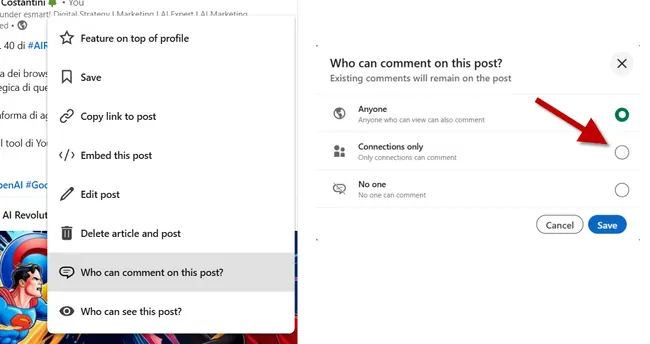
If we want to avoid comments from strangers, we can use the post options to set who can comment. For example, selecting ‘Connections only’ (see image above) allows comments only from our first-degree connections. For a more drastic approach, there is also the option to turn comments off completely.
PS: defining these Commenter Personas was possible thanks to contributions from valuable commenters who shared their thoughts in the following LinkedIn post😉.