
Artificial intelligence has been making a major impact on advertising for some time, especially online.
All the main platforms, starting with Google and Meta, are pushing towards advertising campaigns managed entirely by AI.
The brand only needs to provide the type of objective (awareness, consideration or conversion), the audiences it wants to communicate with, the product/service (even feeding it the relevant landing page is enough), and the budget.
Artificial intelligence takes care of everything else, seeking to optimise investment against the goal. The model can also expand the audience through lookalike logic: in practice, it suggests people with characteristics similar to the main audience who might be interested in our products.
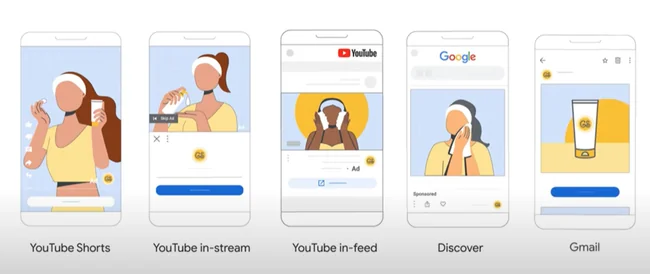
For example, Google Ads’ Demand Gen and Performance Max campaigns and Meta’s Advantage+ campaigns manage the investment for us and can also adapt images, videos and copy to the format and channel.
The various platforms go further, optimising creative material to maximise the final result.
For example: which of the following two photographs of the same toaster in an ad makes you more inclined to buy it?

The answer Amazon’s analysts reached, probably fairly predictably, is that results are better when the product is shown in a real-life setting.
Specifically, an A/B test on a Sponsored Brands ad was carried out with the two toasters, and the version showing the toaster on a kitchen counter received 40% more clicks.
In marketing, we know that:
the first use of a product takes place inside the customer’s mind, so it is essential to support that projection through context.
The photograph on the right helps the person imagine enjoying good toast.
For products with even greater emotional value, it is essential to activate mirror neurons by showing the product in use with a person we can identify with (the principle behind all automotive commercials).
Amazon observed that merchants advertising on its platform are often not particularly attentive to neuromarketing and struggle to create the right creative material (its analysis found that 75% of advertisers had difficulty creating creative ads).
Using generative AI, Bezos’s company launched a tool that lets advertisers effortlessly generate and insert lifestyle imagery to give their ads context, without technical skills.
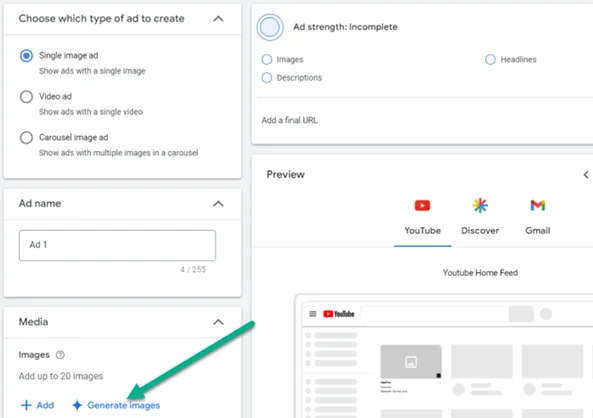
All the major platforms are following the same path. For example, the next image shows the Google Ads dashboard with the feature for creating an image for our ad.
Of course, we can use all the generative AI tools available today to create text and images.
All current language models are multimodal and can therefore generate both text and images.
The main ones are: ChatGPT, Gemini, Claude, Mistral, Copilot.
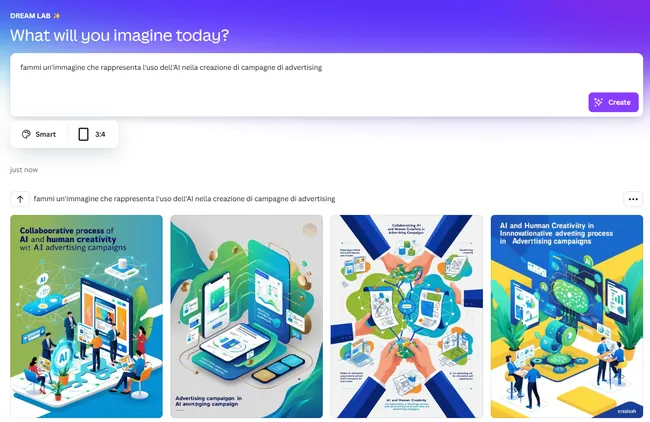
For image generation specifically, I also suggest using Canva Dream Lab (the result of Canva’s acquisition of Leonardo.ai), Ideogram.ai and Midjourney.com.
Another rapidly evolving world is video production for advertising using artificial intelligence.
TikTok Symphony Creative Studio 🪄
In November 2024, TikTok launched Symphony Creative Studio a very interesting AI-based video-generation platform 🎬 that speeds up and simplifies content creation for our advertising campaigns.
Symphony Creative Studio’s main features include:
🔥Generating videos from product descriptions or landing pages, with the option to remix existing content.
🔥Translating and dubbing a video into 30 different languages: video translation with synchronised dubbing, extending the content’s reach to a global audience.
🔥A video editor with TikTok-style editing features for adding captions, music, stickers, effects and transitions.
🔥Finally, we can create videos with digital avatars, such as Ashlee in the video, in more than 30 languages.
I tried a few features and must say they are very interesting. For example, I fed the AI a landing page and it created several advertising videos, with the option to choose different copywriting styles for the scripts.
I need to play with the avatar a little more, but the result of a quick attempt is not bad (remember, it is free).
There is also a feature to generate our own avatar (in the style of HeyGen) by uploading sample videos of ourselves (this feature is currently in testing and available only to a small group).