
When I played basketball as a boy, I remember players’ roles being clearly defined: tall people had to stay under the basket and shorter ones had to be point guards. That’s it!
Heaven forbid a centre tried a three-pointer!!! The coach would hang him.
It was similar in football: the only thing a defender was supposed to hit was a striker’s shins, and if strikers returned to their own half, a sniper in the stands would shoot them! :-)
It seems prehistoric compared with what we see today: players such as LeBron James and Kevin Durant shoot threes, rebound, block and dribble like the best point guard of the 1980s.

In football, defenders have silky touches and strikers help midfield and defence: all eleven attack and all eleven defend!
In short, players’ skills have evolved alongside playing systems in a virtuous circle, so that certain formations can only be used if you have those kinds of players.
The first intellectual LeBron James of the modern era was surely the legendary Herbert Simon, who skilfully combined economics and computing.
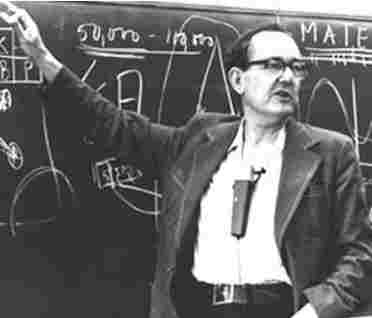
In 1975, Simon won the Turing Award (effectively the Nobel Prize for computing) for fundamental contributions to artificial intelligence and cognitive psychology.
Only three years later, in 1978, he also won the Nobel Prize in Economics for his research into decision-making in economic organisations.
Simon’s model completely overturns the rationalist theories of the early twentieth century, stating that consumers do not follow logical, rational paths: emotion and reason are stimulated simultaneously, and the integrated combination of these two variables determines human behaviour (as modern neuroscience now confirms).
Simon brilliantly combined computing, mathematics, statistics, cognitive psychology, sociology and economics.
His ideas also underpinned Design Thinking (particularly the concept of rapid prototyping).
"To understand them, the systems had to be constructed, and their behaviour observed." - Herbert Simon
As in Simon’s case and in modern sport, in business too, the future is multidisciplinary.
Specialisation is dead!!! Or, better put, it is NOT enough!
The key is the MIX of skills, eclecticism, cross-fertilisation, or whatever else we want to call it.
You need to master more than one field: rebounding is not enough; you must also be good at shooting, dribbling and passing.
It is evolution!
It should be said that specialising in one field used to be difficult enough, while today information and knowledge are available to everyone, quickly and in whatever formats we prefer. In practice, the only obstacles are laziness and a lack of curiosity.
But knowledge is not enough: it must be turned into competence through practical application.
Here too, the world has changed. Particularly in digital, we can now very easily put what we have learned into practice. Think of all the software-as-a-service platforms with pay-as-you-go and freemium pricing policies.
From the darkness of my bedroom, I can access the same tools as a multinational!
In today’s digital economy, we talk about a T-shaped skills model: the vertical stem symbolises our specialisation, while the horizontal bar represents competence that can span several fields.
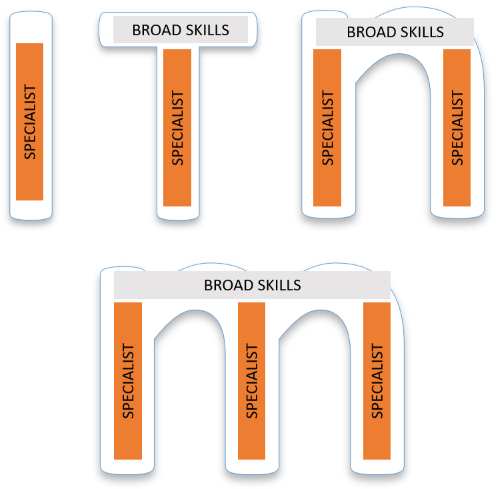
The definition of the ‘T-shaped person’ is attributed both to Tim Brown, CEO of IDEO Design Consultancy, and to McKinsey.
The truth is that we are already moving beyond the T-shaped model towards an n-shaped, or even m-shaped, model.
The opportunity to learn is such that we can gain vertical expertise in several sectors.
Multiple vertical specialisms offer the perfect path to innovation, enabling us to combine different areas, find new ideas and transfer models from one context to another.
In business, technology is increasingly inseparable from strategy. I often hear distinctions being drawn between marketing and technical work, but the truth is that this boundary is growing thinner, and today we talk about Martech.
In the future, the advantage will belong to those who can combine both sets of skills.
If you study or work in Digital Marketing, experimentation is essential. Launch a personal website or blog, play with social profiles to communicate a particular message, etc.
Likewise, more technical professionals must understand customer/user needs, trends, market opportunities, UX, etc.
The Agile model and skills
The mix of skills also allows new working models to emerge.
At the heart of the Agile model is precisely the skill set of the people involved.
We need technically competent people (whatever the field) who are multidisciplinary, curious and open-minded.

In a constantly moving market, the future must be approached with Navy SEAL teams (small, fast groups where everyone can do several things), rather than large armies in formation. Just read recent history to see how groups of young people have conquered entire markets or created new ones!
Trying to apply Agile in teams without these characteristics, after an initial illusion of speed, produces the opposite of the goal: rigidity and slowness.
It would be like applying Sacchi’s total-football systems, where everyone is a defender and a striker, to players from 50 years ago, when defenders had clumsy feet!
The classic mistake in applying Agile is precisely to start with the method rather than the players.