
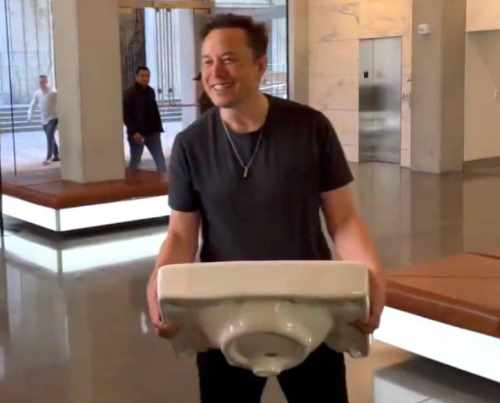
In October 2022, that madman Elon Musk, after buying Twitter for 44 billion dollars, walked into the company’s headquarters carrying a sink!
On Twitter, which he immediately renamed X, he wrote: "Let that sink in!"
It was a theatrical, provocative gesture, in perfect Musk style, to emphasise the historic change taking place with his arrival at the helm of the bird company.
I read and hear countless criticisms and judgements about Musk’s ‘psychological’ profile and his managerial ‘non-style’.
To me, he is extraordinary:
he is the brilliant nerd who breaks the mould.
I love Musk because he follows his dreams and curiosity, and business serves them.
After exiting PayPal, someone else would have enjoyed life travelling the world. For Elon, though, the goal is to follow his passions without a precise financial-return rationale.
The striking example is SpaceX: his playroom, where he brings his love of space to life.
Accounts from people who have dealt with Musk portray him not as a business-oriented manager but as a passionate person who gets into the substance and essence of things for the pleasure of knowledge and discovery.
The Twitter acquisition, IMHO, had the same origins. As a regular user, Elon thought the platform could be improved. We probably have the same thought about products and services we use — but what does Musk do?
He buys the whole lot!
A side effect of his passionate, direct nature is enormous online visibility: he is the greatest example of Personal Brand in business.
Here too, he innovated.
Increasingly, companies’ brands are tied to the personal brands of the people working in them, starting with their CEOs.
The CEO amplifies an organisation’s vision, purpose and values.
Being an unconventional, passionate, visionary CEO who is not shy about communicating his thoughts has two important business side effects:
- He can attract the best talent on the market
- He can mobilise large amounts of capital
Combining these elements, Musk manages not only to follow his dreams but also to build great businesses 💰💰💰.
The SpaceX revolution
They told him: ‘It is too complex and risky.’
They objected: ‘The engineering challenges of landing a rocket vertically, managing atmospheric re-entry and gravitational forces are too great to overcome.’
They pointed out: ‘Other major space agencies, such as NASA and Roscosmos, are not focusing on reusable rockets. If it were a sound idea, those agencies would already have implemented it.’
But he went his own way, built an outstanding team and is now showing us the results.
On 13 October 2024, SpaceX, the aerospace company founded by Elon Musk, successfully completed the test of the Super Heavy rocket, which propelled Starship into the atmosphere and returned obediently to base in Boca Chica, southern Texas.
A historic day. A revolution for space transport, but also for low-orbit travel.
We will be able to travel from Los Angeles to Rome in half an hour on suborbital flights, at affordable prices, thanks to rocket reuse.
Asperger’s syndrome behind Musk’s 🧠 genius?
Musk publicly revealed that he has Asperger’s during a Saturday Night Live episode in 2021, and later discussed it during a TED Talk (shown below).
According to Musk, Asperger’s syndrome profoundly influenced how he thinks and acts, contributing to his success. As a child, he faced bullying because of his different behaviour and difficulties with social interactions, but found comfort and knowledge in books, which allowed him to understand the world better than reality itself.
Asperger’s syndrome, an autism-spectrum disorder, manifests through difficulties with social interaction and non-verbal communication, alongside a strong interest in specific subjects.
Musk shared some personal experiences related to this condition, emphasising how his perception of the world differed from most people’s. For example, he explained that social cues were not intuitive to him and that he tended to interpret words very literally.
Despite these difficulties, Musk turned his unique characteristics into strengths. He described how, from a young age, he took great pleasure in programming computers and studying physics, disciplines he has always considered fundamental tools for understanding reality. His obsession with truth led him to study physics as a key to deciphering the universe’s mysteries and develop innovative technologies in sectors ranging from sustainable energy to space travel.
Musk also reflected on the impact Asperger’s syndrome has had on his approach to innovation and problem-solving.
According to him, his ability to focus deeply and analyse problems from a unique perspective contributed to his success at companies such as Tesla, SpaceX and Neuralink. He also emphasised that his worldview is driven by the desire to expand human consciousness and improve humanity’s future through science and technology.
Unfortunately, Asperger’s creates a filter, and people try to read Musk’s thinking through the same lens they would use for anyone else, but this is a major mistake. He does not have a neurotypical person’s empathy or social filters; he experiences some issues in an extremely personal and intimate way and acts accordingly, often like a teenager.
One consequence of all this is that Musk often behaves like a teenager
Conclusions
Elon Musk embodies the essence of the modern visionary, capable of turning personal passions into industrial revolutions.
His ability to break traditional moulds and determinedly follow his intuitions has led to innovations redefining entire sectors, from space to ground transport.
His unconventional leadership and strong personal brand not only attract the best talent but also catalyse substantial investment, demonstrating that boldness and passion can translate into entrepreneurial success.
In an age when authenticity and vision are fundamental, Musk exemplifies how following one’s dreams can have a significant impact on the world.
Clearly, figures such as Elon Musk are not without problems, and negative traits also hide behind their strengths.
Sometimes, his ‘perpetual teenager’ spirit should be tempered to steer him towards more thoughtful, responsible behaviour (particularly on sensitive subjects).
Finding a balance between his innate creativity and greater maturity could further strengthen his role as a visionary leader, reducing the risks associated with impulsive actions.