
Today we live in an extremely fast market with perfect information. We and our competitors all analyse the same data and can monitor each other's actions in real time; the result is a tendency towards uniform strategies.
Barriers to market entry are getting lower, and thanks to digitalisation and abstraction (the Value Network strategic model), it is becoming easier for new players to enter. In this scenario, newcomers able to think differently can also change the rules of the game and put everyone under pressure.
In this context, forecasting and planning become increasingly difficult: business plans and business cases are ever more indicative and less precise because of the high level of uncertainty.
Over time, I have realised that: those who ride chance rather than suffer it are the winners!
This is why I like to coin the concept of ‘Incidental Marketing’ (or the marketing of chance, or of fortune favouring the bold 😂):
marketing that uses the ability to experiment and try things to master chance and identify innovative combinations and solutions that deliver a competitive advantage. Incidental Marketing is based on agility, speed, creativity, action and data analysis.
Nothing revolutionary 😁: ‘luck marketing’ incorporates the concept of Growth hacking, of Pivoting and Lean Startup with a stronger emphasis on seeking unpredictable paths not known at the outset.
 The Lean Startup, a manifesto for the principles of agility and flexibility
We need to realise that to create something new, we must let chance help us!
The key is to act, experiment sooner and more than others, being creative and analyse the data methodically to uncover new directions.
I really like quoting a line from Sergio Marchionne in an interview with Repubblica:
Do not follow predictable paths, because at the finish line of predictability you will predictably find competitors too. And they may get there before us.
But discovering new territories requires action!
After all, Christopher Columbus himself discovered the Americas purely by chance. He was lucky twice, because had he not encountered them, he would probably have died soon afterwards, lost in the middle of the ocean!
Serendipity in business
The concept of making discoveries by chance while looking for something else is captured well by the English word Serendipity, translated into Italian as: Serendipità.
The word was coined by the English writer Horace Walpole after reading the Persian fairy tale titled ‘The Three Princes of Serendip".
The tale tells of a king who, after thoroughly educating his three sons, realises that for their own good they must travel and explore the world.
To make this happen, he pretends to be angry and expels them from the kingdom.
The princes managed to return home victorious from their wanderings through a combination of intuition, intelligence and chance.
The meaning Walpole gave serendipity was the unexpected good fortune that meets us when we act and are prepared and alert.
The intellectual equivalent of fortune favouring the bold.
Most scientific discoveries are the result of serendipity.
Alexander Fleming discovered penicillin because of a poorly disinfected sample, while Pfizer, researching a drug against heart attacks, discovered sildenafil citrate, which restored vigour to many men's private parts🤪.
We could therefore define incidental marketing as serendipity applied to business!
Many of the successful ideas and businesses we know today came about thanks to precisely this approach or mindset.
Let us look at the best-known ones, starting with what they were and how they changed.
From Odeo to Twitter
In 2005, two former Google employees founded Odeo, a podcast aggregation and production platform based on Adobe Flash technology.
The idea was good, but the timing was wrong! Both because the podcast world was far less developed and because Apple soon launched podcast integration on iTunes and iPod.
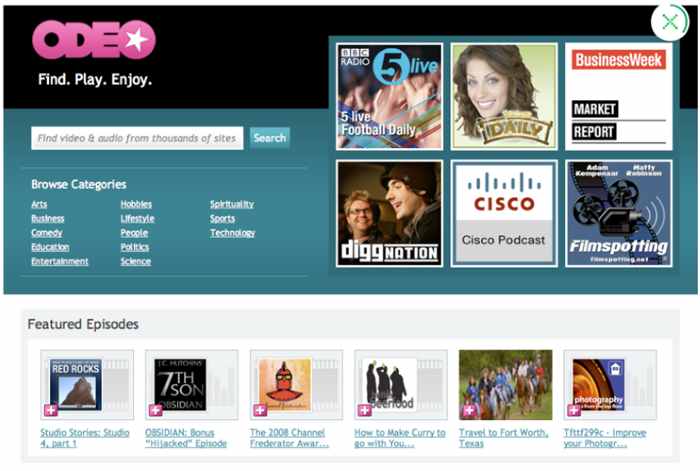 Odeo, the podcast website
Odeo had received funding rounds and urgently needed to evolve into something else!
Founder and programmer Jack Patrick Dorsey (of Italian descent on his mother's side) brought out a project he had been working on in his spare time, and Twitter was born!
Initially, they did not own the twitter.com domain and used the Flickr technique, calling it twttr.
The rest is history, and although the little bird is now somewhat tired (despite crypto and NFTs giving it new positioning), it remains a success story, an example of pivoting and incidental marketing.
From Burbn to Instagram
Ironically, among Odeo's interns in 2005 was a programmer almost two metres tall named Kevin Systrom. A few years later, in 2010, Kevin launched the Burbn app.
Fun fact: Burbn is a contraction of Bourbon whiskey (following the tradition of naming with as few vowels as possible), which takes its name from a county in Kentucky. Kevin was apparently a great admirer of it (if Zuckerberg drank beer, Systrom did not want to be outdone on the alcohol front 😁).
Burbn was an app for checking in at locations, organising meetups and posting images (something like Foursquare). Launched in early 2010, it did not enjoy much success because it was overly complex.
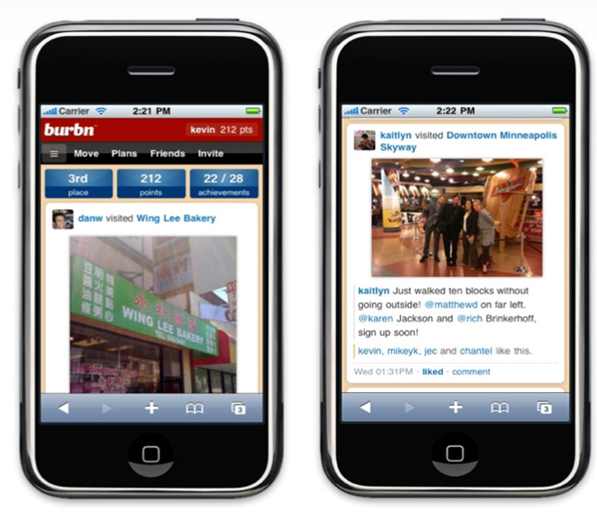 The Burbn app interface
But by analysing data and analytics, they noticed one feature and behaviour people really liked: posting photos!
Before long, the app was transformed and simplified, images became its focus, and Instagram was born in October of the same year!
In April 2012, Facebook bought Instagram for around $1 billion, and Systrom remained CEO until October 2018.
This example shows the importance of data analysis in changing direction and riding chance.
From Snowdevil to Shopify
In 2004, snowboard enthusiasts Tobis Lutke, Daniel Weinand and Scott Lake decided to take the plunge and open an online shop selling snowboards and related equipment, called Snowdevil.ca (the site is still active as a demo).
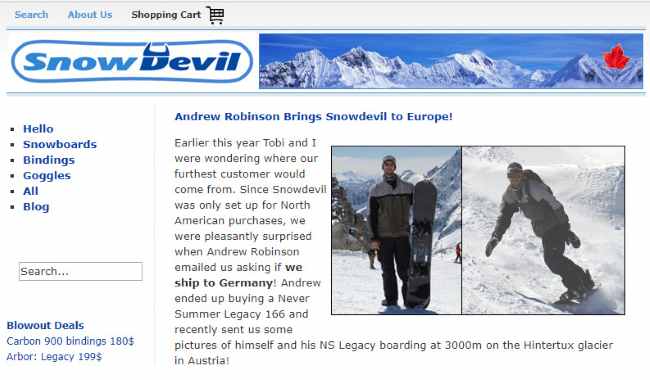 The online snowboard and accessories shop www.snowdevil.ca
Here too, as in the earlier examples, the business idea did not work, but the founders became passionate about and fell in love with the system they had built for the online store.
In particular, Lutke, the programmer who developed the site, realised there were no solutions on the market designed to make life simpler for people wanting to create an e-commerce site.
The founders therefore decided to change the original idea and build a software-as-a-service platform for creating online shops.
Thus www.shopify.com was born in 2006. Driven by its CEO Tobis Lutke, the SAAS platform became a leader in e-commerce solutions, used by more than 1 million stores worldwide 😲.
If the founders had not started experimenting with the ‘classic’ idea of selling snowboards online, they would probably never have reached where they are now!
From a dating site to YouTube
On Valentine's Day 2005, a website was born in San Mateo, California, named YouTube!
Do you know why it launched on Valentine's Day?
Because it was a dating site 😁 where you could meet your soulmate ❤️! To do so, you had to upload an introductory video.
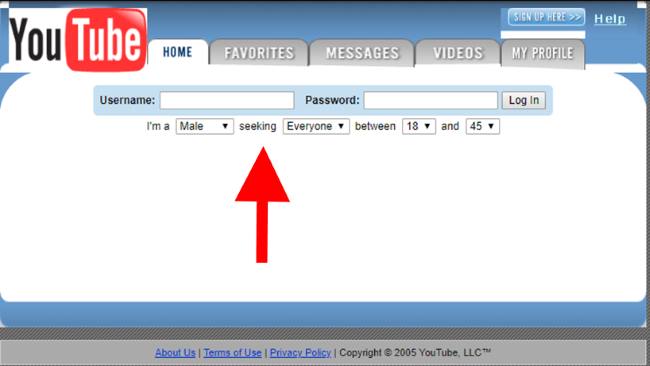 YouTube's dating website in 2005
Online dating became very successful over time, but not for them: they were desperate because nobody posted videos. They even placed Craigslist ads offering $20 to girls willing to upload videos. Still nothing!
Since they were paying server costs and wanted to avoid the impression of absolute emptiness, the founders, showing great creativity 😁, uploaded videos of 747s taking off and landing!
Soon people began posting things, but the videos had nothing to do with the site's purpose (holiday videos, animals, and so on). Observing this content, the founders quickly realised they had to give users room and let them publish whatever they wanted.
In June of the same year, YouTube was revised and transformed into a more general and open platform, as we know it today.
In October 2006, the company was bought by #Google for $1.65 billion!
The three founders, Chad Hurley, Steve Chen and Jawed Karim, had all previously worked for PayPal, adding to the legend of the PayPal Mafia.
The story of Slack and Flickr, born through play 😁
Stewart Butterfield is a Canadian who loves programming and video games and works on building websites.
In the summer of 2002, aged 29, he founded his first company, Ludicorp, with Caterina Fake and Jason Classon.
Based in Vancouver, Ludicorp began by developing an online multiplayer role-playing game called Game Neverending.
The game also contained a chat room with real-time photo-sharing features.
The game was unsuccessful, but as happened with Instagram, photo sharing was useful and appreciated. So in 2004 Butterfield decided to close Neverending and open Flickr, a photo-uploading and sharing platform.
Flickr grew quickly, and the following year Yahoo acquired it for around $20 million. Stewart stayed until July 2008, then left to create a new company called Tiny Speck.
The new company's aim remained the same: Butterfield was determined to launch a browser-based MMORPG (massively multiplayer online role-playing game).
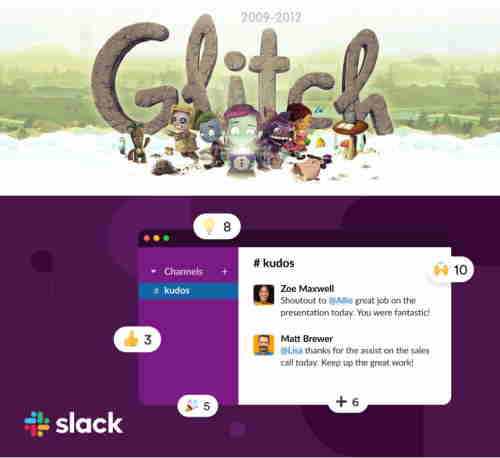
The game was called Glitch. It was non-violent, with no combat; players were asked to complete quests and perform activities (such as growing plants and trees, cooking, and so on) to expand sustainably through the world.
The founder invested his own money, and funding rounds also arrived, allowing development to begin.
The launch date slipped, and after continuous development, in 2012 the creator realised Glitch was not taking off. Butterfield wrote on Twitter to announce that Glitch would be shut down, but Tiny Speck was not dead.
That experience, however, incidentally helped develop a hugely successful platform.
Developing the game required several teams to stay aligned and communicate. To do this, they built an internal solution that let members chat and upload useful material while keeping track of every activity.
Thus, in 2014, came Slack.com , the online business-collaboration software. In its first week after launch, it reached 120,000 daily users (the video below explains how it works).
At the end of July 2021, Salesforce bought Slack for the astronomical sum of $27.7 billion! (Well done, Stewart: well over a thousand times Flickr's 2004 sale value.)
Conclusions
Looking at these companies' stories, and many others like them, we must highlight another fundamental factor in mastering luck: people!
Only with people's passion and expertise can we experiment and find ‘creative’ paths.
Successful products come from ‘great’ teams! I look for passion. I think smart people are passionate people. When you ask them what they are really good at and what they are truly passionate about, they can usually explain it in a way that inspires you, whether it is making cocktails, cooking or writing code.
Kevin Systrom (Instagram founder)
Passion is essential to harnessing chance because it pushes us further, into new territories where business plans or a lack of perseverance advise us not to go!
Another obvious element is that all the startups discussed had programmers among their founders: if you want to do digital business, you need the skills. Execution is a key factor.
‘Luck does not exist. There is the moment when talent meets opportunity.’ – Seneca
The world is full of slides with ideas, but short of people able to bring them to life!
Experienced venture capitalists know very well how important the founding team is. They invest in people before the project, because skilled, passionate people increase the chances of finding an alternative path and mastering chance!