Design Thinking is a design methodology that emerged in the last century and has become very successful in business in recent years.
In particular, it addresses the need to bring more creativity into modern companies dominated by highly analytical thinking.
Today's markets are so dynamic that continuous innovation and change are necessary for survival.
Let's explore the origins of DT, how to use it, its variations, strengths and weaknesses.
The first to discuss Design Thinking was the great Herbert Simon — Nobel laureate in Economics and Turing Award winner — in his 1969 work Sciences of the Artificial, which emphasised the importance of problem definition and creativity.
Simon said:
“Many business schools focus solely on developing analytical skills, underestimating the creative dimension.”
The term Design Thinking as we know it today was coined in the early 1990s by David Kelley and Tim Brown, mechanical engineering lecturers at Stanford University. The two professors founded the famous IDEO consultancy which made the methodology known worldwide.
Below is the well-known example of IDEO's shopping trolley design, reported by ABC — although I have never seen this trolley around 🤔😁.
Definition and meaning of Design Thinking
The classic definition of Design Thinking is:
Design Thinking is an iterative process for solving complex problems. We seek to understand the user, challenge initial assumptions and redefine problems to identify alternative strategies and solutions that may not be immediately apparent at our initial level of understanding.
Here is Tim Brown's definition, which I personally prefer:
Design thinking is a human-centred approach to innovation that draws on the designer's toolkit to integrate people's needs, technological possibilities and business requirements for success.
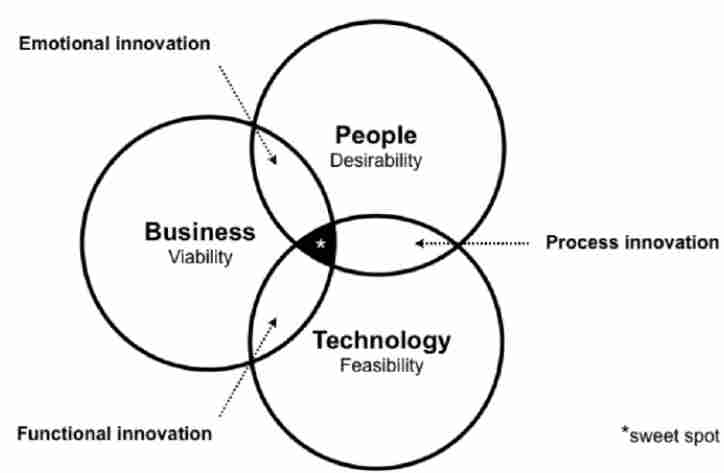
Combining these definitions, we could say Design Thinking combines a philosophy with a set of tools for solving complex problems.
Therefore: Mindset + Methodology.
Its key characteristics are:
Design Thinking has moved beyond pure design to encompass many more fields:
- devising products and services
- supporting start-ups
- building the digital UX
- digital transformation (value network)
- identifying new brand and product meanings
Let's see how it works in practice using the five-stage model proposed by Stanford's Hasso Plattner Institute of Design, the d.school.
The stages of the design thinking model
Starting with the problem or challenge we want to solve, the method involves five stages:
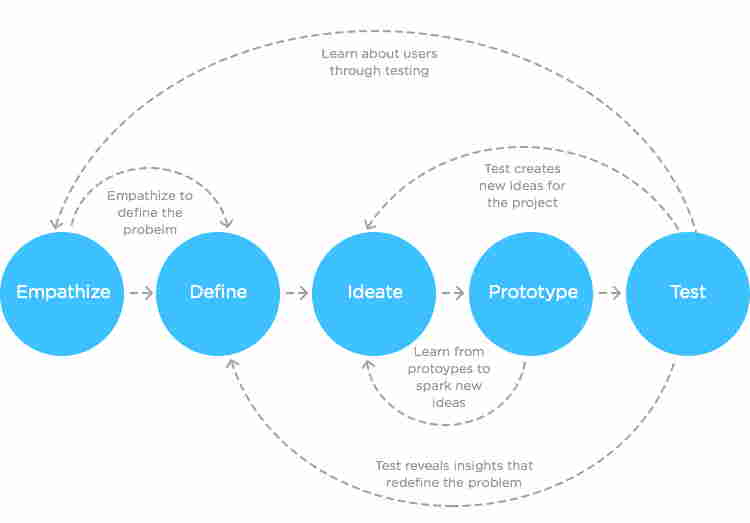
The stages are iterative, as shown in the image above.
We analyse and define the problem starting with the customer, generate ideas and select those to try, then refine them by learning from the end customer's experience.
One last point: DT is collaborative, so a team of people must be assembled for the working sessions.
1. Empathise
The first stage is to put ourselves in the customer's shoes — those of potential users of our products, services and processes — to understand fully the problem we want to solve.
As we have seen, empathy is one of marketing's main soft skills.
We can use different tools, selecting those most appropriate to each case. We work at three levels:
- engagement
- observation
- immersion and identification
The first step is to engage with customers, talk to them and ask questions to understand the problems, motivations, experiences and emotions involved in choosing and using a product.
We can also run focus groups and surveys.
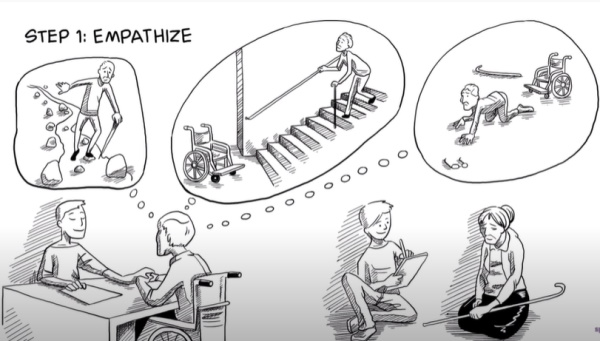
When interviewing customers, it is important to explore how and why, even when you think you know the answer.
Generally, asking why produces abstract statements, while asking how produces more specific ones.
Abstract statements are often more meaningful but less actionable.
A good technique is to ask about a specific event, for example: "Tell me about the last time you...".
Ideally, people should tell us stories. These help us decode the world and the context in which needs arise.
When we find inconsistencies, we should explore them, because they may conceal interesting insights and hidden needs.
Ask open, neutral questions, such as: "What do you think about physical activity?".
The observation of customers is equally important because it reveals information that has not been stated explicitly. This too is a basic marketing soft skill).
For example, if we are studying how to improve the experience of a lift, the best approach is to use it with other people for a while, carefully observing their behaviour.
Let me share a very interesting anecdote I read some time ago.
A new university campus had been built, but one issue was still debated: where to put the paved walkways!
Some thought the paths should go around the grass; others thought they should cut diagonally across campus.
A professor had the winning idea:
“Let's not build paths in the first year. Let's wait until next year and see where the grass has worn away.”
That would show them the routes students preferred.
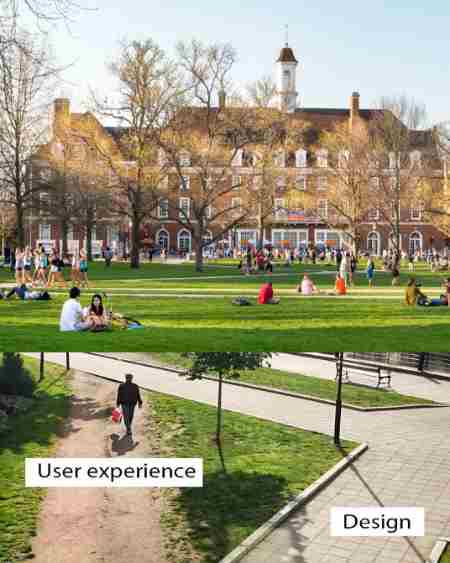
This anecdote neatly expresses observing, experimenting and then deciding — an approach applicable in many contexts.
Where possible, gather as much information as possible directly from the field before deciding.
Do not ask people what they want: observe and analyse what they do in action, like the students on the campus grass.
In digital work, a fundamental tool for analysing the user experience is usability testing.
It allows us to observe users and understand what they do, what they obtain and how they feel.
Now let's look at the technique of immersion.
Here, we identify completely with customers by using the products and services, testing them in every possible context of use.
For example, I might use a general-purpose backpack for work, university, holidays or sport. This lets me explore and test all the customer's experiences of using it.
It is no coincidence that a key marketing principle says:
"You must be the first customer of your own products and services."
It helps the design team to give customers a face and a name through customer personas. This technique improves the process of identifying with them.
A customer persona is a profile embodying a segment of your potential audience, with a detailed description of background — age, career and education — behaviour, lifestyle, interests and goals.
Personas emerge after the full empathy stage.
One tool for visualising the information collected is the Empathy Map which organises and compares user information, such as shared interview findings.
The map is typically divided into six parts to create a holistic view of a customer persona's experience and needs: Think + Feel, Say + Do, See, Hear, Pain and Gain.
Working in groups, people put themselves in the customer's position and use sticky notes to populate the map. In the Hear section, for example, I might write what an expert, spouse or daughter tells the customer in the context being analysed.
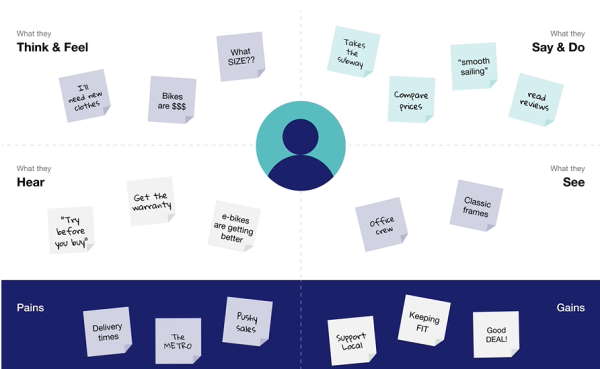
Another tool is User Stories. There is nothing mysterious here: describe what customers want and why in a format that the team can easily record and compare.
Again, a sticky note is the typical format, as shown in the image.
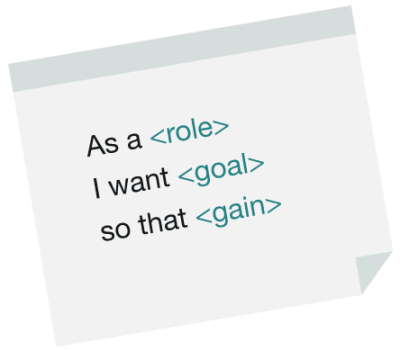
Stories are widely used to identify a product or service's feature list within an Agile development framework.
For example: as a customer of service X, I want to change my offer with one click without wasting time, so I can spend it with my family.
2. Define the problem
During this stage, information collected previously is brought together and studied to understand customers well and define the problem in a human-centred statement.
For example, in sports equipment, "We need to increase our market share by 10%" is not a human-centred definition of the problem.
Using the analysis from stage 1, we might instead say that boys and girls need physical activity for their physical and psychological development.
We might therefore identify young people's self-esteem and need for socialisation as problems to address.
As the great Herbert Simon said, being able to clearly state the problem is a fundamental part of solving it.
We must express potential customers' needs, not the company's needs or one individual's wishes if they do not represent the identified customer persona..
In the Define stage, the team validates the previous findings, including customer personas, and sets priorities: given 10 user stories, which should we work on first?
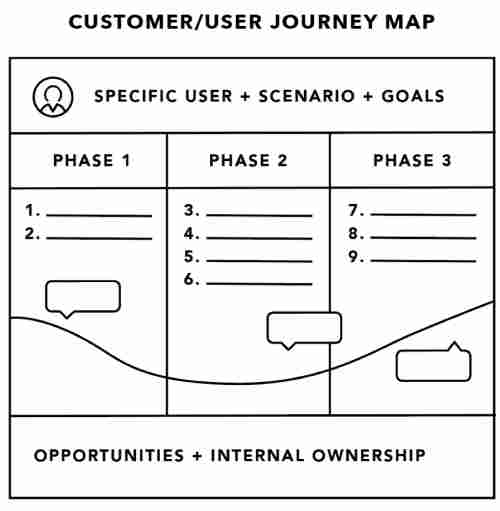
One useful tool at this stage is the Customer Journey Map which summarises and describes the customer–company relationship through a sequential timeline, contact channels, actions and emotions experienced by the customer.
We can apply a journey map to anything. For new fitness ideas, for instance, we could map the day of someone who trains daily: do they pack their bag in the morning or the night before, and so on?
3. Ideate
"How might we encourage teenage girls to take an action that benefits them and also involves the company's product or service?
During the third stage, you and your team can begin thinking outside the box to identify new solutions to your problem statement and explore alternative ways of viewing the problem.
There are various ideation techniques, such as Brainstorming, Brainwriting, Worst Possible Idea and SCAMPER.
Brainstorming was invented by advertising creative Alex Osborn in the 1960s.
Brainstorming and Worst Possible Idea sessions generally stimulate free thinking and expand the problem space. Generating as many ideas or solutions as possible is important at the start of ideation.
But the heart of this approach is encouraging and using lateral thinking: in fact, all design thinking's most powerful ideation techniques come from lateral thinking.
SCAMPER also originated with Osborn and was developed in the 1970s through Bob Eberle's contribution.
SCAMPER stands for Substitute, Combine, Adapt, Modify — also magnify and minify — Put to another use, Eliminate and Reverse.
- Substitute. Can any part of the object be replaced? Consider the consequences of making that substitution.
- Combine. What happens if the object is combined with something else? A shirt that trains our muscles through electrical stimulation, for example, or a restaurant placemat showing exercises and their calorie expenditure.
- Add/adapt. What if we use the object for another purpose? An exercise bike that also generates electricity.
- Modify What happens if we change elements such as the object's shape or colour?
- Change the purpose Can the object serve a different purpose? Aluminium foil, for example, could be used not only for food but also for insulation or protection. Who or what could use it? Try changing its intended use: paper tissues, for example, might become a notepad with foldable paper.
- Eliminate. What if I simplify the object or remove something from the journey? Removing DVD/CD drives from computers is one example.
- Rearrange/reverse. Can I reverse something? IKEA, for instance, gets customers to assemble their own furniture.
These are just a few techniques taken from lateral thinking and repackaged, but there are many others: All the Lateral Thinking techniques.
4. Prototype
Prototyping makes the ideas conceptualised in earlier stages concrete.
A prototype can be anything with a physical form or digital interface.
By nature, a prototype is rough and low-resolution. Its purpose is to let the design team, users and others experiment and interact.
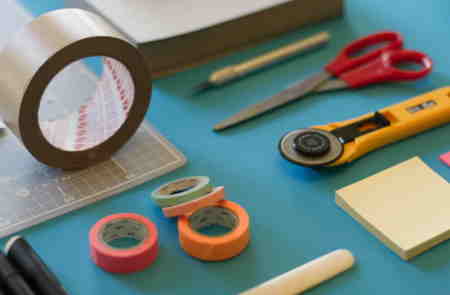
Prototyping need not require major spending. For physical objects, stationery such as paper, scissors and tape can sometimes be enough to make an idea tangible.
5. Test in the field
Testing lets us receive feedback and refine our solution.
Because the process is iterative, testing plays a crucial role. It provides further user information, helps refine the idea or rethink it completely, and, as the diagram shows, can lead back to any stage.
Conclusions and considerations
Design thinking is a very useful, powerful methodology and mindset because it practically brings together several existing components.
The discipline emerged from mechanical engineers who probably had less marketing experience: the early stages are, in fact, the foundations of modern marketing 😂
The claim to be human-centred is fundamental in more technical settings, where attention can shift towards the product.
For people from marketing, the approach is human-centred by design.
Philip Kotler wrote about it years before Design Thinking emerged.
Iteration and experimentation also belong to the agile techniques of start-ups and many digital companies.
Design thinking, like marketing methodology as a whole, is like a car: without an engine and fuel, it is useless!
I believe the engine and fuel are creativity, lateral thinking, marketing sensitivity and the ability to experiment.
The methodology's output can vary greatly. Giving people sticky notes is not enough: there must be passion, enthusiasm, creativity and team spirit.
DT deserves credit for bringing approaches together while placing greater emphasis on the creative component, experimentation and collective participation.
Collective participation also helps build consensus, particularly on complex projects within large companies.