The Vision is one of the most overused words in business, and perhaps one of the least understood.
We can speak of business vision as an attitude and the ability to see and interpret the future, with a clear position and a leading role within it.
Today, the most familiar meaning of Vision is a company's long-term goal or goals.
But this must not remain only in senior management's minds. It is essential that the whole company understands, shares, absorbs and lives it. It must also be clearly recognised by the market and customers.
To achieve this, it is usually publicised inside and outside the business: vision statements appear in the "About us" or "Company information" sections of company websites.
Let's look at some famous examples, Amazon and Apple, to see how visions are expressed and understand how to build one.
Amazon's Vision
Our vision is to be the most customer-centric company in the world.
We want to build a place where people can search for and discover anything they want to buy online.
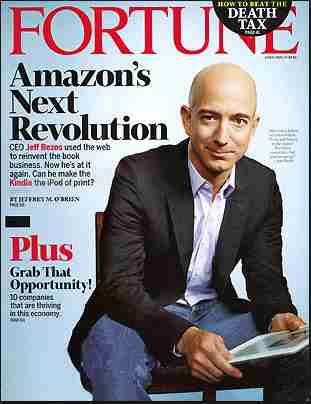
Apple's Vision
The best way to describe Apple's vision is to use the words of its CEO Tim Cook, who explained it in detail in an interview:
We believe we are on the face of the earth to make great products. We constantly focus on innovation. We believe in the simple, not the complex.
We believe we should own and control the primary technologies behind the products we make and participate only in markets where we can make a significant contribution. We believe in saying no to thousands of projects so that we can truly focus on the few that are really important and meaningful to us. We believe in deep collaboration and the cross-pollination of ideas among our groups, which allow us to innovate in ways others cannot. And frankly, we settle for nothing less than excellence in every group in the company, and we have the intellectual honesty to admit when we are wrong and the courage to change. I think these values are so embedded at every level of the company that Apple will always do its work very well.
Other examples of visions:
Patagonia: “Build the best product, cause no unnecessary harm and use business to inspire and implement solutions to the environmental crisis.”
IKEA: “Create a better everyday life for many people.”
Tesla: "Accelerate the world's transition to sustainable energy."
Microsoft: "Enable people and organisations around the world to realise their full potential."
Amazon: "Be the world's most customer-focused company, where customers can find and discover anything they want to buy online."
Boeing: "People working together as a global enterprise for aerospace industry leadership."
BBC: "Be the world's most creative organisation."
:
Elements for creating a company's Vision
But what is the point of a vision? Why create and state one?
In essence, the vision is the dream, the aspiration, the desire, and the mindset with which we pursue it.
Defining it is very important for a company's long-term life. It preserves the values that ensure success today and stimulates future progress.
The vision is a manifesto with which all the company's actions, strategies and behaviours must be consistent.
It must be a shared dream.
When developing the concept of a vision, we must include two elements, as indicated by the Harvard Business Review):
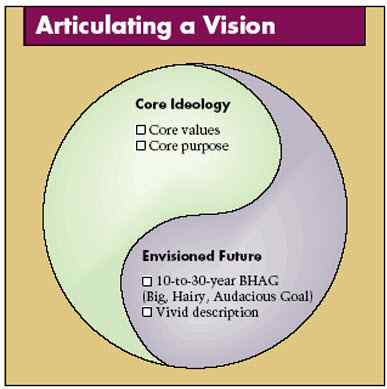
- Core Ideology
- Envisioned Future
Core Ideology, the heart of our ideology, consists of two components:
- Core values
- Core Purpose
The first consists of the company's key values: what does it believe in?
Some examples expressed in Apple's values are simplicity, building technologies in-house, focusing on important and meaningful elements, product excellence and so on.
These are timeless guidelines that form part of a company's history. With some care, identifying them should not be difficult.
Through the Core Purpose we must state why the company exists. What is our purpose in the market?
For example, Apple exists on the face of the earth to make great products, while 3M's purpose is to solve problems in innovative ways.
The purpose is often used in a brand's tagline.
Examples:
- Nike: “Just Do it”
- Apple: “Think Different”
- Coca-Cola: “Open Happiness”
- L'Oréal Paris: "Because You're Worth It"
A company's purpose is often separated from its vision and treated as an overarching element.
Regardless of where we place it as a statement of intent, the important thing is to be clear about the company's why.
The main goal is to inspire the people who make the difference in business: those who work there.
People's passion and commitment to the company's values and purpose are every company's critical success factor.
Now let's see how to incorporate the picture of the future, the Envisioned Future.
To do so, we need to create:
- A clear, ambitious goal that acts as a catalyst for team spirit. The time horizon is not short: it ranges from 10 to 30 years. For example, Ford's historic goal is to "democratize the automobile".
- A vivid description that is effective in helping people visualise and imagine the vision.
Today, we increasingly see vision expressed as purpose, because the idea of purpose feels closer to people and less like marketing 😃.
The difference between Mission and Vision
We have seen how to build a vision. It is often confused with the mission because they are very similar and can sometimes overlap.
The main elements that distinguish them are:
- The time horizon
- The presence of a dream
The Mission concerns the present and the activities the company performs now. It often begins with "We offer", "We provide" or "We are".
The Mission is about action.
By its nature, it can change as strategy changes.
The Vision, instead, concerns the future, long time horizons and achieving our dream, our perfect world.
Because of these characteristics, the vision operates not only inside the company, as the mission does, but also outside it, in the role the company will play in society.
For this reason, Vision is closely connected to a company's Social Responsibility, extending as far as Brand Activism.
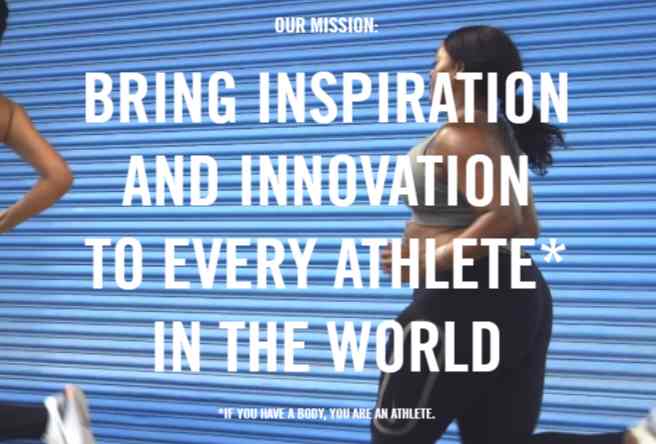
Below is Nike's mission:
BRING INSPIRATION AND INNOVATION TO EVERY ATHLETE* IN THE WORLD (*IF YOU HAVE A BODY, YOU ARE AN ATHLETE).
BRING INSPIRATION AND INNOVATION TO EVERY ATHLETE* IN THE WORLD (*IF YOU HAVE A BODY, YOU ARE AN ATHLETE).
These are the activities Nike performs today for its customers: everyone with a body!
But what is the dream? Here it is, stated in the purpose — what drives the company:
Our purpose is to unite the world through sport to create a healthy planet, active communities and an equal playing field for all.
Our purpose is to unite the world through sport to create a healthy planet, active communities and equal conditions for everyone.
Both statements are very powerful, clear and direct, but the second concerns an ideal world, merging the company with wider society and its improvement.
Nike's Vision is strongly focused on purpose and is clearly long-term.
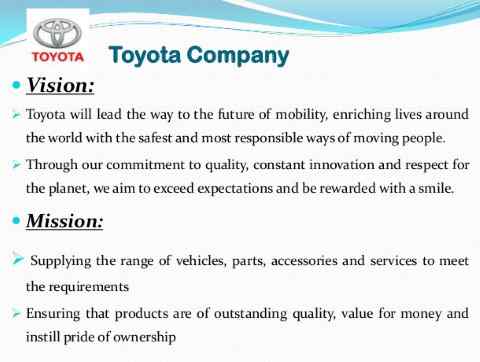
Another example, from Toyota:
Google publishes only its mission:
The mission is to organise the world's information and make it universally accessible and useful.
A vision can also be found online, which I quote below:
The vision is to provide access to the world's information with one click.
As you can see, however, it is very similar to the mission and lacks the typical elements of a vision.
We often find a mixture of vision and mission, as with Apple, but ultimately what matters most is that it can encapsulate both a company's soul and its ability to act.