
You have 300–500 milliseconds to sense whether a price is out of place. And your brain does it by itself.
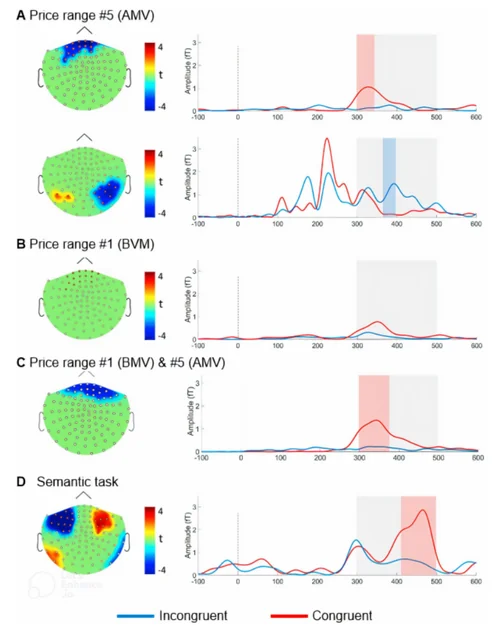
A neuromarketing study in Frontiers in Human Neuroscience, involving universities in Moscow and Helsinki, showed that seeing a price higher or lower than expected generates a small brain response to incongruity after about 300–500 milliseconds.
Researchers showed smartphone images with different prices and asked whether they were expensive or cheap, recording brain activity with non-invasive external EEG/MEG sensors.
The observed signal is called N400/M400: essentially an alarm activated when something does not fit. Near the right price, the alarm weakens.
In practice, this brain signature helps identify the price corridor: the range in which a price sounds natural. Outside it, rejection becomes more likely if the price is too high, or brand/product devaluation if too low.
The same signal also reveals something about positioning strength: when people have clear price expectations for a brand, the corridor is narrow; when the brand is new or ambiguous, it widens.
Why it matters in pricing
N400/M400 weakens near the expected price. Identifying this corridor reduces the risk of rejection from excessive prices and brand devaluation from low prices, guiding positioning choices.