
When will ChatGPT Trends arrive? While Google Trends has guided marketers and creators for years, information-seeking behaviour is now moving into AI chats. There, we do not just type keywords: we express complete needs, intentions and context. It is an epochal change.
From keywords to prompts: why everything changes
A keyword is a weak, partial signal. A prompt encompasses intent (what I want), constraints (budget, tone, format), context (‘for my B2B startup’) and the expected outcome (‘write me an email’). This makes prompts far more informative than traditional searches, and useful for mapping needs, jobs to be done and language.
The statistical challenge: variance & normalisation
The richness of prompts comes at a cost: variance is much higher. Two people can ask for the same thing in very different sentences. To offer a reliable ‘Trends’, at least three steps are needed:
- Preprocessing: cleaning, anonymisation and semantic tokenisation.
- Classification by intent, tasks (tasks) and domains.
- Semantic clustering (e.g. embeddings + HDBSCAN/ANN), with dynamic thresholds to group similar requests.
Then we need normalisation (by active population, geography and channel) and de-biasing to prevent product releases or campaigns from distorting the trend.
How a ‘ChatGPT Trends’ might work
Hypothetical pipeline: log ingestion → anonymisation → categorisation (intent, entities, industry) → semantic clustering → popularity scoring → trend detection (e.g. EWM/Prophet) → breakdown by country, industry and category.
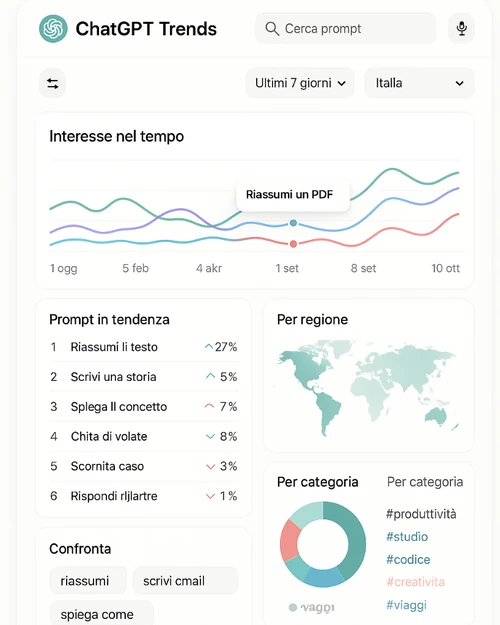
The result? Dashboards with interest over time, trending prompts, comparisons between prompts/intents, regional maps and categories. Exactly as in the mockup above.
Business model and privacy
It is plausible that players such as OpenAI, Anthropic and Google are testing these insights for internal use and for advertising products, rather than for a free public tool.
Sustainability depends on: (1) strong anonymisation, (2) explicit consent to the use of aggregated data, (3) reporting at a safe level of granularity (minimum thresholds), and (4) independent audits.
What you can do today without an official ‘Trends’
- Collect your own prompts (from your team and customers) and tag them by intent, channel and industry.
- Cross-reference public data: Google Trends, Search Console, marketplaces (App Store, template stores) and communities.
- Build an intent vocabulary and update the clustering monthly (including with no-code tools + embeddings).
- Produce a monthly insight deck for product, content and advertising.
Useful metrics
Share of Intent, emergence time (from first occurrence to peak), persistence (how many weeks it remains above the threshold), geographical spread, overlap between intents.
Conclusions
The shift from keywords to prompts will change marketing as much as mobile changed the web. Preparing now — with methods, data and governance — is a competitive advantage.
PS: the image is a mockup of what ‘ChatGPT Trends’ might look like.