
What data centres and AI data centres are
A data centre is a physical facility housing the computer systems needed to store, process and transmit data. It contains servers, storage devices and networking equipment. This is the infrastructure that keeps websites, applications, email and cloud services running.
To maintain service continuity, a data centre has backup power, cooling, reliable connections and physical and digital security measures. Behind a service we call “the cloud” are tangible places full of machines, cables and equipment.
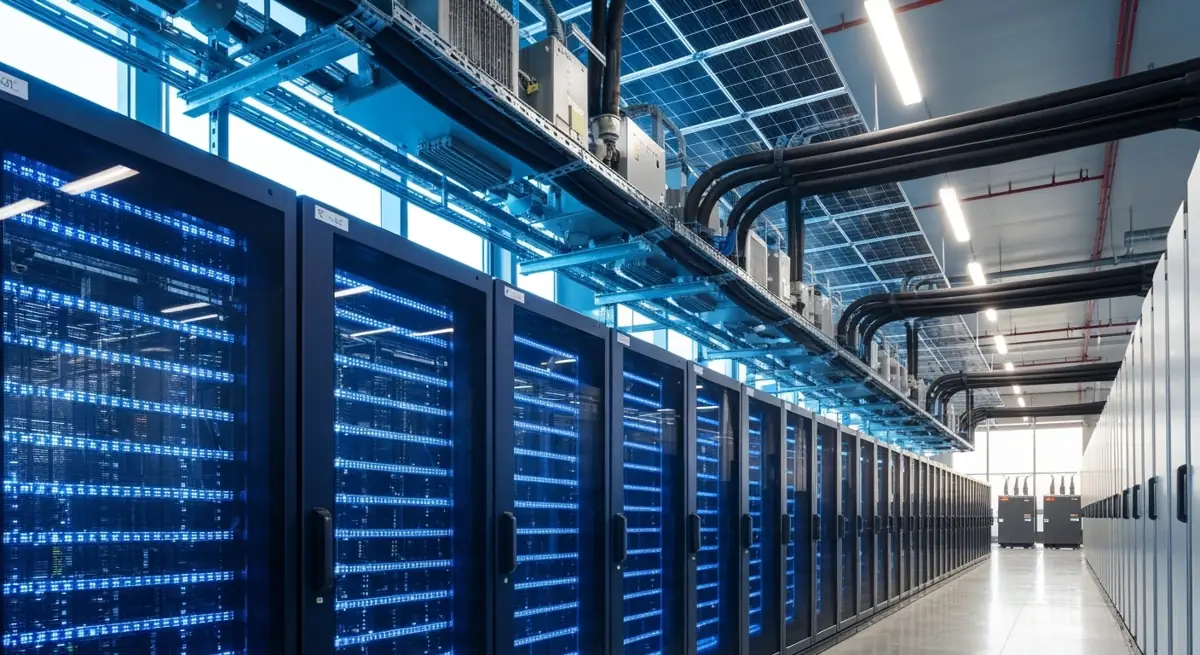
An AI data centre is a data centre designed or adapted to support artificial intelligence workloads. It trains models by processing large amounts of data and runs them when people use them. This second activity is called inference and happens, for example, when a model answers a question or generates an image.
Four features are particularly important:
- Specialised chips, such as GPUs and other accelerators, capable of performing huge numbers of calculations in parallel.
- Very high-speed internal connections, allowing chips and servers to exchange data and work together.
- High power density, because the cabinets housing servers, known as racks, contain hardware that can require far more energy than traditional configurations.
- Advanced cooling, often using liquid in the densest configurations, to remove the heat produced by components.
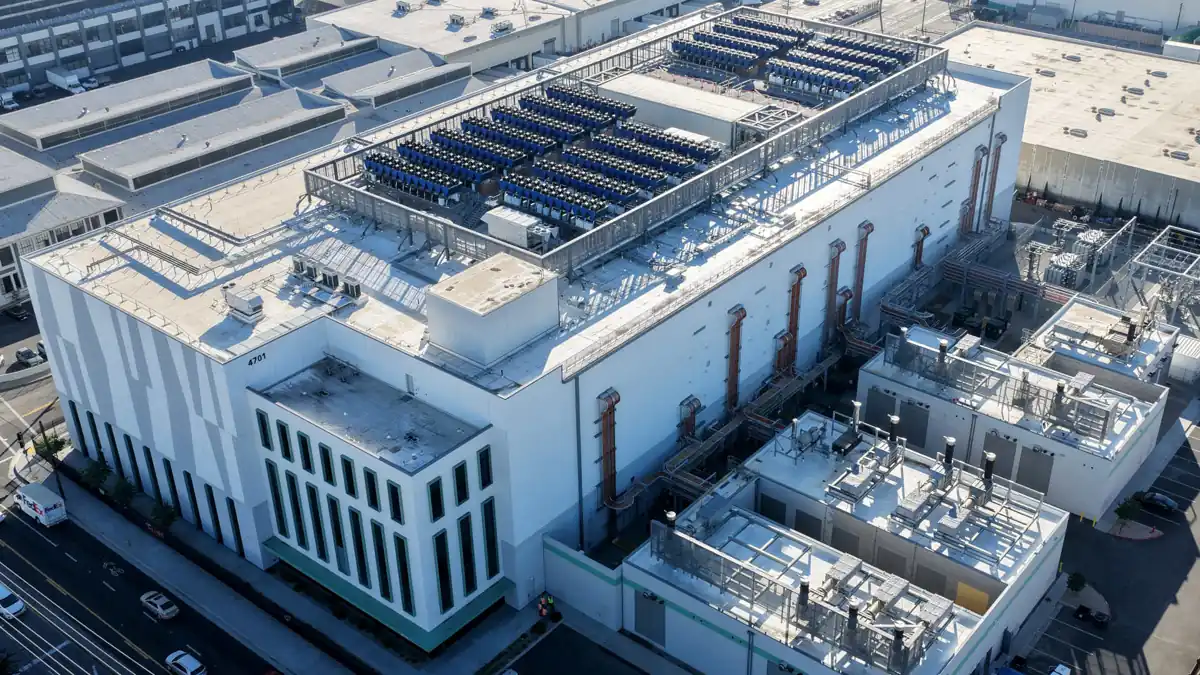
The fight against data centres
In the United States, following the Democrats’ midterm election victory, new AI bills are being prepared for the Congress taking office in January 2027, in response to growing public concerns.
The proposals under consideration cover three main areas.
- Protecting consumers from electricity bill increases associated with data centre construction.
- Requiring independent safety assessments of the most advanced AI models.
- Clarifying companies’ responsibilities when AI systems cause harm.
During the elections, candidates proposing moratoriums or limits on new data centres achieved significant results. In Texas, the governor-elect has already promised legislation to protect residents from the impact of this infrastructure.
According to Goldman Sachs, Democratic victories at state and local level could bring new restrictions on data centre construction.
And the phenomenon extends beyond America. In Amsterdam, around a hundred activists entered the construction site of a data centre intended for Microsoft, while similar protests are emerging in several European countries.
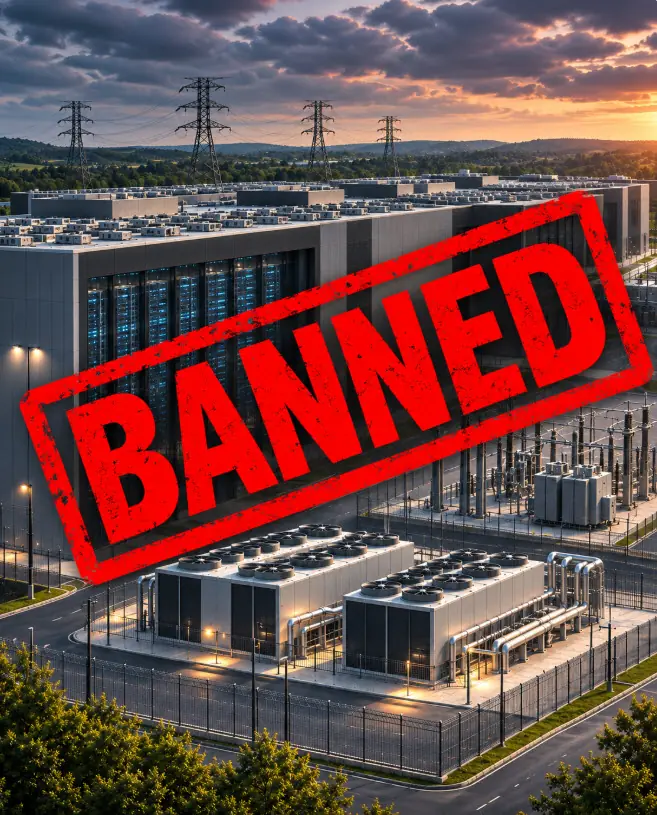
Behind every prompt are data centres, GPUs, electricity grids, water, cooling systems, cables, transformers, land and, above all, enormous amounts of energy.
This is why I believe we are entering a new phase of the AI race.
- The first phase was technological: who can build the best model?
- The second was financial: who can raise enough capital to build the infrastructure?
- The third will be political and social: who can actually build that infrastructure without losing the support of the communities that must host it?
Because you can have $100 billion to invest, the GPUs and the customers. But without energy, permits and local support, the data centre does not get built.
The solution?
AI is hungry for energy. Large data centres can consume as much as entire cities, electricity grids struggle to keep pace, and more and more communities oppose new facilities.
Put data centres in space. It sounds like science fiction, but Google and SpaceX already have launch plans for their first tests.
How a data centre in orbit works
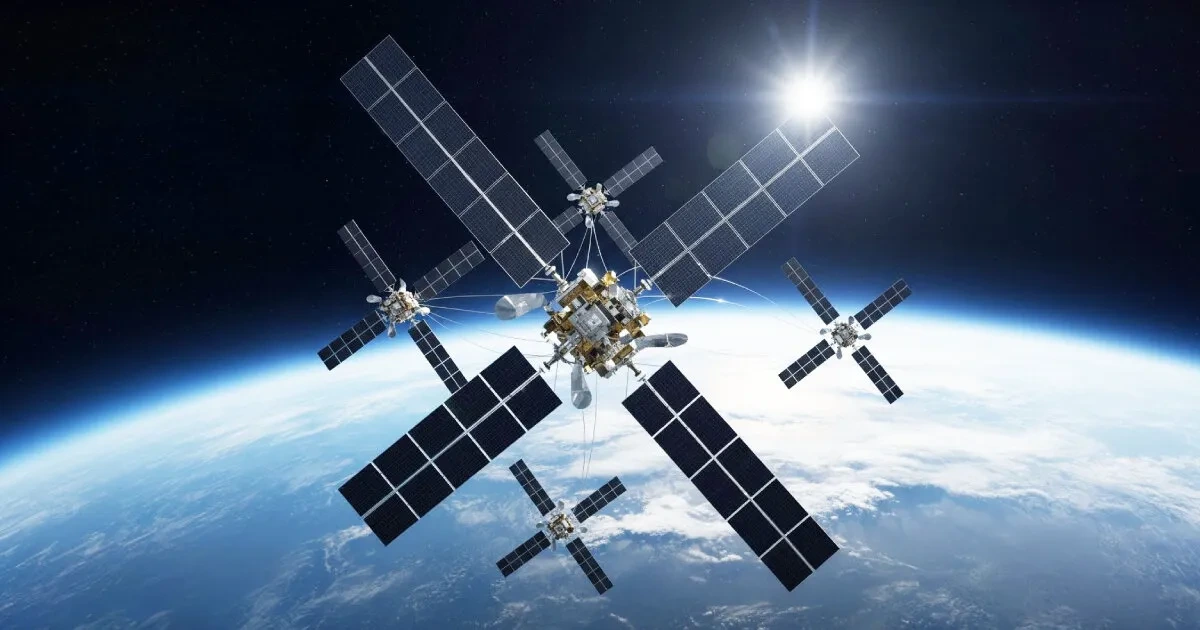
The idea is simple: instead of a huge building full of servers, launch a constellation of satellites, each carrying AI chips and large solar panels. The satellites talk to one another by laser and work as a single distributed computer.
The main advantage is energy. In a dawn–dusk sun-synchronous orbit, the satellite remains in sunlight almost continuously. According to Google, under the conditions considered in the project, a panel can produce up to eight times the energy of one on Earth: no clouds and no atmosphere for the light to pass through.
A few useful terms
- LEO (Low Earth Orbit): low Earth orbit, extending to roughly 2,000 km, where Starlink satellites also operate.
- Optical inter-satellite links: “wireless fibre optics”, laser beams that transfer data between satellites at extremely high speeds.
- TPUs / GPUs: the specialised chips that train and run AI models.
- Inference: the moment when the model answers a question, as distinct from training.
Google: Project Suncatcher
Google introduced Project Suncatcher in November 2025 with a research paper. The project also studies a configuration of 81 satellites at roughly 650 km altitude, flying in close formation with distances of around 100–200 metres between some neighbours, linked by laser and powered by the Sun.
The finding that struck me most concerns radiation: Google bombarded its Trillium TPU chips with a proton beam and found that they could withstand a dose greater than that expected during a shielded five-year mission in orbit.
The first concrete step is a prototype satellite built with Planet for SpaceX’s Transporter-18 mission. In its September 2026 update, Google distinguishes this initial hardware test from the two-satellite mission planned for 2027, which will also test laser links. Yes, you read that correctly: Google is relying on its competitor’s rocket.
SpaceX: Starmind
As ever, Elon Musk is thinking big. In January 2026, SpaceX asked the FCC, the US communications regulator, for permission to launch up to one million satellites as orbital data centres. A few days later, SpaceX acquired xAI, the company behind Grok, bringing rockets, the Starlink network and AI under the same roof.
The project is called Starmind, and the first satellite is AI1: a 75-metre solar-panel wingspan, a height of 30 metres and a 160 m² liquid radiator to remove heat. August brought the Nvidia partnership: the satellite will use a Vera Rubin NVL72 system optimised for space, with 72 GPUs and up to 250 kW of peak electrical power for the compute payload.
The timetable? SpaceX names late 2027 as its earliest target for large-scale production and deployment associated with the Gigasat Factory. These are development plans, still to be turned into an operational network.
The challenges to solve
Space is not a comfortable place for a server:
- Heat: in a vacuum there is no air to provide cooling; heat must be released to the surroundings through thermal radiation. This requires enormous radiators, which add weight and cost.
- Maintenance: if a chip fails on Earth, a technician turns up. At an altitude of 600 km, they do not.
- Launch costs: Google assumes they could fall below $200 per kilogram by the mid-2030s. At that point, in its model, launch and operating costs could approach the energy costs of an equivalent terrestrial data centre.
- Debris and the night sky: a million additional satellites worry astronomers and orbital safety experts.
Conclusions
Of course, we are still a long way from having hyperscale data centres in space. Enormous problems remain to be solved, but the direction is interesting.
Because if AI continues to grow at its current pace, we could reach a point where the problem will no longer be simply building enough computing capacity.
It will be deciding where to put it.